The part of nephron involved in active reabsorption of sodium is
A decrease in blood pressure/volume will not cause the release of
Which of the following statements is correct?
Match the items given in Column I with those in Column II and select the correct option given below: Column I (Function) a. Ultrafiltration b. Concentration of urine c. Transport of urine d. Storage of urine Column II (Part of Excretory system) i. Henle's loop ii. Ureter iii. Urinary bladder iv. Malpighian corpuscle v. Proximal convoluted tubule
Match the items given in Column I with those in Column II and select the correct option given below : Column I a. Glycosuria b. Gout c. Renal calculi d. Glomerular nephritis Column II i. Accumulation of uric acid in joints ii. Mass of crystallised salts within the kidney iii. Inflammation in glomeruli iv. Presence of glucose in urine
Match the items in Column-I with those in Column-II: Column-I (a) Podocytes (b) Protonephridia (c) Nephridia (d) Renal calculi Column-II (i) Crystallised oxalates (ii) Annelids (iii) Amphioxus (iv) Filtration slits Select the correct option from the following
Two ways to go deeper on this chapter
Choose your next step
Use of an artificial kidney during hemodialysis may result in : (a) Nitrogenous waste build-up in the body (b) Non-elimination of excess potassium ions (c) Reduced absorption of calcium ions from gastro-intestinal tract (d) Reduced RBC production Which of the following options is the most appropriate?
Match the following parts of a nephron with their function: (a) Descending limb of Henle's loop (b) Proximal convoluted tubule (c) Ascending limb of Henle's loop (d) Distal convoluted tubule (i) Reabsorption of salts only (ii) Reabsorption of water only (iii) Conditional reabsorption of sodium ion and water (iv) Reabsorption of ion, water and organic nutrients. Select the correct option from the following
Which of the following factors is responsible for the formation of concentrated urine?
Presence of which of the following conditions in urine are indicative of diabetes mellitus?
Which of the following would help in prevention of diuresis?
Cuboidal epithelium with brush border of microvilli is found in:
Nitrogenous waste is excreted in the form of pellet or paste by:
Given below are two statements: One is labelled as Assertion A and the other is labelled as Reason R: Assertion (A): Nephrons are of two types: Cortical & Juxta medullary, based on their relative position in cortex and medulla. Reason (R): Juxta medullary nephrons have short loop of Henle whereas, cortical nephrons have longer loop of Henle. In the light of the above statements, choose the correct answer from the options given below:
Which of the following statements are correct? A. An excessive loss of body fluid from the body switches off osmoreceptors. B. ADH facilitates water reabsorption to prevent diuresis. C. ANF causes vasodilation. D. ADH causes increase in blood pressure. E. ADH is responsible for decrease in GFR. Choose the correct answer from the options given below:
The Cockroach is :
Arrange the events of Renin – Angiotensin mechanism in correct sequence. (A) Activation of JG cell and release of renin. (B) Angiotensin II activates release of aldosterone. (C) Fall in glomerular blood pressure. (D) Reabsorption of Na+ and water from distal convoluted tubule. (E) Angiotensinogen is converted to Angiotensin I and then to Angiotensin II. Choose the correct answer from the options given below :
In cockroach, excretion is brought about by A. Phallic gland B. Urecose gland C. Nephrocytes D. Fat body E. Collaterial glands Choose the correct answer from the options given below:
Match List I with List II: List I A. Taenia B. Paramoecium C. Periplaneta D. Pheretima List II I. Nephridia II. Contractile vacuole III. Flame cells IV. Urecose gland Choose the correct answer from the options given below:
Given below are two statements : one is labelled as Assertion (A) and the other is labelled as Reason (R). Assertion (A) : Ascending limb of loop of Henle is impermeable to water and allows transport of electrolytes actively or passively. Reason (R) : Dilution of filtrate takes place due to efflux of electrolytes in the medullary fluid. In the light of the above statements, choose the correct answer from the options given below :
Given below are two statements: Statement I: In the nephron, the descending limb of loop of Henle is impermeable to water and permeable to electrolytes. Statement II: The proximal convoluted tubule is lined by simple columnar brush border epithelium and increases the surface area for reabsorption. In the light of the above statements, choose the correct answer from the options given below:
Choose the correct statement given below regarding juxta medullary nephron.
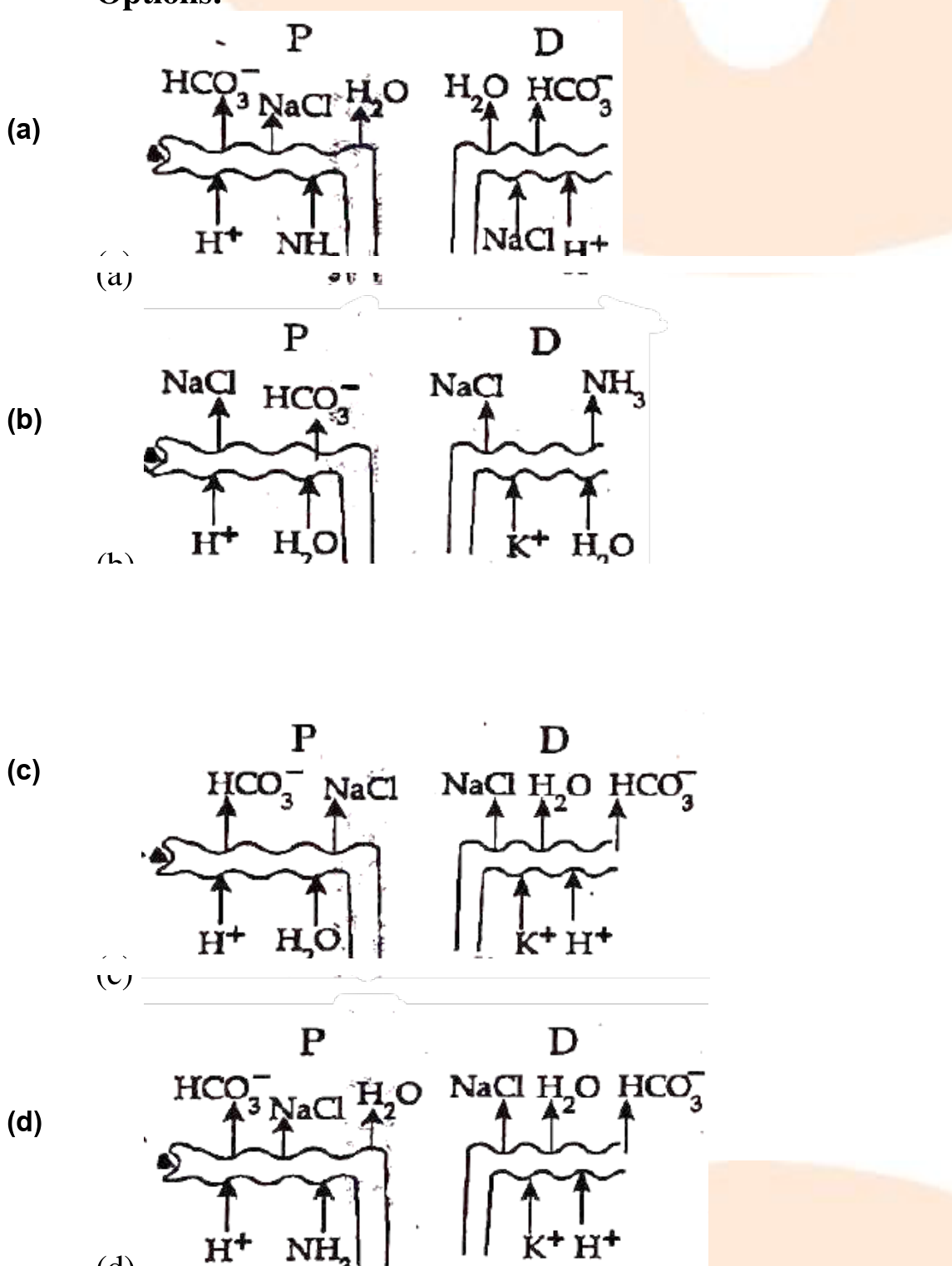
Which of the following diagrams is correct with regard to the proximal (P) and distal (D) tubule of the Nephron.
Match List - I with List - II List-I A. Emphysema B. Angina Pectoris C. Glomerulo-nephritis D. Tetany List-II I. Rapid spasms in muscle due to low Ca++ in body fluid II. Damaged alveolar walls and decreased respiratory surface III. Acute chest pain when not enough oxygen is reaching to heart muscle IV. Inflammation of glomeruli of kidney Choose the correct answer from the options given below :
The JGA (Juxta Glomerular Apparatus) is a special sensitive region formed by cellular modifications in _______ related to the same nephron.
Arrange the following events occuring in Renin-Angiotensin mechanism in the correct order: A. Increase in blood pressure and Glomerular filtration rate B. Reabsorption of Na+ and water from distal parts of tubule due to Aldosterone C. Fall in Glomerular filtration rate D. Vasoconstriction by Angiotensin II and release of Aldosterone. E. Renin converts Angiotensinogen into Angiotensin I, followed by Angiotensin II. Choose the correct answer from the options given below:
Want more Excretory Products and Their Elimination questions?
MedicNEET has 43,000+ NEET-style questions across Physics, Chemistry & Biology with detailed NCERT-based explanations — including the long, tricky questions that actually come in the exam.
Download MedicNEET App — Free