
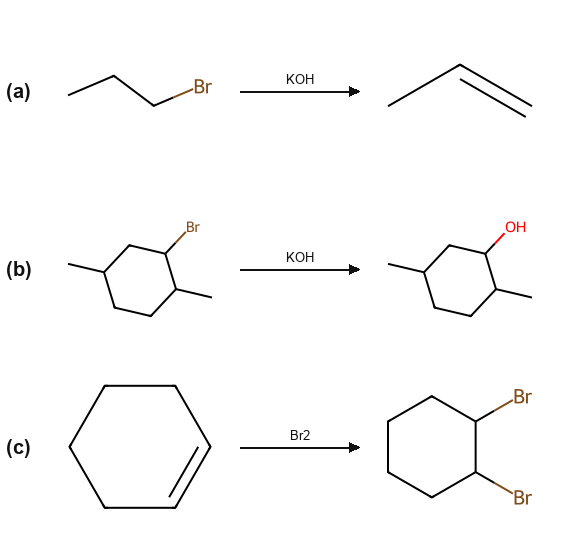
For the following reactions: (a) (b) a bromo-dimethylcyclohexane + gives the corresponding hydroxy-dimethylcyclohexane ( replaced by ) (c) 1,2-dibromocyclohexane Which of the following statements is correct?
Answer: (B) (a) is elimination, (b) is substitution and (c) is an addition reaction.. \textbf{Answer:} (b) \textbf{Solution:} Reaction (a): an alkyl bromide with alcoholic loses to give an alkene (propene) - this dehydrohalogenation is an elimination.
- A.(a) and (b) are elimination reactions and (c) is an addition reaction.
- B.(a) is elimination, (b) is substitution and (c) is an addition reaction.✓
- C.(a) is elimination, (b) and (c) are substitution reactions.
- D.(a) is substitution, (b) and (c) are addition reactions.
Correct Answer
(B) (a) is elimination, (b) is substitution and (c) is an addition reaction.
Solution & Explanation
\textbf{Answer:} (b) \textbf{Solution:} Reaction (a): an alkyl bromide with alcoholic loses to give an alkene (propene) - this dehydrohalogenation is an elimination. Reaction (b): is replaced by with no change in the carbon skeleton or degree of unsaturation - nucleophilic substitution. Reaction (c): adds across the of cyclohexene to give a vicinal dibromide with no atom lost - addition. Hence (a) = elimination, (b) = substitution, (c) = addition. Hence (b).