
Which of the following biphenyls is optically active?
Answer: (B) (B). \textbf{Answer:} (b) \textbf{Solution:} A biphenyl is optically active (an atropisomer) only when rotation about the central bond is restricted by bulky ortho substituents AND the two ortho substituents on each ring are different, so the molecule is non-superimposable on its mirror image.
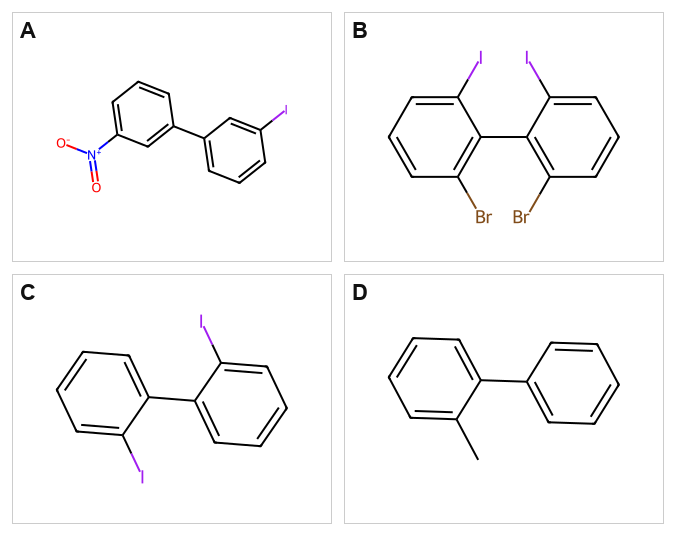
- A.(A)
- B.(B)✓
- C.(C)
- D.(D)
Correct Answer
(B) (B)
Solution & Explanation
\textbf{Answer:} (b) \textbf{Solution:} A biphenyl is optically active (an atropisomer) only when rotation about the central bond is restricted by bulky ortho substituents AND the two ortho substituents on each ring are different, so the molecule is non-superimposable on its mirror image. In (B) all four ortho positions are blocked ( and differing on each ring), so rotation is hindered and the molecule lacks a plane/centre of symmetry, making it chiral and optically active. Options (A), (C) and (D) either lack sufficient ortho substitution to hinder rotation or possess symmetry that makes them superimposable on their mirror images. Hence (b).