
Which amongst the following compounds/species is least basic?
Answer: (D) (conjugate-acid cation of urea). \textbf{Answer:} (d) \textbf{Solution:} Basicity depends on the availability of a lone pair on nitrogen.
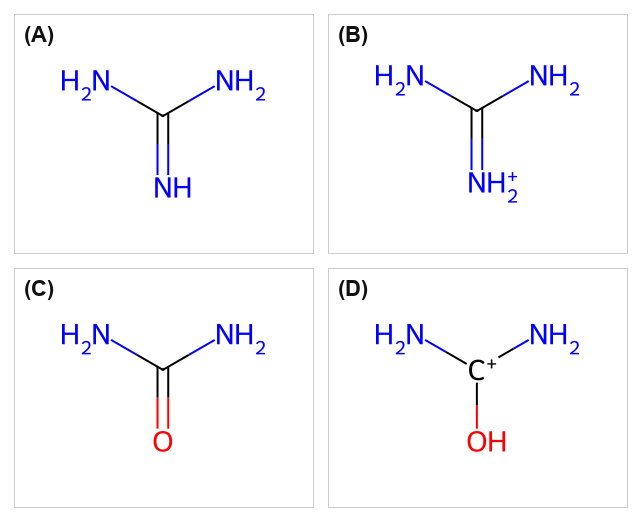
- A. (guanidine)
- B. (guanidinium ion)
- C. (urea)
- D. (conjugate-acid cation of urea)✓
Correct Answer
(D) (conjugate-acid cation of urea)
Solution & Explanation
\textbf{Answer:} (d) \textbf{Solution:} Basicity depends on the availability of a lone pair on nitrogen. In guanidine (a), resonance delocalisation makes its conjugate acid (guanidinium) highly stabilised, so guanidine is very strongly basic. Urea (c) is weakly basic because the C=O group withdraws electron density. The cationic species (b) and (d) are already protonated, and a positively charged species is the poorest base. In (d) the positive charge sits on a carbon flanked by an group, whose electron-withdrawing effect pulls electron density further away from the nitrogens, leaving essentially no available lone pair to donate. Hence (d) is the least basic of the set.