
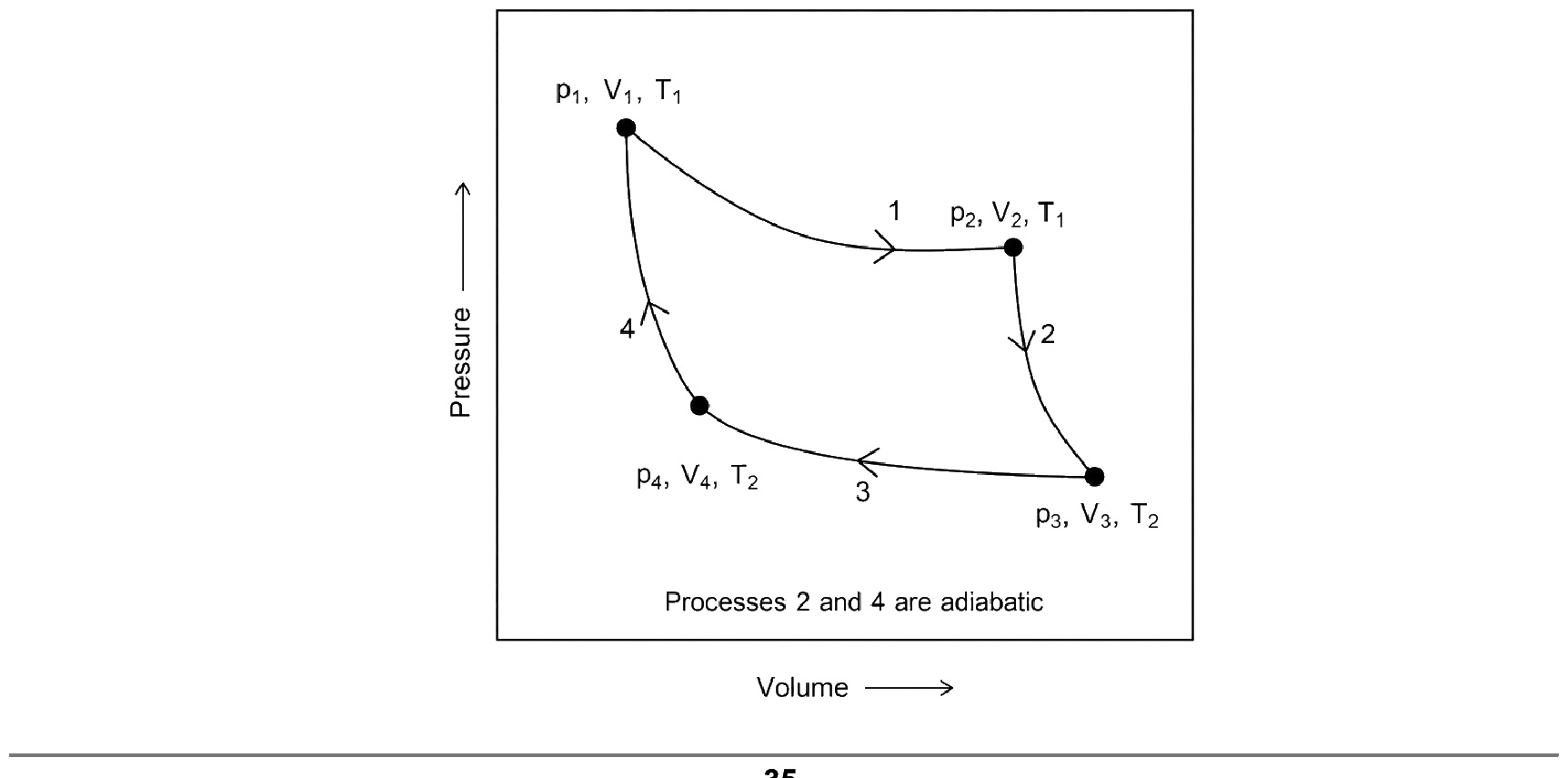
For the reversible processes of 1 mol of an ideal gas shown (a cycle p₁V₁T₁→ p₂V₂T₁ [process 1, isothermal] → p₃V₃T₂ [process 2, adiabatic] → p₄V₄T₂ [process 3, isothermal] → back [process 4, adiabatic]), with w₁,w₂,w₃,w₄ the work done (in calories) and Δ U₂,Δ U₄ the internal-energy changes in processes 2 and 4. [Use R=2 cal K⁻¹mol⁻¹.] The correct option is:
- A.w₁+w₃=-2T₁(V₂)/(V₁)-2T₂(V₄)/(V₃)✓
- B.w₂+w₄=Δ U₂-Δ U₄
- C.w₁+w₂=2T₁(V₂)/(V₁)
- D.w₁+w₂+w₃+w₄=0
Correct Answer
(A) w₁+w₃=-2T₁(V₂)/(V₁)-2T₂(V₄)/(V₃)
Solution & Explanation
Work sign convention: for a reversible isothermal step of an ideal gas, w = −nRT·ln(V_f/V_i). Here n = 1 and R = 2 cal K⁻¹mol⁻¹. Process 1 is isothermal at T₁ from V₁ to V₂, so w₁ = −2T₁·ln(V₂/V₁). Process 3 is isothermal at T₂ from V₃ to V₄, so w₃ = −2T₂·ln(V₄/V₃). Adding the two isothermal works: w₁ + w₃ = −2T₁·ln(V₂/V₁) − 2T₂·ln(V₄/V₃), which is exactly option A. Note: processes 2 and 4 are adiabatic (q = 0), where w = ΔU and is governed by temperature change, not by these log terms; the asked combination involves only the isothermal steps. Answer: option A.
✅ We had this exact concept in our bank before the exam — Concept match, 78% match.
That's the Predicted Batch — it trains you on the exact high-probability concepts NEET repeats every year. 98% of the 2026 paper (176/180) was in our bank before the exam.
Master these concepts + 50,000+ NEET PYQs in the app — free, built for NEET 2027.
Start the Predicted Batch — Free →