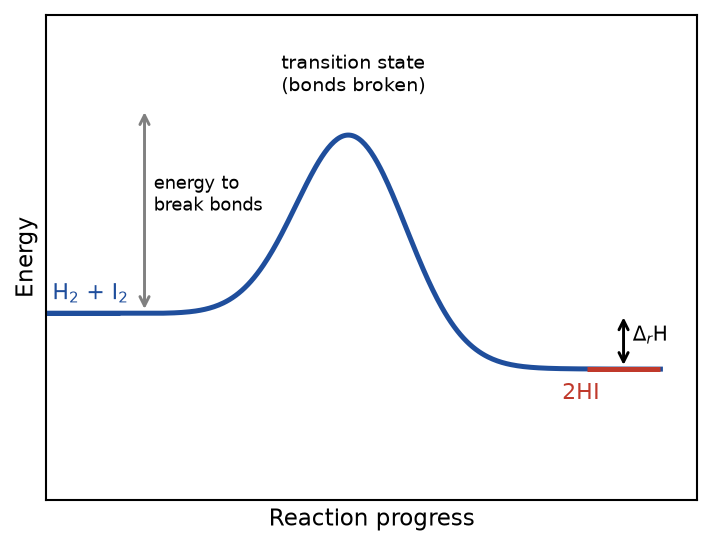
The correct thermodynamic conditions for the spontaneous reaction at all temperatures is:
Consider the following liquid–vapour equilibrium: $\ce{Liquid <=> Vapour}$. Which of the following relations is correct?
For a sample of perfect gas when its pressure is changed isothermally from $p_i$ to $p_f$, the entropy change is given by
If the $E^\circ_{cell}$ for a given reaction has a negative value, which of the following gives the correct relationships for the values of $\Delta G^\circ$ and $K_{eq}$?
A gas is allowed to expand in a well insulated container against a constant external pressure of $2.5\ \text{atm}$ from an initial volume of $2.50\ \text{L}$ to a final volume of $4.50\ \text{L}$. The change in internal energy $\Delta U$ of the gas in joules will be
For a given reaction, $\Delta H = 35.5\ kJ\,mol^{-1}$ and $\Delta S = 83.6\ J\,K^{-1}mol^{-1}$. The reaction is spontaneous at: (Assume that $\Delta H$ and $\Delta S$ do not vary with temperature.)
Two ways to go deeper on this chapter
Choose your next step
The bond dissociation energies of $\ce{X2}$, $\ce{Y2}$ and $\ce{XY}$ are in the ratio of $1 : 0.5 : 1$. $\Delta H$ for the formation of $\ce{XY}$ is $-200\ kJ\,mol^{-1}$. The bond dissociation energy of $\ce{X2}$ will be
Under isothermal condition, a gas at $300\ \text{K}$ expands from $0.1\ \text{L}$ to $0.25\ \text{L}$ against a constant external pressure of $2\ \text{bar}$. The work done by the gas is (Given that $1\ \text{L\,bar} = 100\ \text{J}$)
For the cell reaction $\ce{2Fe^3+(aq) + 2I^-(aq) -> 2Fe^2+(aq) + I2(aq)}$, $E^\circ_{cell} = 0.24\ \text{V}$ at $298\ \text{K}$. The standard Gibbs energy ($\Delta_r G^\circ$) of the cell reaction is:
For a cell involving one electron, $E^\circ_{cell} = 0.59\ \text{V}$ at $298\ \text{K}$. The equilibrium constant for the cell reaction is: (Given that $\dfrac{2.303RT}{F} = 0.059\ \text{V}$ at $T = 298\ \text{K}$)
In which case is the change in entropy negative?
The correct option for free expansion of an ideal gas under adiabatic condition is:
Hydrolysis of sucrose is given by the following reaction: $\ce{Sucrose + H2O <=> Glucose + Fructose}$. If the equilibrium constant ($K_c$) is $2 \times 10^{13}$ at $300\ \text{K}$, the value of $\Delta_r G^\circ$ at the same temperature will be:
For the reaction $\ce{2Cl(g) -> Cl2(g)}$, the correct option is:
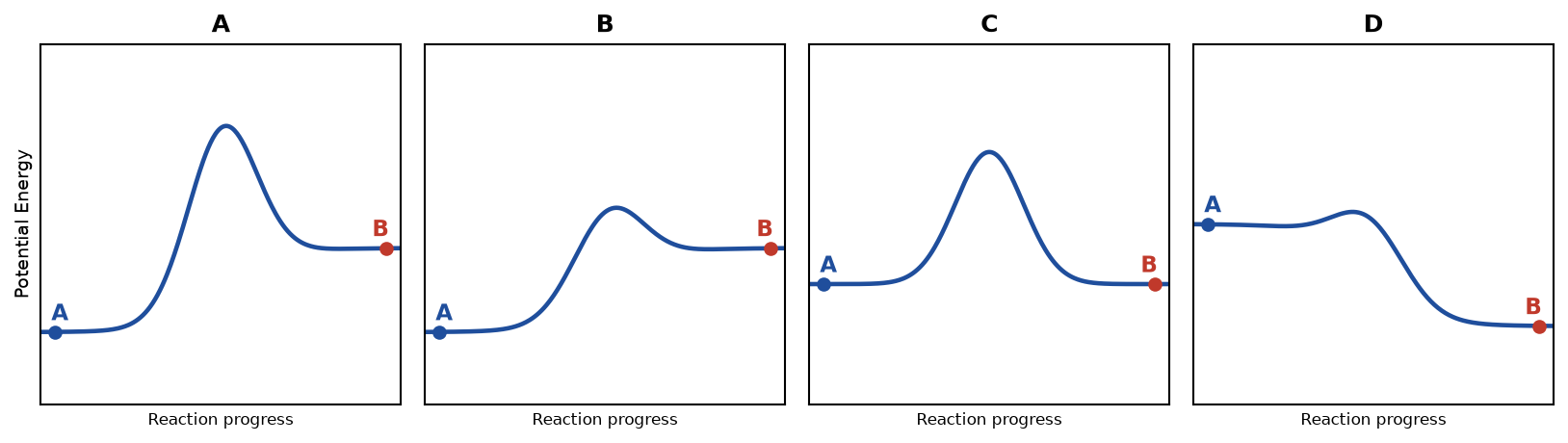
For a reaction $\ce{A -> B}$, the enthalpy of reaction is $-4.2\ kJ\,mol^{-1}$ and the enthalpy of activation is $9.6\ kJ\,mol^{-1}$. The correct potential energy profile for the reaction is shown in which option?
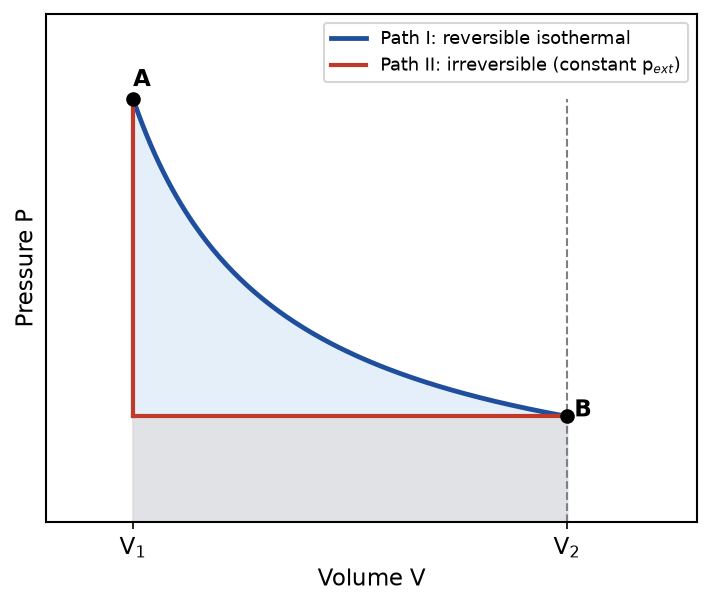
For the irreversible expansion of an ideal gas under isothermal conditions, the correct option is:
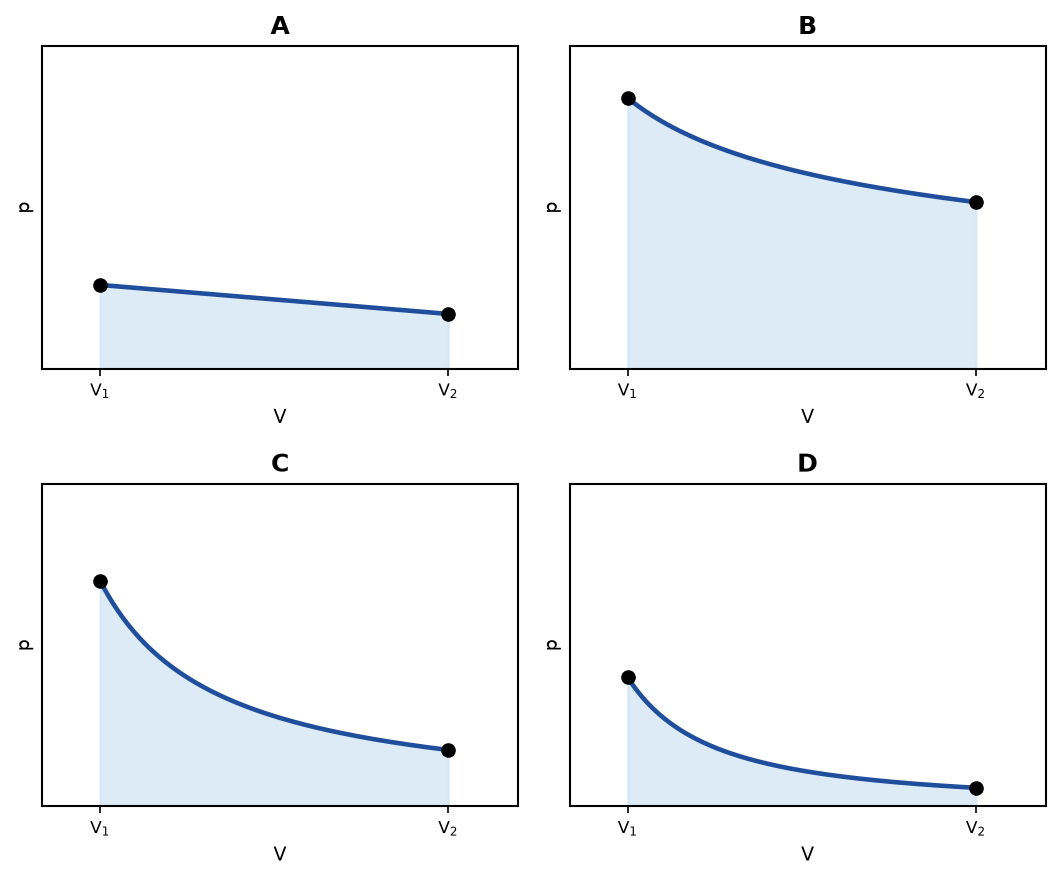
Which of the following $p$–$V$ curves represents the maximum work done?
An ideal gas expands isothermally from $10^{-3}\ \text{m}^3$ to $10^{-2}\ \text{m}^3$ at $300\ \text{K}$ against a constant pressure of $10^{5}\ \text{N\,m}^{-2}$. The work done on the gas is:
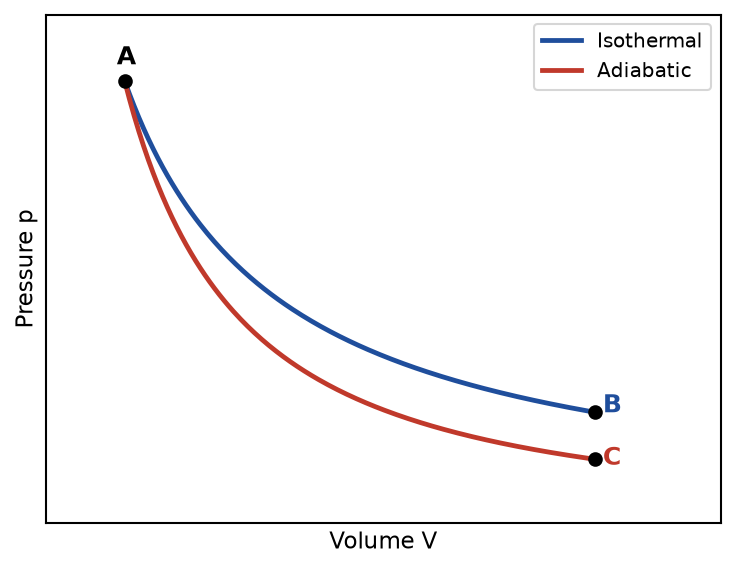
Reversible expansion of an ideal gas under isothermal and adiabatic conditions is shown in the figure ($\ce{A->B}$ isothermal expansion, $\ce{A->C}$ adiabatic expansion on a $p$–$V$ plot). Which of the following options is NOT correct?
Which amongst the following options is the correct relation between change in enthalpy and change in internal energy?
The equilibrium concentrations of the species in the reaction $\ce{A + B <=> C + D}$ are $2$, $3$, $10$ and $6\ \text{mol\,L}^{-1}$, respectively, at $300\ \text{K}$. $\Delta G^\circ$ for the reaction is (Given $R = 2\ \text{cal\,mol}^{-1}\text{K}^{-1}$).
Consider the following reaction: $\ce{2H2(g) + O2(g) -> 2H2O(g)}$, $\Delta_r H^\circ = -483.64\ \text{kJ}$. What is the enthalpy change for the decomposition of one mole of water?
In which of the following processes does entropy increase? A. A liquid evaporates to vapour. B. Temperature of a crystalline solid is lowered from $130\ \text{K}$ to $0\ \text{K}$. C. $\ce{2NaHCO3(s) -> Na2CO3(s) + CO2(g) + H2O(g)}$ D. $\ce{Cl2(g) -> 2Cl(g)}$ Choose the correct option:
The work done during the reversible isothermal expansion of one mole of hydrogen gas at $25^\circ\text{C}$ from a pressure of $20$ atmosphere to $10$ atmosphere is: (Given $R = 2.0\ \text{cal\,K}^{-1}\text{mol}^{-1}$)
The standard heat of formation, in $\text{kcal\,mol}^{-1}$, of $\ce{Ba^2+}$ is: [Given: standard heat of formation of $\ce{SO4^2-}$ ion (aq) $= -216\ \text{kcal\,mol}^{-1}$, standard heat of crystallisation of $\ce{BaSO4(s)} = -4.5\ \text{kcal\,mol}^{-1}$, standard heat of formation of $\ce{BaSO4(s)} = -349\ \text{kcal\,mol}^{-1}$]
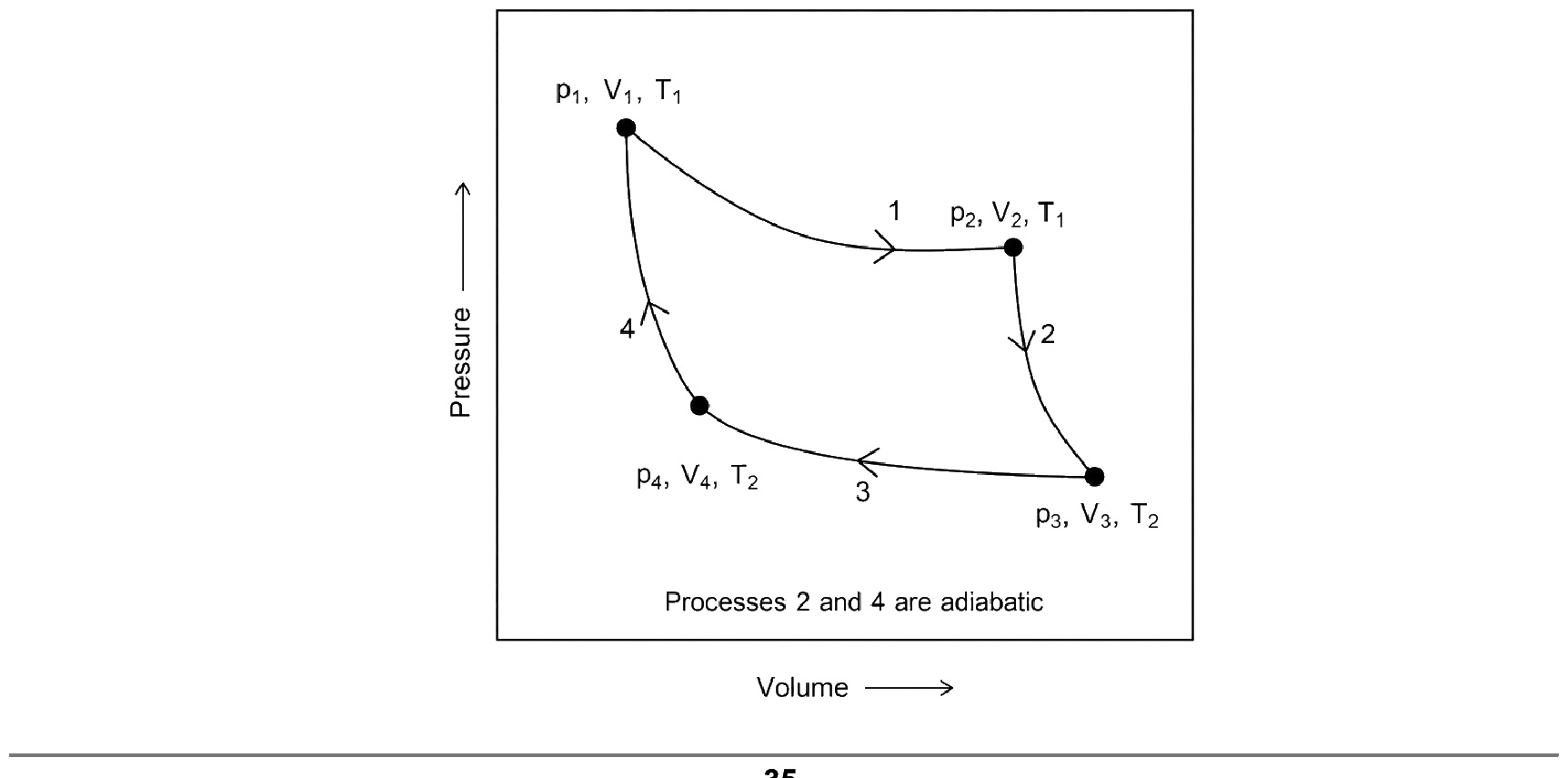
$\ce{C(s) + 2H2(g) -> CH4(g)}$; $\Delta H = -74.8\ kJ\,mol^{-1}$. Which of the following diagrams gives an accurate representation of the above reaction? [R $\rightarrow$ reactants; P $\rightarrow$ products]
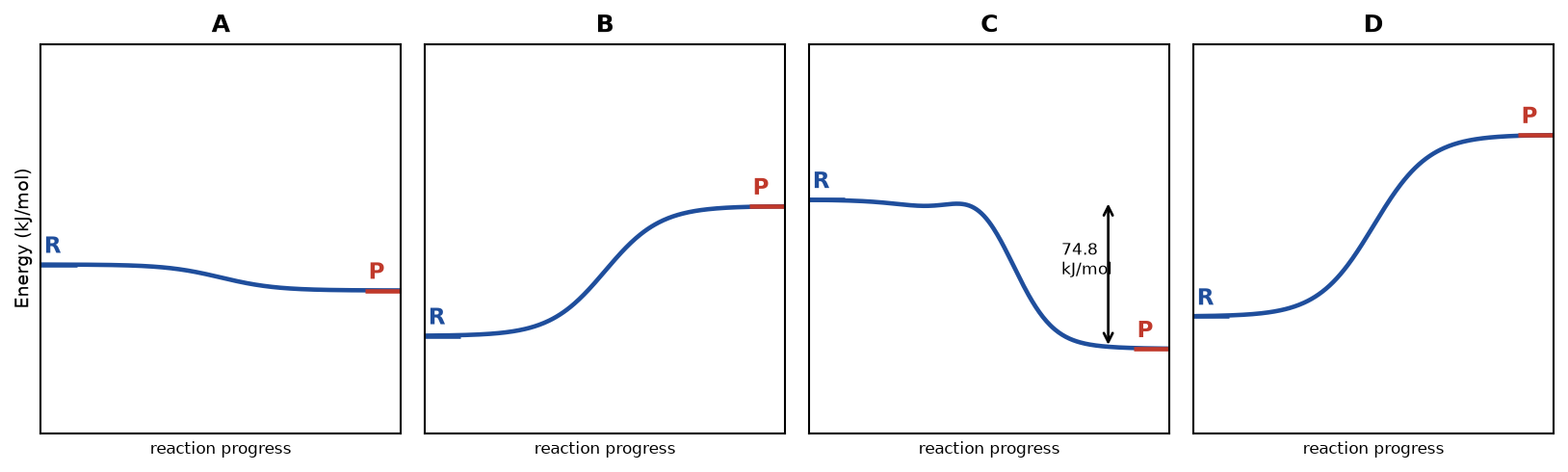
For the reversible processes of 1 mol of an ideal gas shown (a cycle $p_1V_1T_1\to p_2V_2T_1$ [process 1, isothermal] $\to p_3V_3T_2$ [process 2, adiabatic] $\to p_4V_4T_2$ [process 3, isothermal] $\to$ back [process 4, adiabatic]), with $w_1,w_2,w_3,w_4$ the work done (in calories) and $\Delta U_2,\Delta U_4$ the internal-energy changes in processes 2 and 4. [Use $R=2\,\text{cal K}^{-1}\text{mol}^{-1}$.] The correct option is:
Consider the following reaction: $\ce{2A(g) + B(g) -> 2D(g)}$ $\Delta U^\circ = -10\ kJ\,mol^{-1}$ and $\Delta S^\circ = -44\ J\,K^{-1}$ at $298\ \text{K}$. Identify the correct option with $\Delta G^\circ$ for the reaction and the spontaneity of the reaction at $298\ \text{K}$. (Given: $R = 8.31\ J\,mol^{-1}K^{-1}$)
At a certain temperature $T$ (K), during a process, $500\ \text{J}$ is absorbed by the system and work of $200\ \text{J}$ is done by the system. Then the change in internal energy of the system is:
Two moles of an ideal gas undergo free expansion from $10\,$L to $100\,$L at $300\,$K. The values of $\Delta S_{system}$ and $\Delta S_{surroundings}$ are (R = universal gas constant):
A protein undergoes reversible thermal denaturation $N\rightleftharpoons D$. At $60\,^\circ$C the concentrations of $N$ and $D$ are equal at equilibrium, and the standard enthalpy change of denaturation is $666\,\text{kJ mol}^{-1}$. The standard entropy change $\Delta S^\circ$ (in $\text{kJ K}^{-1}\text{mol}^{-1}$) of the protein upon denaturation at $60\,^\circ$C is closest to:
Want more Thermodynamics questions?
MedicNEET has 43,000+ NEET-style questions across Physics, Chemistry & Biology with detailed NCERT-based explanations — including the long, tricky questions that actually come in the exam.
Download MedicNEET App — Free