NEET Chemistry Previous Year Questions (2016–2026) with Answers & Solutions
Class 11Chemistry60 Questions2016–2026
Year-wise Weightage (2016–2026)
Year
Questions Asked
Marks
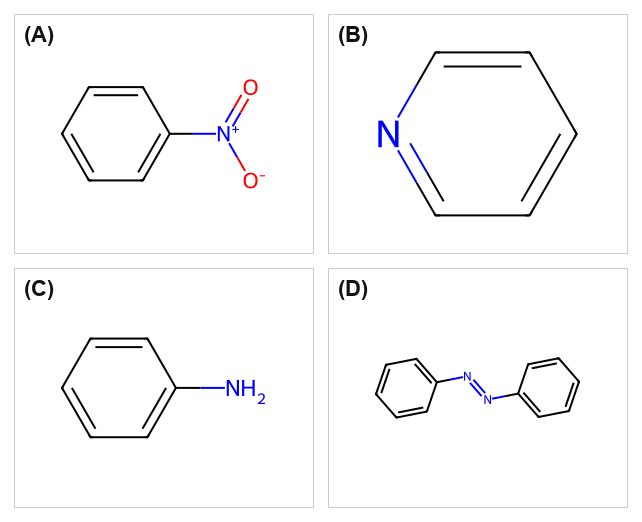
2026
4
16
2025
8
32
2024
6
24
2023
5
20
2022
5
20
Show earlier years (2016–2021)
2021
5
20
2020
3
12
2019
6
24
2018
4
16
2017
6
24
2016
11
44
Q1
NEET 2016 Phase 1
The correct statement regarding a carbonyl compound having a hydrogen atom on its alpha-carbon is:
Q2
NEET 2016 Phase 1
The correct statement regarding the comparison of staggered and eclipsed conformations of ethane is:
Q3
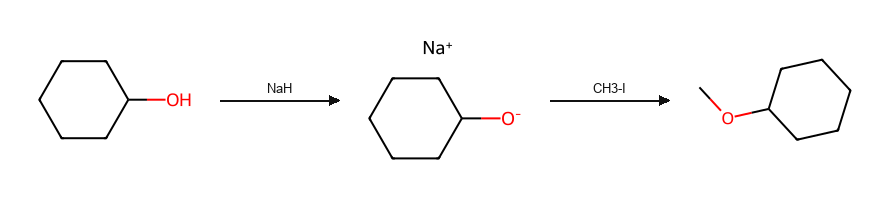
NEET 2016 Phase 1
The reaction shown in the scheme can be classified as:
Q4
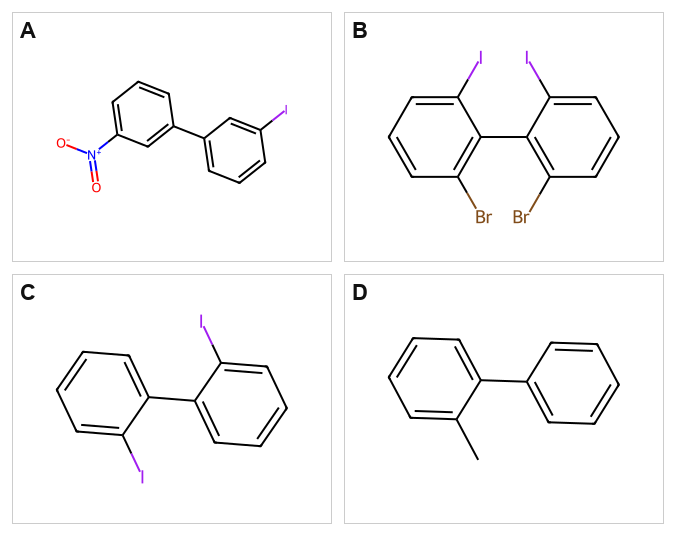
NEET 2016 Phase 1
Which of the following biphenyls is optically active?
Q5
NEET 2016 Phase 1
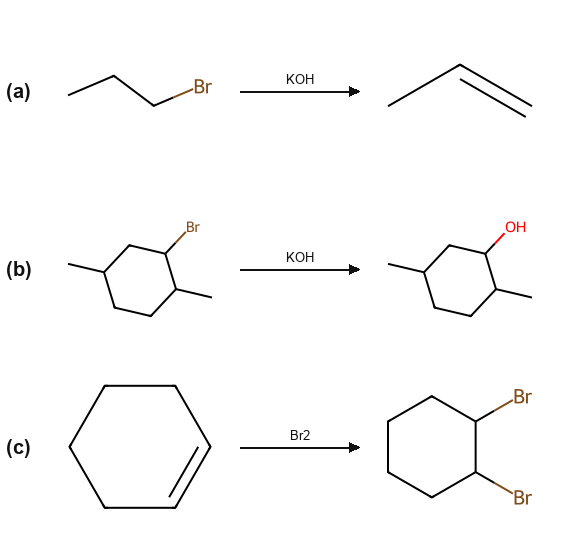
For the following reactions:
(a) \ce{CH3CH2CH2Br + KOH -> CH3CH=CH2 + KBr + H2O}
(b) a bromo-dimethylcyclohexane + \ce{KOH} gives the corresponding hydroxy-dimethylcyclohexane (\ce{Br} replaced by \ce{OH})
(c) \ce{cyclohexene + Br2 ->} 1,2-dibromocyclohexane
Which of the following statements is correct?
Q6
NEET 2016 Phase 1
The correct statement regarding the basicity of aryl amines is:
The pair of electrons in the given carbanion, \ce{CH3-C#C^-}, is present in which of the following orbitals?
Q8
NEET 2016 Phase 2
Which of the following can be used as the halide component for a Friedel-Crafts reaction?
Q9
NEET 2016 Phase 2
In which of the following molecules are all atoms coplanar?
Q10
NEET 2016 Phase 2
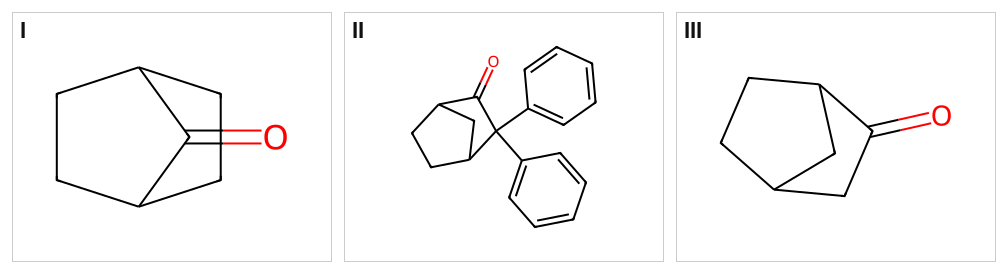
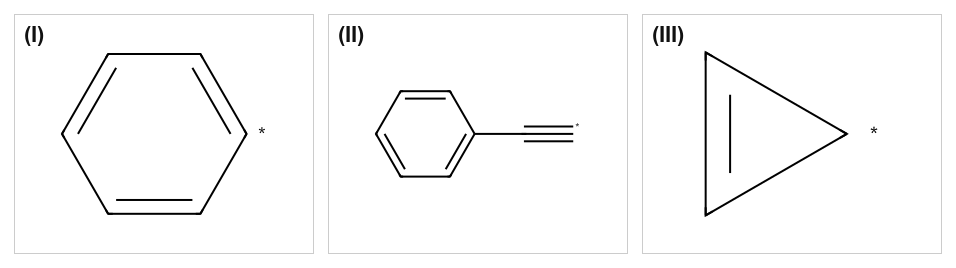
Which among the given bicyclic ketone molecules (I), (II) and (III) can exhibit tautomerism?
Q11
NEET 2016 Phase 2
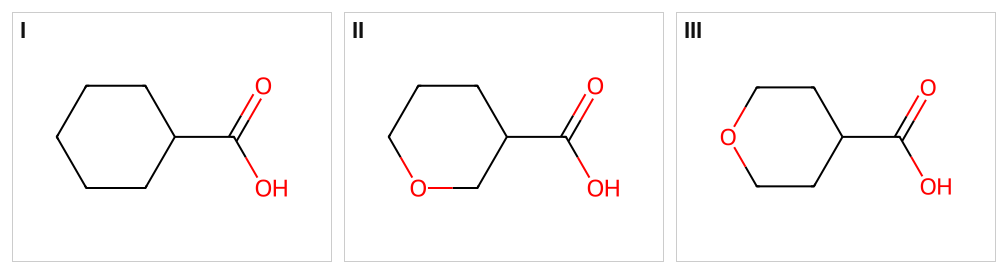
The correct order of strengths of the carboxylic acids (I), (II) and (III) is:
Q12
NEET 2017
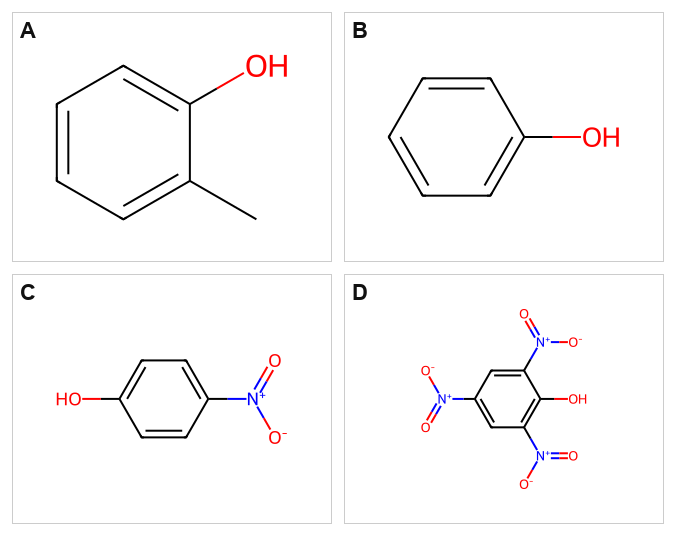
Which one is the most acidic compound?
Q13
NEET 2017
Which one is the correct order of acidity?
Q14
NEET 2017
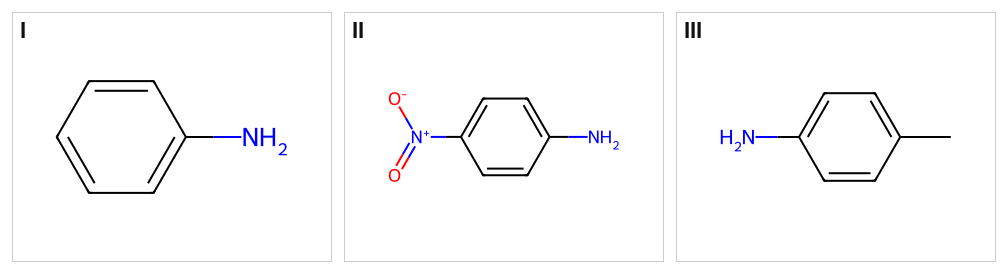
The correct increasing order of basic strength for the following compounds is: (I) aniline, (II) p-nitroaniline, (III) p-toluidine (4-methylaniline).
Q15
NEET 2017
The correct statement regarding an electrophile is:
Q16
NEET 2017
The most suitable method of separation of a 1:1 mixture of ortho- and para-nitrophenols is:
Q17
NEET 2017
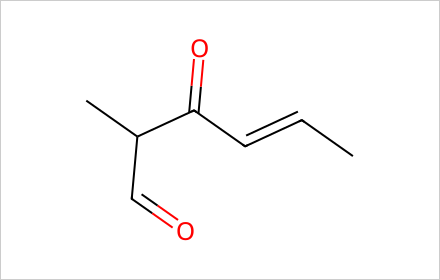
The IUPAC name of the compound shown (a six-carbon chain bearing a terminal \ce{-CHO}, an adjacent \ce{CH3} branch, a ketone \ce{C=O}, and a \ce{C=C} double bond) is:
Q18
NEET 2018
In which of the following molecules is the order of hybridisation $sp^2$, $sp^2$, $sp$, $sp$ for the carbon atoms from left to right?
Q19
NEET 2018
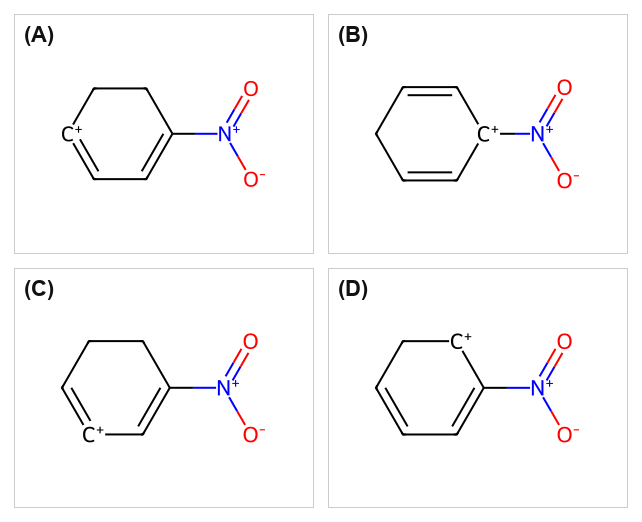
Which of the following carbocations is expected to be the most stable? (Each is a cyclohexadienyl-type cation bearing an \ce{-NO2} substituent on the ring, with the positive charge located at varying ring positions relative to the \ce{-NO2} group.)
Q20
NEET 2018
Which of the following is correct with respect to the $-I$ effect of the substituents? (R = alkyl)
Q21
NEET 2018
In the Reimer-Tiemann reaction, \ce{C6H5-O^- Na^+ + CHCl3 + NaOH -> } salicylaldehyde (o-hydroxybenzaldehyde), the electrophile involved is:
Q22
NEET 2019
The number of sigma ($\sigma$) and pi ($\pi$) bonds in pent-2-en-4-yne is
Q23
NEET 2019
Among the following, the reaction that proceeds through an electrophilic substitution is:
Q24
NEET 2019
The compound that is most difficult to protonate is:
Q25
NEET 2019
The correct order of the basic strength of methyl-substituted amines in aqueous solution is:
Q26
NEET 2019 Odisha · NEET 2024
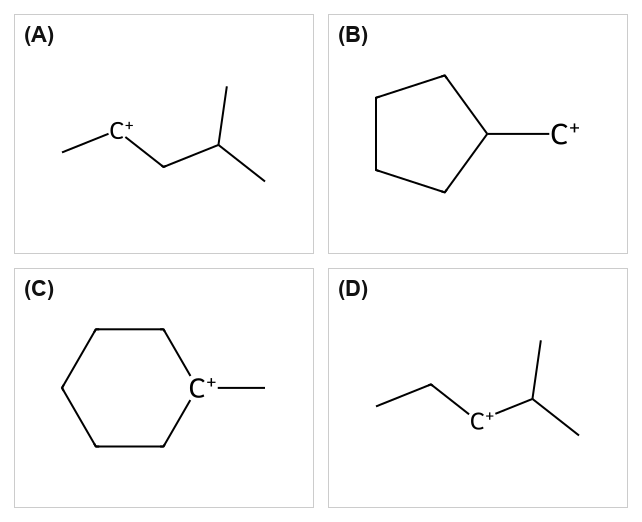
The most stable carbocation among the following is:
Q27
NEET 2019 Odisha · NEET 2024
The most stable carbocation among the following is:
Q28
NEET 2020
A tertiary butyl carbocation is more stable than the secondary butyl carbocation because of which one of the following?
Q29
NEET 2020
Paper chromatography is an example of
Q30
NEET 2020
For the elimination reaction of 2-bromopentane to form pent-2-ene, consider the following statements:
(a) It is a $\beta$-elimination reaction.
(b) It follows Zaitsev's rule.
(c) It is a dehydrohalogenation reaction.
Which of the statements are correct?
Q31
NEET 2021
The compound which shows metamerism is:
Q32
NEET 2021
An organic compound contains 78% (by wt.) carbon and the remaining percentage of hydrogen. The empirical formula of this compound is: [Atomic wt. of C = 12, H = 1]
Q33
NEET 2021
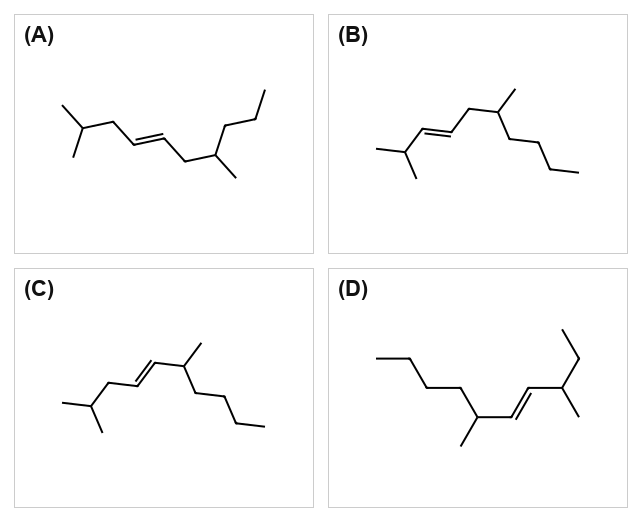
Choose the correct skeletal structure for 2,6-dimethyldec-4-ene.
Q34
NEET 2021
What is the IUPAC name of the organic compound formed in the following reaction?
\ce{CH3-CO-CH3 ->[(i) C2H5MgBr, dry ether][(ii) H2O/H+] Product}
Q35
NEET 2021
The dihedral angle of the least stable conformer of ethane is:
Q36
NEET 2022
Statement I: The acidic strength of monosubstituted nitrophenol is higher than phenol because of the electron-withdrawing nitro group.
Statement II: o-nitrophenol, m-nitrophenol and p-nitrophenol will have the same acidic strength as they have one nitro group attached to the phenolic ring.
Choose the most appropriate answer.
Q37
NEET 2022
The Kjeldahl's method for the estimation of nitrogen can be used to estimate the amount of nitrogen in which one of the following compounds?
Q38
NEET 2022
The incorrect statement regarding chirality is:
Q39
NEET 2022
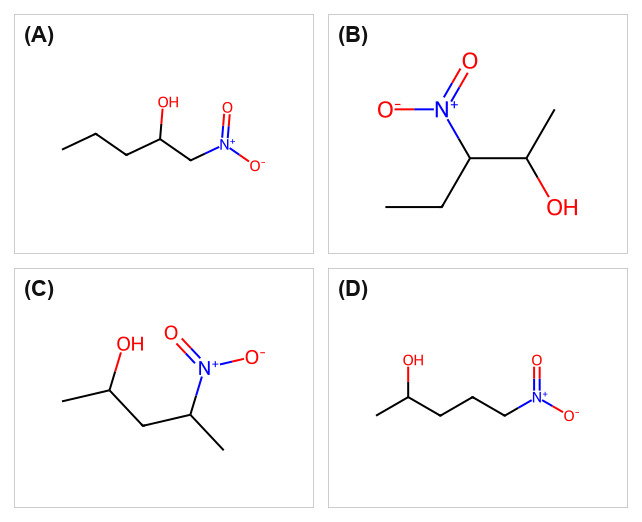
The correct IUPAC name of the following compound is:
\ce{CH3-CH(Cl)-CH(CH3)-CH(OH)-CH2-CH2-Br}
Q40
NEET 2022 · NEET 2026 (1)
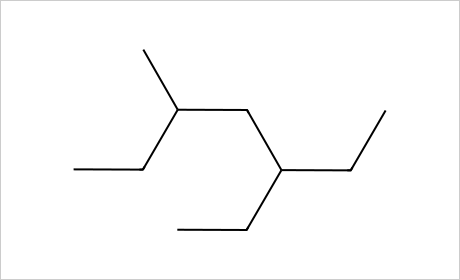
The correct IUPAC name of the following compound is:
Q41
NEET 2023 Phase 2
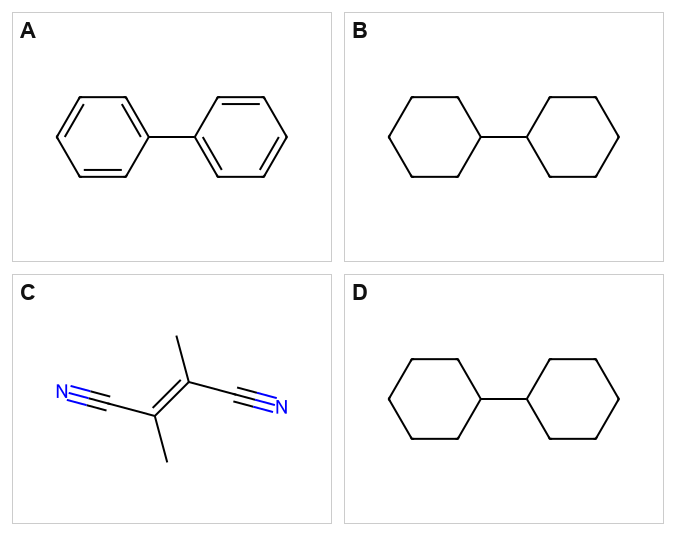
Which amongst the following compounds will show geometrical isomerism?
Q42
NEET 2023 Phase 2
Which amongst the following compounds/species is least basic?
Q43
NEET 2023 Phase 2
Given below are two statements:
Statement I: In an organic compound, when inductive and electromeric effects operate in opposite directions, the inductive effect predominates.
Statement II: Hyperconjugation is observed in o-xylene.
In the light of the above statements, choose the correct answer from the options given below.
Q44
NEET 2023 Phase 1
In Lassaigne's extract of an organic compound, both nitrogen and sulphur are present, which gives a blood-red colour with \ce{Fe^3+} due to the formation of:
Q45
NEET 2023 Phase 1
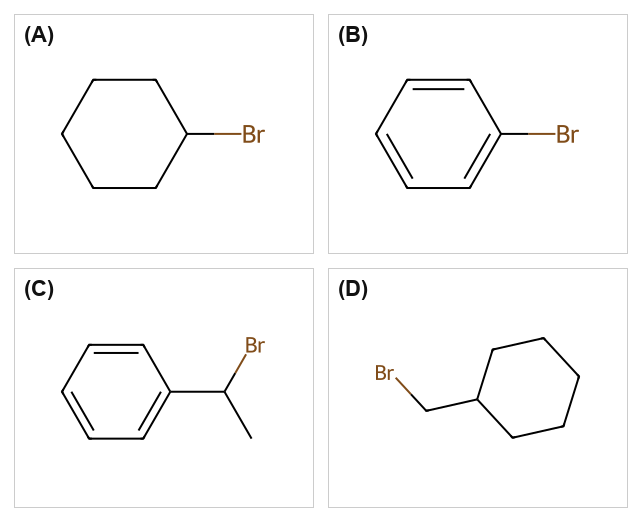
Which amongst the following compounds would be most readily dehydrated under acidic conditions?
Q46
NEET 2024
The compound that will undergo SN1 reaction with the fastest rate is:
Q47
NEET 2024
A compound with a molecular formula $\ce{C6H14}$ has two tertiary carbons. Its IUPAC name is:
Q48
NEET 2024
On heating, some solid substances change from the solid to the vapour state without passing through the liquid state. The technique used for the purification of such substances based on the above principle is known as:
Q49
NEET 2024
A compound X contains 32% of A, 20% of B and the remaining percentage of C. The empirical formula of X is (given atomic masses A = 64, B = 40, C = 32 u):
Q50
NEET 2025
The correct order of decreasing acidity of the following aliphatic acids is:
Q51
NEET 2025
Which one of the following reactions does NOT belong to Lassaigne's test?
Q52
NEET 2025
How many products (including stereoisomers) are expected from the monochlorination of 2-methylbutane, $\ce{(CH3)2CH-CH2-CH3}$?
Q53
NEET 2025
The total number of possible isomers (both structural as well as stereoisomers) of cyclic ethers of molecular formula $\ce{C4H8O}$ is:
Q54
NEET 2025
Among the given compounds I-III, the correct order of bond dissociation energy of the C-H bond marked with an asterisk (*) is:
Q55
NEET 2025
The correct order of decreasing basic strength of the given amines is:
Q56
NEET 2025
Match List I (Mixture) with List II (Method of Separation).
List I
A. $\ce{CHCl3}$ + $\ce{C6H5NH2}$
B. Crude oil in the petroleum industry
C. Glycerol from spent-lye
D. Aniline-water
List II
I. Distillation under reduced pressure
II. Steam distillation
III. Fractional distillation
IV. Simple distillation
Q57
NEET 2025
Which one of the following compounds can exist as cis-trans isomers?
Q58
ReNEET 2026
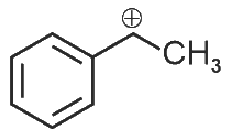
The carbocation $\ce{C6H5-\overset{+}{C}H-CH3}$ (1-phenylethyl cation) is stabilized by the interaction of the empty $p$ orbital with:
Q59
NEET 2026 (1)
The pair of molecules that are metamers among the following is:
Q60
NEET 2026 (1)
During Lassaigne's test, the elements present in an organic compound are converted from:
Want more General Principles Of Organic Chemistry questions?
MedicNEET has 43,000+ NEET-style questions across Physics, Chemistry & Biology with detailed NCERT-based explanations — including the long, tricky questions that actually come in the exam.
Practise General Principles Of Organic Chemistry MCQs — Free
Beyond the PYQs above — every Chemistry question format NEET now uses, starting with the newest ReNEET 2026-style reasoning MCQs. Tap an option for the answer and a worked solution. Free, no login.
✨ General Principles Of Organic Chemistry — ReNEET 2026-Style Reasoning Questions
The newest, most exam-current chemistry format — reasoning-based questions modelled on ReNEET 2026. Practise where NEET is heading before the exam does.
Q1. Assertion (A): Trichloroacetic acid, ClX3C−COOH, is a much stronger acid than acetic acid, CHX3COOH.
Reason (R): The three chlorine atoms pull electron density away through the sigma bonds (a combined −I effect), which spreads out the negative charge of the carboxylate ion and stabilises it.
Choose the correct option.
Q2. But-1-ene, CHX3−CHX2−CH=CHX2, adds HBr in the absence of any peroxide. The proton can add to give either of two carbocations. Which carbocation forms preferentially, and what is the major product?
Q3. Classify the six species as electrophile (E) or nucleophile (Nu):\n\HX+, \BFX3, \NHX3, \OHX−, \AlClX3, \CNX−.\nWhich grouping is correct?
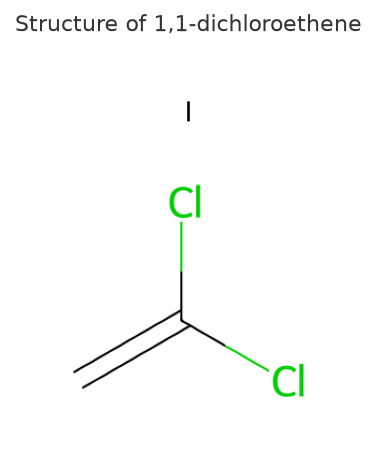
Q4. Read the two statements about 1,1-dichloroethene, CHX2=CClX2 (structure shown).\nAssertion (A): 1,1-dichloroethene does not show geometrical (cis-trans) isomerism.\nReason (R): One of its doubly bonded carbon atoms carries two identical groups.\nChoose the correct option.
Q5. Given below are two statements about π-electron effects:
Statement I: The resonance (mesomeric) effect is a permanent effect present in the ground state of a conjugated molecule.
Statement II: The electromeric effect is a temporary effect that appears only while an attacking reagent is in contact with a multiple bond, and reverses when the reagent is removed.
Choose the correct option:
Q6. In the Friedel-Crafts acylation of benzene with acetyl chloride, CX6HX6+CHX3COClAlClX3 acetophenone, which option correctly identifies the attacking electrophile and the role of anhydrous AlClX3?
Q7. In the E/Z system of nomenclature, the descriptor Z (from the German 'zusammen', together) is assigned to the isomer in which:
Q8. The eclipsed conformation of ethane has three pairs of eclipsing C−H bonds and a total torsional strain of about 12.5kJ mol−1. The approximate strain contributed by each eclipsing interaction is:
Q9. For n-butane, the dihedral (torsion) angle between the two terminal methyl groups in the anti and gauche conformations are, respectively:
Q10. In the benzene molecule, CX6HX6, each carbon atom is:
You’ve practised 10 of 114 General Principles Of Organic Chemistry questions in this set.
🧩 General Principles Of Organic Chemistry — General Principles Of Organic Chemistry Questions — All Formats
Every format NEET uses — assertion-reason, statement, match-the-column and standard MCQs — each with an instant explanation.
Q1. The number of α-hydrogen atoms available for hyperconjugation in the tert-butyl carbocation, (CHX3)X3CX+, is:
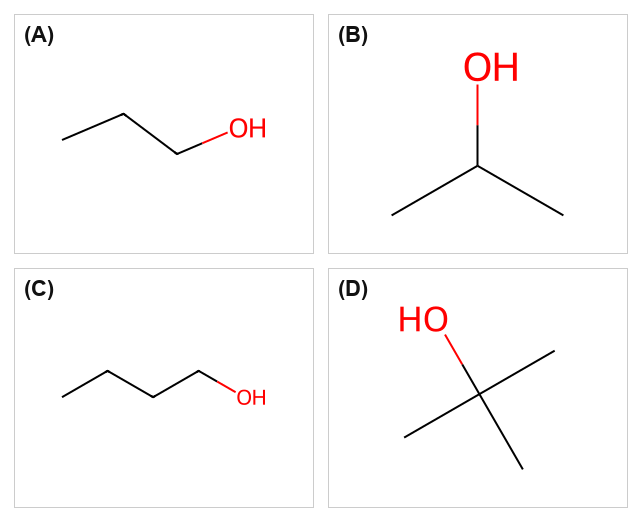
Q2. The following alcohols are subjected to acid-catalysed dehydration, which proceeds through a carbocation intermediate. Which alcohol is dehydrated most readily (fastest)?
Q3. Homolytic fission of a covalent bond produces:
Q4. Three acids are given: (I) ClCHX2CHX2COOH, (II) CHX3CHClCOOH, (III) CHX3CHX2COOH. Considering only the inductive effect, the correct order of acid strength is:
Q5. Which of the following is the strongest acid?
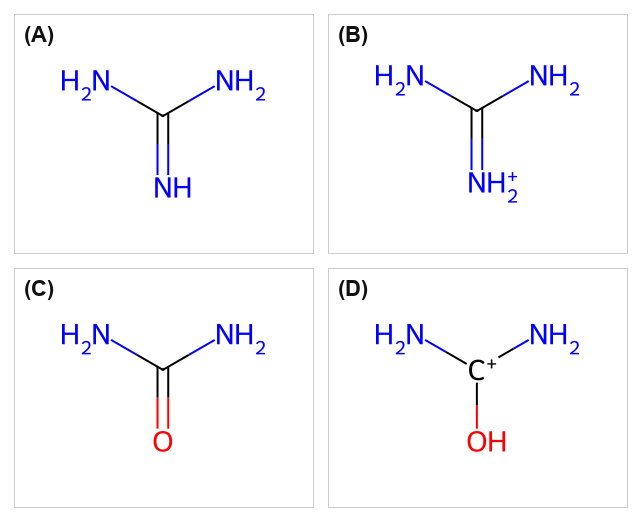
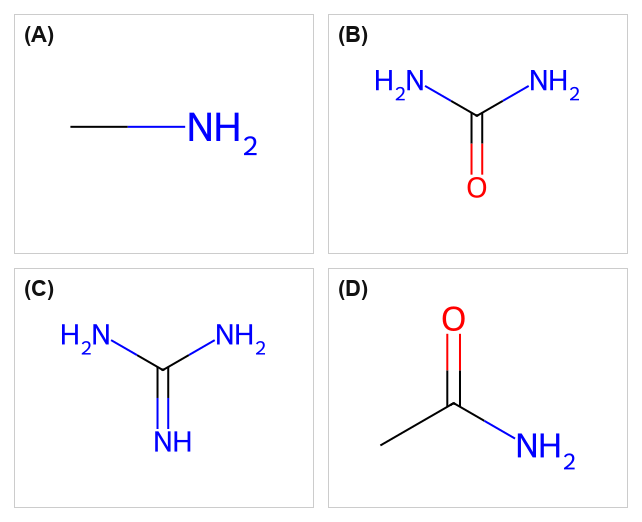
Q6. The four structures below all contain nitrogen. Which one is the STRONGEST base? (Hint: compare how well each conjugate acid is stabilised after protonation.)
Q7. The correct statement about a meso compound is:
Q8. In the staggered conformation of ethane, the dihedral (torsion) angle between the front and back C−H bonds is:
Q9. In propene, CHX3−CH=CHX2, the hybridisation states of the three carbon atoms (left to right) are respectively:
Q10. In Lassaigne's test, the appearance of a violet colour on adding sodium nitroprusside to the sodium fusion extract indicates the presence of:
You’ve practised 10 of 80 General Principles Of Organic Chemistry questions in this set.
General Principles Of Organic Chemistry — NEET PYQ Analysis
General Principles Of Organic Chemistry is a Class 11 NEET Chemistry chapter consistently tested from 2016 to ReNEET 2026. This page has all 60 authentic previous year questions from real NEET papers — with answers and detailed solutions, not model questions.
For full chapter-wise practice in timed test mode, download the MedicNEET app — 43,000+ questions across the full NEET syllabus. Back to the NEET Chemistry PYQ index.
All NEET Chemistry PYQ Chapters
Every NEET Chemistry previous-year question (2016–2026), chapter-wise — free, no login.