The electronic configurations of \ce{Eu} (Atomic no. 63), \ce{Gd} (Atomic No. 64) and \ce{Tb} (Atomic No. 65), respectively, are:
Two electrons occupying the same orbital are distinguished by:
How many electrons can fit in the orbital for which $n=3$ and $l=1$?
Which of the following pairs of $d$-orbitals will have electron density along the axes?
Which one is the wrong statement?
Which one is a wrong statement?
Two ways to go deeper on this chapter
Choose your next step
Magnesium reacts with an element \ce{X} to form an ionic compound. If the ground-state electronic configuration of \ce{X} is $1s^{2}\,2s^{2}\,2p^{3}$, the simplest formula for this compound is:
$4d$, $5p$, $5f$ and $6p$ orbitals are arranged in the order of decreasing energy. The correct option is:
Which of the following series of transitions in the spectrum of the hydrogen atom falls in the visible region?
An orbital having 3 angular nodes and 3 total nodes is:
In a hydrogen atom, the de Broglie wavelength of an electron in the second Bohr orbit is: [Given that Bohr radius $a_0 = 52.9$ pm]
The number of protons, neutrons and electrons in $^{175}_{71}\ce{Lu}$, respectively, are:
The calculated 'spin-only' magnetic moment of \ce{Ti^2+} ($3d^{2}$) is:
A particular station of All India Radio, New Delhi, broadcasts on a frequency of $1368$ kHz (kilohertz). The wavelength of the electromagnetic radiation emitted by the transmitter is: [Speed of light, $c = 3 \times 10^{8}$ m s$^{-1}$]
Tritium, a radioactive isotope of hydrogen, emits which of the following particles?
From the following pairs of ions, which one is NOT an iso-electronic pair?
The IUPAC name of an element with atomic number 119 is:
If the radius of the second Bohr orbit of the \ce{He+} ion is $105.8$ pm, what is the radius of the third Bohr orbit of the \ce{Li^2+} ion?
The relation between $n_m$ ($n_m$ = the number of permissible values of the magnetic quantum number $m$) for a given value of the azimuthal quantum number $l$ is:
Which one of the following represents all isoelectronic species?
Given below are two statements: Statement I: The value of the wave function $\psi$ depends upon the coordinates of the electron in the atom. Statement II: The probability of finding an electron at a point within an atom is proportional to the orbital wave function $\psi$. In the light of the above statements, choose the correct answer from the options given below.
The incorrect set of quantum numbers from the following is:
The energy of an electron in the ground state ($n=1$) for the \ce{He+} ion is $-x$ J. Then the energy of an electron in the $n=2$ state for the \ce{Be^3+} ion, in J, is:
Match List-I with List-II: List-I (Quantum Number) (A) $m_l$ (B) $m_s$ (C) $l$ (D) $n$ List-II (Information provided) (I) shape of orbital (II) size of orbital (III) orientation of orbital (IV) orientation of spin of electrons Choose the correct option:
The ratio of the wavelengths of the light absorbed by a hydrogen atom when it undergoes $n=2 \rightarrow n=3$ and $n=4 \rightarrow n=6$ transitions, respectively, is:
Energy and radius of the ground-state Bohr orbit of \ce{He+} and \ce{Li^2+} are: [Given $R_H = 2.18 \times 10^{-18}$ J, $a_0 = 52.9$ pm]
Dalton's atomic theory could not explain which of the following?
Which among the following electronic configurations belong to main-group elements? A. $[\ce{Ne}]3s^{1}$ B. $[\ce{Ar}]3d^{3}\,4s^{2}$ C. $[\ce{Kr}]4d^{10}\,5s^{2}\,5p^{5}$ D. $[\ce{Ar}]3d^{10}\,4s^{1}$ E. $[\ce{Rn}]5f^{0}\,6d^{2}\,7s^{2}$
Consider the schematic plots of the orbital wavefunction $\psi_r$ against distance $r$ from the nucleus (A: monotonically decreasing; B: one sign-change; C: two ripples crossing zero twice; D: oscillatory). The figure representing two radial nodes in the orbital is:
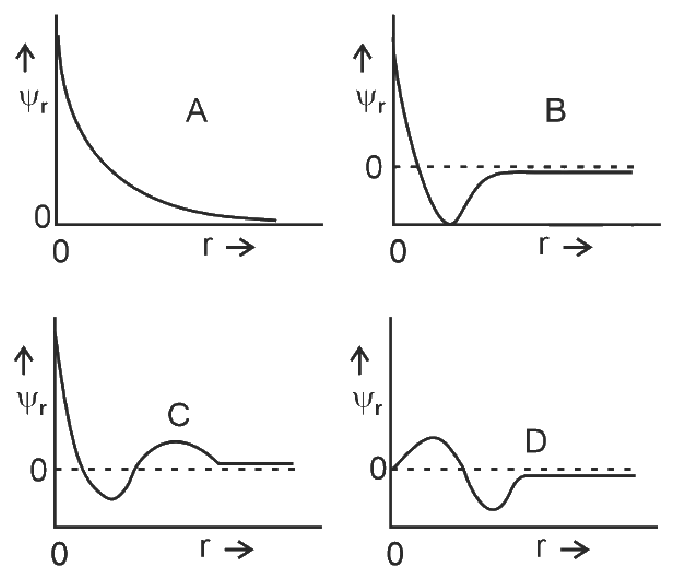
Match List-I with List-II: List-I ($n$, $l$) (A) $n=2$, $l=1$ (B) $n=4$, $l=0$ (C) $n=5$, $l=3$ (D) $n=3$, $l=2$ List-II (Orbital) (I) $3d$ (II) $2p$ (III) $4s$ (IV) $5f$ Choose the correct answer from the options given below:
A bulb is rated at $150$ watt, converting $8\%$ of its energy into light. If the energy of one photon is $4.42 \times 10^{-19}$ J, how many photons are emitted by the bulb per second?
Want more Structure Of Atom questions?
MedicNEET has 43,000+ NEET-style questions across Physics, Chemistry & Biology with detailed NCERT-based explanations — including the long, tricky questions that actually come in the exam.
Download MedicNEET App — Free