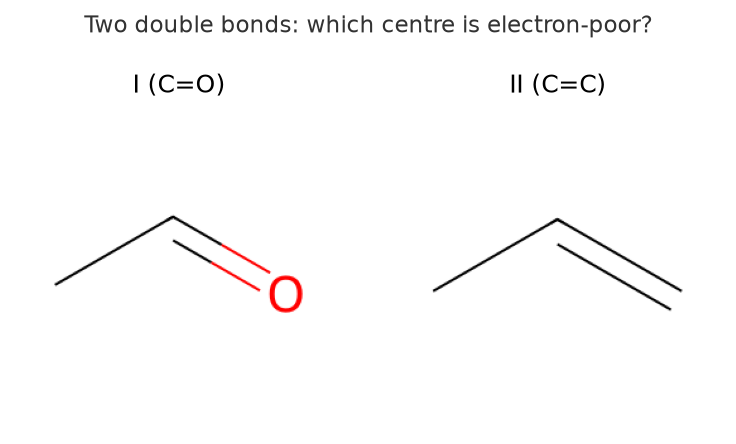
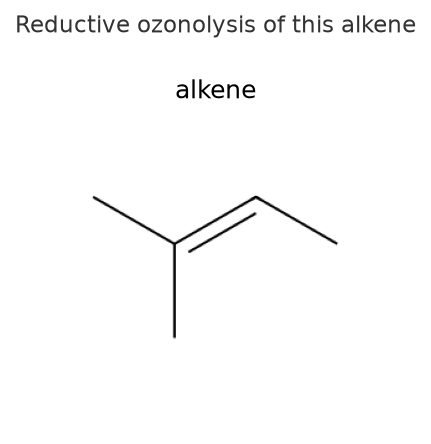
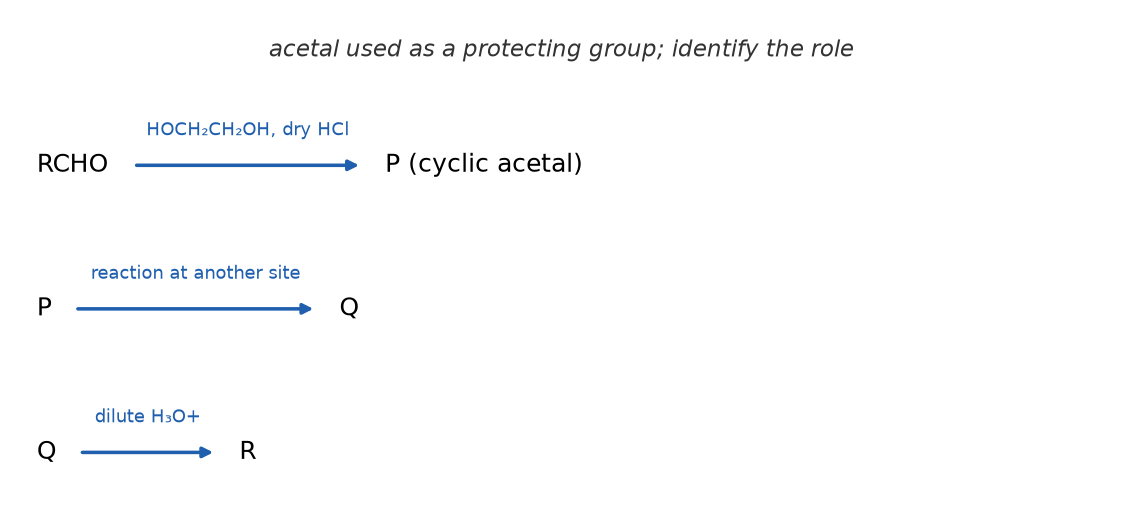
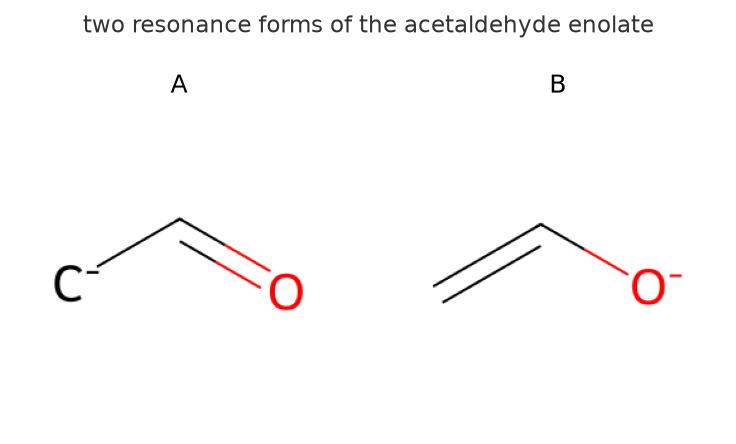
The correct statement regarding a carbonyl compound with a hydrogen atom on its $\alpha$-carbon is:
The product formed by the reaction of an aldehyde with a primary amine is:
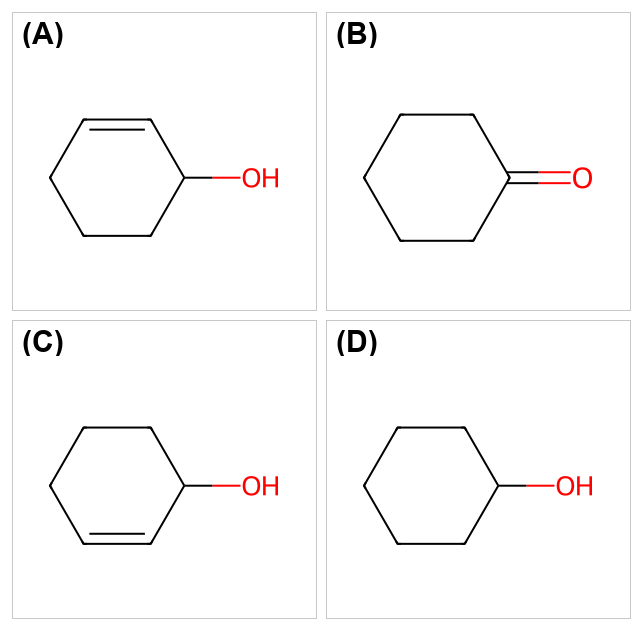
The correct structure of the product $A$ formed in the following reaction is: \ce{cyclohex-2-en-1-one ->[{H2 (1 atm)}][{Pd/C, EtOH}] A}
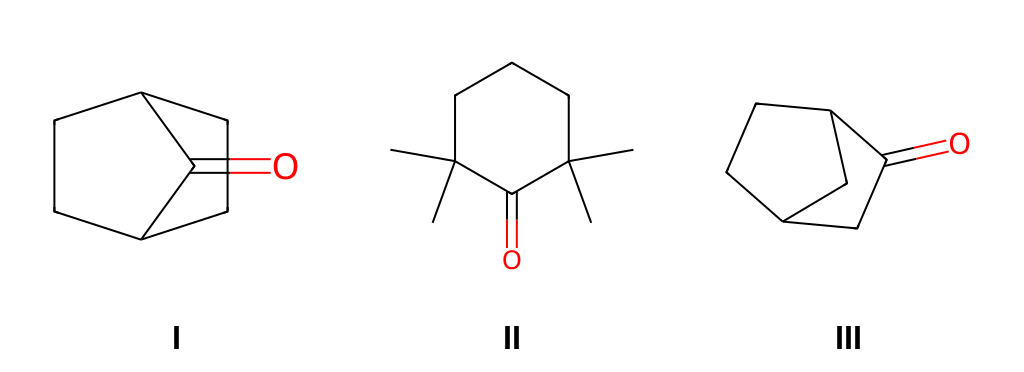
Which among the following molecules (I, II, III) can exhibit tautomerism?
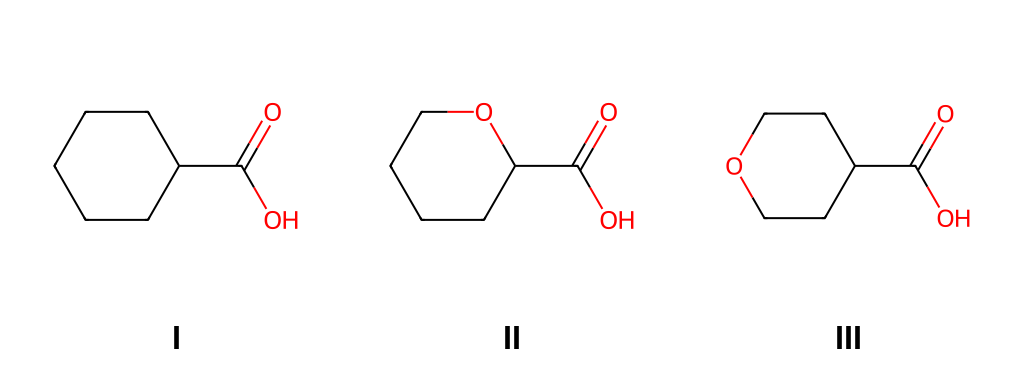
The correct order of strengths of the following carboxylic acids is: (I) cyclohexanecarboxylic acid; (II) a tetrahydropyran-carboxylic acid in which the ring oxygen lies close (beta) to the \ce{-COOH}-bearing carbon; (III) a tetrahydropyran-carboxylic acid in which the ring oxygen lies far (gamma, across the ring) from the \ce{-COOH}-bearing carbon.
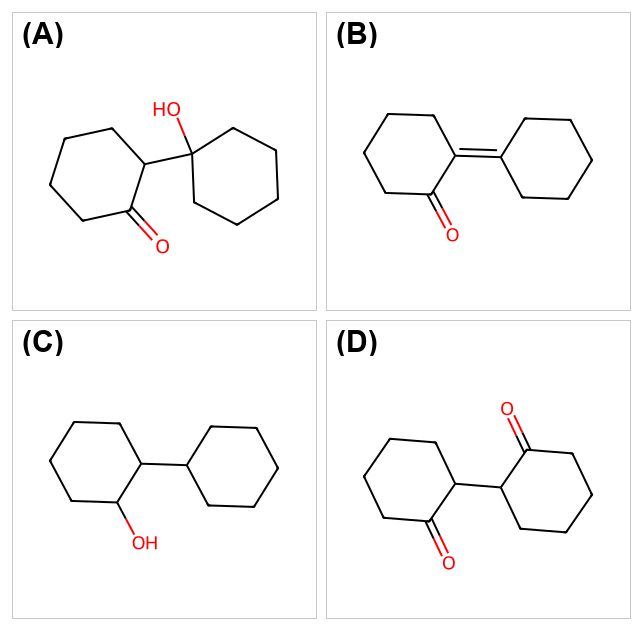
Which of the following is the product formed when cyclohexanone undergoes aldol condensation followed by heating?
Two ways to go deeper on this chapter
Choose your next step
Consider the following reactions of \ce{X} ($\ce{C2H6O}$): \ce{X ->[Cu][573 K] A} \ce{A ->[{[Ag(NH3)2]+, OH-}][\Delta] silver mirror} \ce{A ->[OH-, \Delta][aldol] Y} \ce{A ->[{H2N-NH-CO-NH2}] Z} Identify \ce{A}, \ce{X}, \ce{Y} and \ce{Z}.
The IUPAC name of the compound \ce{OHC-CH(CH3)-CO-CH=CH-CH3} is:
Identify the major products $P$, $Q$ and $R$ in the following sequence of reactions: \ce{C6H6 + CH3CH2CH2Cl ->[{anhydrous AlCl3}] P} \ce{P ->[{(i) O2}][{(ii) H3O+}] Q + R}
A mixture of 2.3 g formic acid (\ce{HCOOH}) and 4.5 g oxalic acid (\ce{(COOH)2}) is treated with conc. \ce{H2SO4}. The evolved gaseous mixture is passed through \ce{KOH} pellets. The weight (in g) of the remaining gas at STP will be
Carboxylic acids have higher boiling points than aldehydes, ketones and even alcohols of comparable molecular mass. It is due to their:
Compound $A$, \ce{C8H10O}, reacts with NaOI (produced by reacting $Y$ with NaOH) and yields a yellow precipitate with characteristic smell. $A$ and $Y$ are respectively:
The compound that is most difficult to protonate is:
The major product of the following reaction is: benzene-1,2-dicarboxylic acid (phthalic acid) \ce{->[{NH3}][{strong heating}]} ?
The reaction that does \textbf{not} give benzoic acid as the major product is:
When the vapours of a secondary alcohol are passed over heated copper at 573 K, the product formed is:
The reaction between benzaldehyde and acetophenone in the presence of dilute NaOH is known as:
The reaction between acetone (\ce{CH3COCH3}) and methylmagnesium chloride (\ce{CH3MgCl}) followed by hydrolysis gives
Identify compound X in the following reaction: \ce{C6H5-CH3 ->[{Cl2}][{h\nu}] X ->[{H2O}][{373 K}] C6H5-CHO}
What is the IUPAC name of the organic compound formed in the following reaction? \ce{CH3COCH3 ->[{(i) C2H5MgBr, dry ether}][{(ii) H2O, H+}] Product}
The intermediate compound \ce{X} in the following reaction is: \ce{C6H5-CH3 ->[CrO2Cl2][CS2] X ->[H3O+] C6H5-CHO}
Match List-I with List-II and choose the correct answer. List-I: (a) \ce{C6H6 ->[{CO, HCl}][{Anhy. AlCl3, CuCl}] C6H5-CHO} (b) \ce{R-CO-CH3 ->[NaOX] R-COO^- + CHX3} (c) \ce{R-CH2-OH + R'COOH ->[{Conc. H2SO4}] } (d) \ce{R-CH2-COOH ->[{(i) X2/Red P}][{(ii) H2O}] } List-II: (i) Hell-Volhard-Zelinsky reaction (ii) Gattermann-Koch reaction (iii) Haloform reaction (iv) Esterification
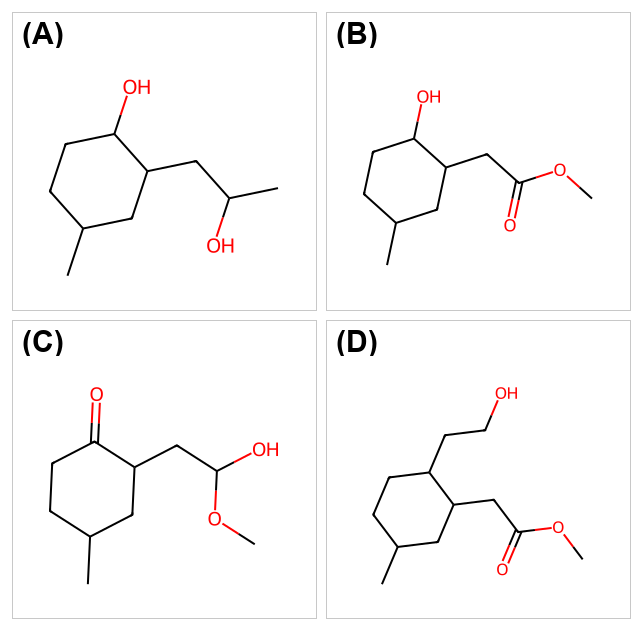
The product formed in the following reaction is: \ce{4-methyl-2-(2-methoxy-2-oxoethyl)cyclohexan-1-one ->[{NaBH4}][{C2H5OH}] ?} (A cyclohexanone ring bearing a \ce{-CH2COOCH3} methyl-ester side chain and a \ce{CH3} substituent.)
Consider the reaction: \ce{CH3CH2COONa ->[NaOH + ?][\Delta] CH3CH3 + Na2CO3} Identify the missing reagent.
Statement I: The boiling points of aldehydes and ketones are higher than hydrocarbons of comparable molecular masses because of weak molecular association due to dipole-dipole interactions. Statement II: The boiling points of aldehydes and ketones are lower than the alcohols of similar molecular masses due to the absence of H-bonding. In the light of the above statements, choose the most appropriate answer:
Match List-I with List-II. List-I (Products formed): (a) Cyanohydrin (b) Acetal (c) Schiff's base (d) Oxime List-II (Reaction of carbonyl compound with): (i) \ce{NH2OH} (ii) \ce{RNH2} (iii) alcohol (iv) \ce{HCN} Choose the correct answer from the options given below:
Which one of the following is \textbf{not} formed when acetone (\ce{CH3COCH3}) reacts with 2-pentanone (\ce{CH3COCH2CH2CH3}) in the presence of dilute \ce{NaOH} followed by heating?
Identify the final product [D] in the following sequence: \ce{CH3CHO ->[{(i) LiAlH4}][{(ii) H3O+}] [A] ->[{H2SO4}][\Delta] [B] ->[HBr] [C] ->[{C6H5Br, Na}][{dry ether}] [D]}
Complete the following reaction. Cyclohexanone $[A]$ reacts with \ce{HCN} to give $[B]$, which on treatment with conc. \ce{H2SO4}/heat gives $[C]$. $C$ is:
Identify the product (A) in the following reaction. The substrate is 1-(4-acetylphenyl)ethan-1-one type compound bearing two \ce{-COCH3} (acetyl) groups, treated with \ce{Zn-Hg} / conc. \ce{HCl}: \ce{substrate ->[Zn-Hg][conc. HCl] A + 2 H2O}
Identify the major product obtained when 2-acetylbenzaldehyde (an ortho-disubstituted benzene bearing \ce{-CO-CH3} and \ce{-CHO}) is treated with \ce{2[Ag(NH3)2]+} and \ce{3OH-} on heating.
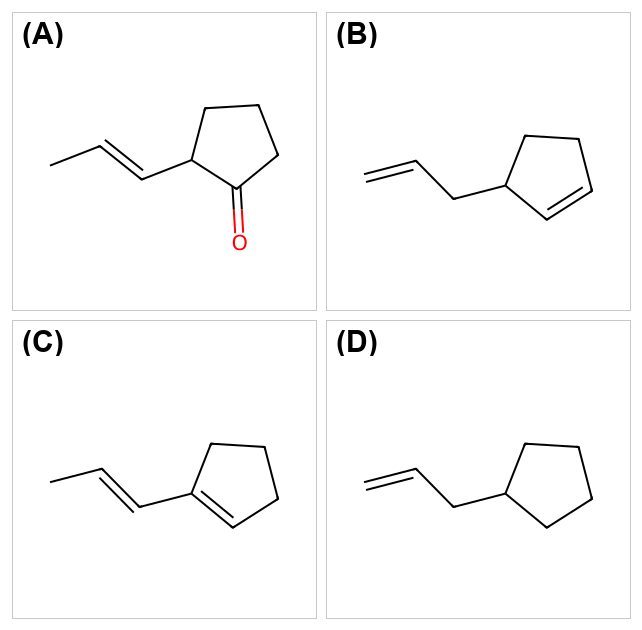
The major product formed in the following conversion is: A cyclopentanone bearing a \ce{-CH2COCH3} (2-oxopropyl) side chain treated with (i) \ce{NaBH4}, then (ii) \ce{H2SO4}, heat.
Consider the reaction: \ce{CH3COCH3 ->[dil. Ba(OH)2] X} The functional groups present in compound \ce{X} are
Reagents which can be used to convert alcohols to carboxylic acids are: (A) \ce{CrO3 - H2SO4} (B) \ce{K2Cr2O7 + H2SO4} (C) \ce{KMnO4 + KOH}/\ce{H3O+} (D) \ce{Cu}, 573 K (E) \ce{CrO3}, \ce{(CH3CO)2O} Choose the most appropriate answer:
Identify $X$ in the following reactions: \ce{R-COOH ->[{(i) X}][{(ii) H2O/HCl}] R-CH2OH} \ce{R-CH=CH2 ->[{(i) X}][{(ii) H2O, NaOH, H2O2}] R-CH2-CH2-OH}
The following conversion is known as: \ce{C6H5-COCl ->[H2][Pd-BaSO4] C6H5-CHO}
Identify the product in the following reaction: cyclobutyl chloride \ce{->[{(i) KCN}][{(ii) H2O/HCl, \Delta}] ->[{(iii) Br2/red P}][{(iv) H2O}]} Product.
Fehling's solution 'A' is:
Match List-I with List-II: List-I (Reaction) (a) \ce{C6H6 -> C6H5-CO-C6H5} (benzophenone) (b) Alkene \ce{->} carbonyl (oxidative cleavage) (c) \ce{C6H5-OH ->} carbonyl (oxidation) (d) \ce{C6H5-CH2-CH3 -> C6H5-COOH} List-II (Reagents/Condition) (i) \ce{C6H5COCl}, anhyd. \ce{AlCl3} (ii) \ce{CrO3} (iii) \ce{KMnO4}/\ce{KOH}, $\Delta$ (iv) (1) \ce{O3}, (2) \ce{Zn-H2O} Choose the correct option:
Identify the correct reagents that would bring about the transformation \ce{C6H5-CH2-CH=CH2 -> C6H5-CH2-CH2-CHO} (allylbenzene to 3-phenylpropanal).
Identify the suitable reagent for the following conversion: \ce{C6H5COOCH3 -> C6H5CHO} (methyl benzoate to benzaldehyde)
The correct order of decreasing acidity of the following aliphatic acids is
The major product of the following reaction is: 4-oxo-4-phenylbutanenitrile \ce{C6H5-CO-CH2-CH2-CN} is treated with (i) \ce{CH3MgBr} (excess) and then (ii) \ce{H3O+}.
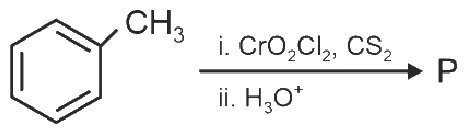
Consider the reaction: toluene $\xrightarrow{\text{(i) }\ce{CrO2Cl2},\,\ce{CS2}}\xrightarrow{\text{(ii) }\ce{H3O+}} P$. Choose the correct option about $P$.
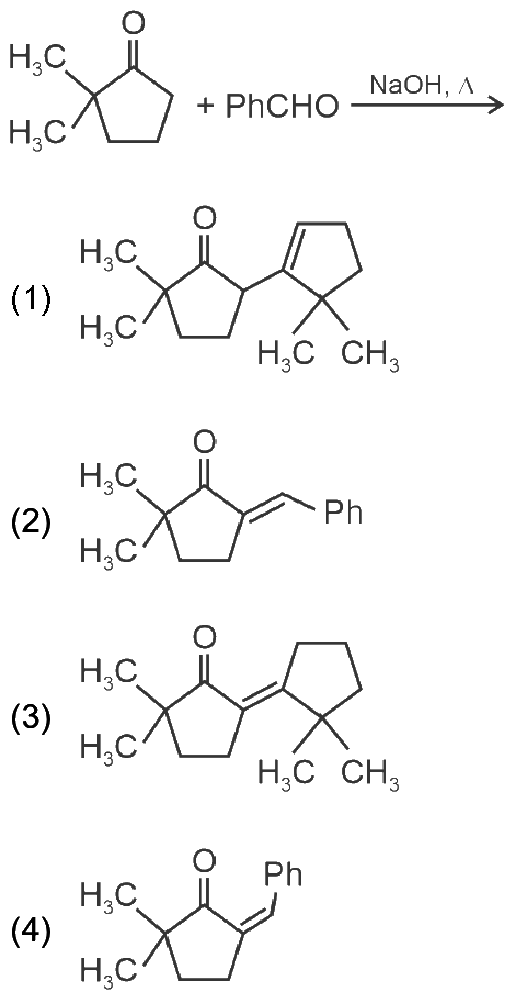
The compound that CANNOT be obtained from the aldol condensation reaction shown (2,2-dimethylcyclopentanone $+\ \ce{PhCHO} \xrightarrow{\text{NaOH},\,\Delta}$) is:
Statement-I: Oxidation of p-nitrotoluene with acidic $\ce{KMnO4}$ gives an acid that is stronger than benzoic acid. Statement-II: Reduction of p-nitrotoluene with Sn/HCl followed by neutralization gives an amine that is more basic than aniline. Choose the most appropriate answer:
Compound $P$ (\ce{C8H8O}) gives a red-orange precipitate with 2,4-DNP reagent and does not reduce Fehling's reagent. On drastic oxidation with chromic acid, $P$ gives an aromatic product $Q$ that produces effervescence on treatment with aq. \ce{NaHCO3}. Compounds $P$ and $Q$ respectively are:
For the following reaction sequence, choose the correct option. Benzene $\xrightarrow{\text{(i) }\ce{CH3COCl},\ \ce{AlCl3}}\ \xrightarrow{\text{(ii) NaOCl}}\ P+Q$

Arrange the following compounds in the increasing order of polarity: A. $\ce{CH3CH2OCH2CH3}$, B. $\ce{CH3CH2OH}$, C. $\ce{CH3COCH3}$, D. $\ce{CH3COOH}$.
Want more Aldehydes, Ketones And Carboxylic Acid questions?
MedicNEET has 43,000+ NEET-style questions across Physics, Chemistry & Biology with detailed NCERT-based explanations — including the long, tricky questions that actually come in the exam.
Download MedicNEET App — Free