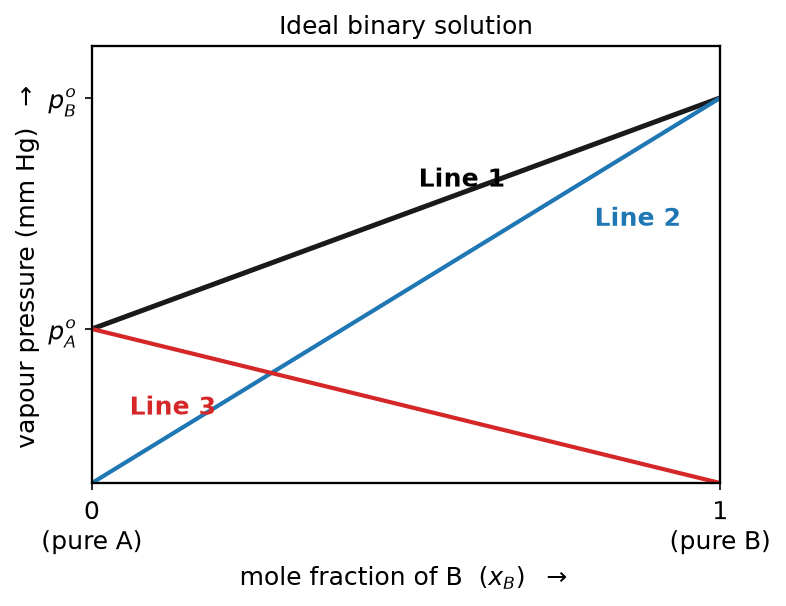
Which of the following statements about the composition of the vapour over an ideal 1 : 1 molar mixture of benzene and toluene is correct? Assume that the temperature is constant at 25 °C. (Given vapour pressure data at 25 °C, \ce{C6H6} = 12.8 kPa, \ce{C6H5CH3} = 3.85 kPa)
At 100 °C the vapour pressure of a solution of 6.5 g of a solute in 100 g water is 732 mm. If $K_b = 0.52$, the boiling point of this solution will be:
The van't Hoff factor ($i$) for a dilute aqueous solution of the strong electrolyte barium hydroxide is
Which one of the following is incorrect for an ideal solution?
If molality of the dilute solution is doubled, the value of molal depression constant ($K_f$) will be
Which of the following is dependent on temperature?
Two ways to go deeper on this chapter
Choose your next step
The mixture that forms a maximum boiling azeotrope is:
For an ideal solution, the correct option is:
Which of the following statements is correct regarding a solution of two compounds A and B exhibiting positive deviation from ideal behaviour?
In water-saturated air the mole fraction of water vapour is 0.02. If the total pressure of the saturated air is 1.2 atm, the partial pressure of dry air is:
The density of a 2 M aqueous solution of \ce{NaOH} is $1.28\ \text{g/cm}^3$. The molality of the solution is [Given that molar mass of \ce{NaOH} $= 40\ \text{g mol}^{-1}$]:
The mixture which shows positive deviation from Raoult's law is:
The freezing point depression constant ($K_f$) of benzene is 5.12 K kg mol⁻¹. The freezing point depression for the solution of molality 0.078 m containing a non-electrolyte solute in benzene is (rounded off upto two decimal places):
The following solutions were prepared by dissolving 10 g glucose (\ce{C6H12O6}) in 250 mL of water (P1), 10 g of urea (\ce{CH4N2O}) in 250 mL of water (P2) and 10 g of sucrose (\ce{C12H22O11}) in 250 mL of water (P3). The right option for the decreasing order of osmotic pressure of these solutions is:
The correct option for the value of vapour pressure of a solution at 45 °C with benzene to octane in molar ratio 3 : 2 is: [At 45 °C vapour pressure of benzene is 280 mm Hg and that of octane is 420 mm Hg. Assume ideal solution]
In a one molal solution that contains 0.5 mole of a solute, there is:
The density of a 1 M solution of a compound 'X' is $1.25\ \text{g mL}^{-1}$. The correct option for the molality of the solution is (Molar mass of compound X $= 85\ \text{g}$):
Which amongst the following aqueous solutions of electrolytes will have minimum elevation in boiling point? Choose the correct option.
Given below are two statements: one is labelled as Assertion (A) and the other is labelled as Reason (R). Assertion (A): Helium is used to dilute oxygen in diving apparatus. Reason (R): Helium has high solubility in \ce{O2}. In the light of the above statements, choose the correct answer from the options given below.
The Henry's law constant ($K_H$) values of three gases (A, B, C) in water are 145, $2 \times 10^{-5}$ and 35 kbar, respectively. The solubility of these gases in water follow the order:
The plot of osmotic pressure ($\pi$) vs concentration (mol L⁻¹) for a solution gives a straight line with slope 25.73 L bar mol⁻¹. The temperature at which the osmotic pressure measurement is done is: (Use $R = 0.083$ L bar mol⁻¹ K⁻¹)
Which of the following aqueous solution will exhibit highest boiling point?
5 moles of liquid X and 10 moles of liquid Y make a solution having a vapour pressure of 70 torr. The vapour pressures of pure X and Y are 63 torr and 78 torr respectively. Which of the following is true regarding the described solution?
Assertion A: For an ideal solution formed by mixing liquids $P$ and $Q$, $\Delta_{mix}H=0$ and $\Delta_{mix}V=0$. Reason R: No interactions occur between $P$ and $Q$. Choose the most appropriate answer:
Consider these statements about solutions formed by mixing two liquids: (A) An ideal solution obeys Raoult's law throughout the composition range. (B) A mixture of chloroform and acetone shows negative deviation from Raoult's law. (C) A mixture of aniline and phenol shows positive deviation from Raoult's law. The correct option is:
Identify the correct statements: (A) The molality of 2.5 g of ethanoic acid (Molar mass: $60\ \text{g mol}^{-1}$) in 75 g of benzene solution is 0.556 m. (B) The molarity of a solution containing 5 g of \ce{NaOH} (molar mass: $40\ \text{g mol}^{-1}$) in 450 mL of solution is 0.278 M at 298 K. (C) Aquatic species are more comfortable in cold water. (D) The solubility of a gas increases with decrease in pressure. (E) For a binary mixture of A and B, the number of moles of A and B are $n_A$ and $n_B$ respectively. The mole fraction of B will be $x_B = \frac{n_A}{n_A + n_B}$.
A mixture of chloroform and acetone forms a solution with negative deviation from Raoult's law due to:
Want more Solutions questions?
MedicNEET has 43,000+ NEET-style questions across Physics, Chemistry & Biology with detailed NCERT-based explanations — including the long, tricky questions that actually come in the exam.
Download MedicNEET App — Free