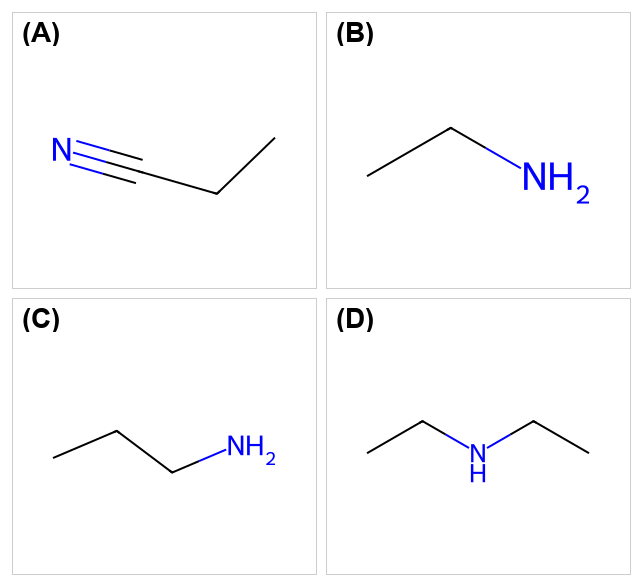
For the following reactions: (a) $\ce{CH3CH2CH2Br + KOH(alc) -> CH3CH=CH2 + KBr + H2O}$ (b) $\ce{CH3CHBrCH2CH3 + KOH(aq) -> CH3CH(OH)CH2CH3 + KBr}$ (c) $\ce{C6H10(cyclohexene) + Br2 -> }$ trans-1,2-dibromocyclohexane Which of the following statements is correct?
Which of the following can be used as the halide component for a Friedel-Crafts (alkylation) reaction?
Which of the following compounds shall NOT produce propene by reaction with $\ce{HBr}$ followed by elimination, or by direct elimination only?
Identify A and predict the type of reaction: 2-bromoanisole (an aryl bromide bearing an $\ce{-OCH3}$ group ortho to $\ce{Br}$) $\ce{->[NaNH2]}$ A
The compound A on treatment with $\ce{Na}$ gives B, and with $\ce{PCl5}$ gives C. B and C react together to give diethyl ether. A, B and C, in order, are:
The compound $\ce{C7H8}$ undergoes the following reactions: $\ce{C7H8 ->[Cl2] A ->[Br2/Fe] B ->[Zn/HCl] C}$ The product C is:
Two ways to go deeper on this chapter
Choose your next step
Hydrocarbon A reacts with bromine by substitution to form an alkyl bromide, which by the Wurtz reaction is converted to a gaseous hydrocarbon containing less than four carbon atoms. A is:
Among the following, the reaction that proceeds through an electrophilic substitution is:
An alkene A on reaction with $\ce{O3}$ then $\ce{Zn/H2O}$ gives propanone and ethanal in equimolar ratio. Addition of $\ce{HCl}$ to alkene A gives B as the major product. The structure of B is:
The hydrolysis reaction (with aq. NaOH) that takes place at the slowest rate, among the following, is :
Reaction between acetone and methylmagnesium chloride, followed by hydrolysis, will give:
The elimination reaction of 2-bromopentane to form pent-2-ene is: (a) a $\beta$-elimination reaction (b) follows Zaitsev (Saytzeff) rule (c) a dehydrohalogenation reaction (d) a dehydration reaction The correct set of statements is:
What is the change in oxidation number of carbon in the following reaction? $\ce{CH4(g) + 4Cl2(g) -> CCl4(l) + 4HCl(g)}$
Which of the following alkanes cannot be made in good yield by the Wurtz reaction?
The major product of the following reaction is: \ce{(CH3)2CH-CH=CH2 + HBr ->[(C6H5CO)2O2] ?}
The major product formed in the dehydrohalogenation of 2-bromopentane is pent-2-ene. This product formation is based on:
In the reaction \ce{RMgX + CO2 ->[\text{dry ether}] Y ->[H3O+] RCOOH}, the intermediate Y is:
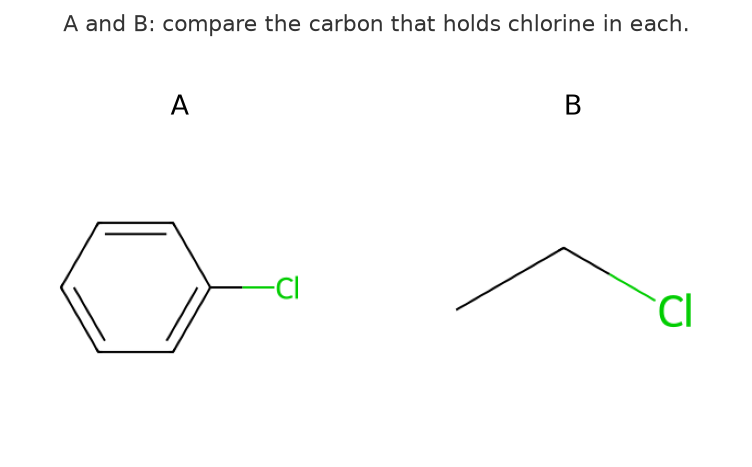
Which of the following sequence of reagents is suitable to synthesize chlorobenzene from the starting material shown?
The incorrect statement regarding chirality is:
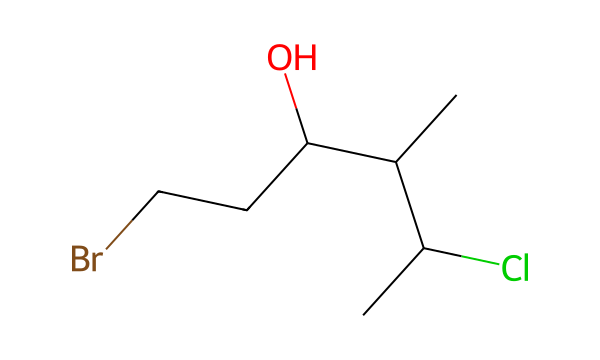
The correct IUPAC name of the compound shown (a six-carbon chain bearing \ce{Br} at C1, \ce{OH} at C3, a \ce{CH3} branch at C4, and \ce{Cl} at C5) is:
Identify the final product [D] in the following sequence: \ce{CH3CHO ->[(i) LiAlH4][(ii) H3O+] [A] ->[H2SO4,\ \Delta] [B] ->[HBr] [C] ->[C6H5Br,\ Na/\text{dry ether}] [D]}
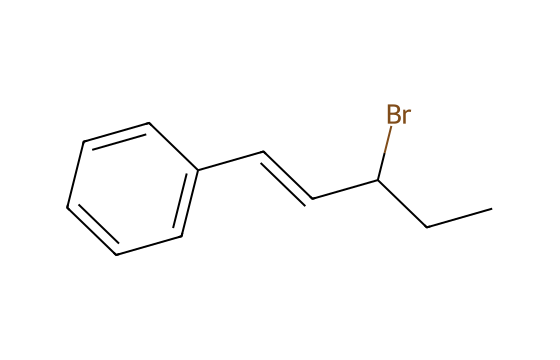
The compound shown — \ce{C6H5-CH=CH-CH(Br)-CH2-CH3} (a benzene ring with a \ce{-CH=CH-} unit, then an sp$^3$ carbon bearing \ce{Br} adjacent to the \ce{C=C}) — is an example of a:
Identify the final product in the following sequence: \ce{C6H5N2^+ Cl^- ->[CuBr/HBr] (i) ->[Mg/\text{dry ether}] (ii) ->[H2O] Product}
Identify the product (P) in the following reaction: \ce{(CH3)2CH-CH(OH)-CH3 + HBr -> P} (the alcohol is 3-methylbutan-2-ol)
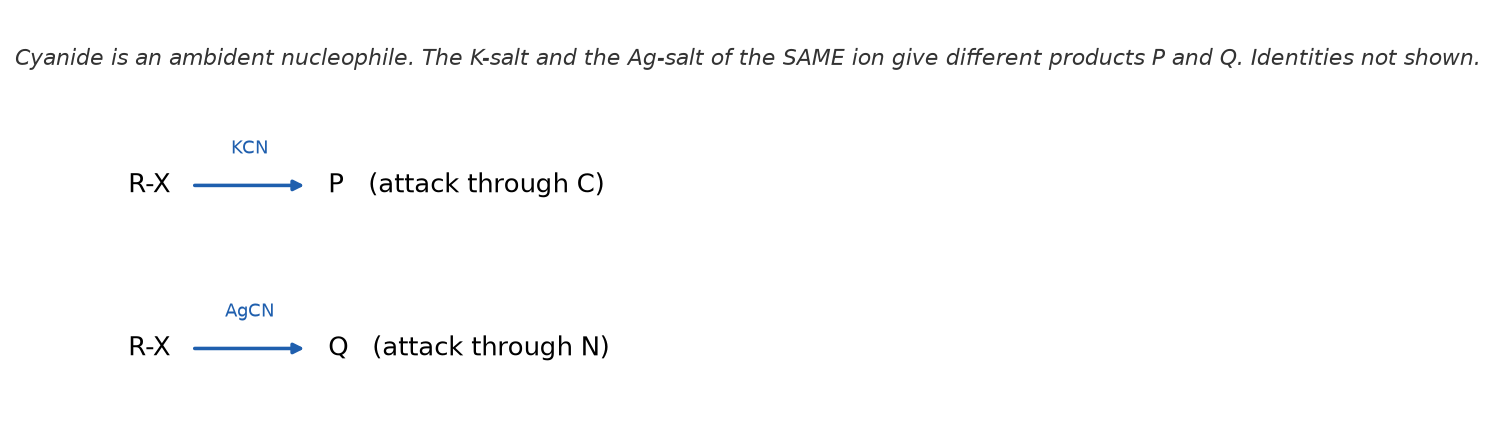
Which of the following reactions of alkyl halides produces an isocyanide (isonitrile) as the major product? (P) \ce{R-X + HCN ->} (Q) \ce{R-X + AgCN ->} (R) \ce{R-X + KCN ->} (S) \ce{R-X + NaCN ->[H2O/C2H5OH]} Choose the most appropriate answer.
The correct order for the rate of $\alpha,\beta$-dehydrohalogenation of the following compounds is: (i) \ce{CH3CH2CH2CH2I} (1-iodobutane, 1$^\circ$) (ii) \ce{CH3CH2CHI-CH3} (2-iodobutane, 2$^\circ$) (iii) \ce{(CH3)3C-I} (2-iodo-2-methylpropane, 3$^\circ$)
Choose the correct sequence of reagents for the conversion of 4-nitrotoluene to 2-bromotoluene.
Identify $X$ in the following reaction. $\ce{p\text{-}Br\text{-}C6H4\text{-}Cl}$ (1.0 mol) $\ce{->[\text{Mg (1.0 mol)}][\text{dry ether}]}$ Intermediate $\ce{->[D2O]}$ $X$
Identify the product in the following reaction. Chlorocyclobutane $\ce{->[\text{(i) KCN}]}$ $\ce{->[\text{(ii) H2O/HCl, }\Delta]}$ $\ce{->[\text{(iii) Br2/red P}]}$ $\ce{->[\text{(iv) H2O}]}$ Product
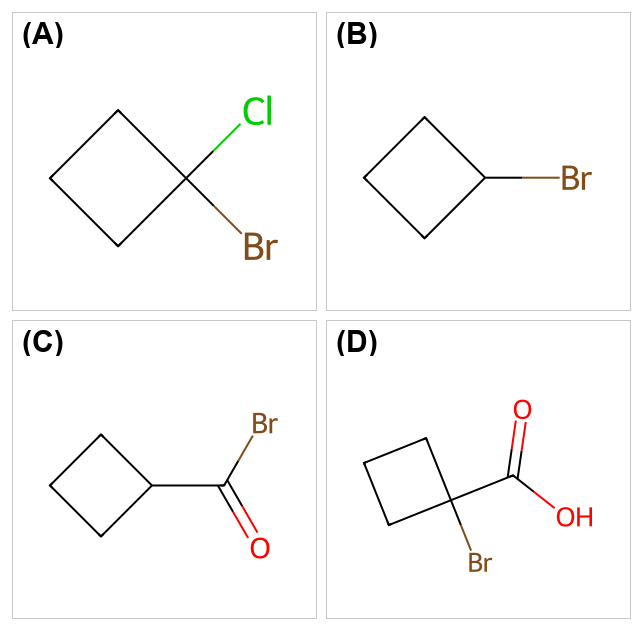
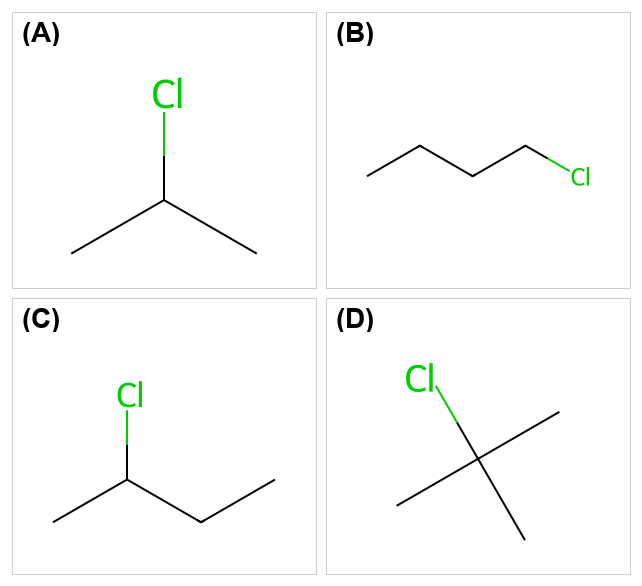
The compound that will undergo $\ce{S_N1}$ reaction with the fastest rate is
The products $A$ and $B$ obtained in the following reactions, respectively are $\ce{3 ROH + PCl3 -> 3 RCl + }A$ $\ce{ROH + PCl5 -> RCl + HCl + }B$
Identify the major product $C$ formed in the following reaction sequence: $\ce{CH3CH2CH2I ->[NaCN]}$ $A$ $\ce{->[\text{partial hydrolysis}][OH^-]}$ $B$ $\ce{->[NaOH + Br2]}$ $C$ (major)
Major products $A$ and $B$ formed in the following reaction sequence are: 2-methylcyclohexan-1-ol $\ce{->[PBr3]}$ $A$ (major) $\ce{->[\text{alc. KOH}][\Delta]}$ $B$ (major)
Given below are two statements: one labelled Assertion (A) and the other Reason (R). Assertion (A): $\ce{CH3CH2CH2I}$ (n-propyl iodide) undergoes $\ce{S_N2}$ reaction faster than $\ce{CH3CH2CH2Cl}$ (n-propyl chloride). Reason (R): Iodine is a better leaving group because of its large size. In the light of the above statements, choose the correct answer from the options given below.
Given below are two statements: Statement I: Benzenediazonium salt is prepared by the reaction of aniline with acid at 273-278 K. It decomposes easily in the dry state. Statement II: Insertion of iodine into the benzene ring is difficult and hence iodobenzene is prepared through the reaction of benzenediazonium salt with KI. In the light of the above statements, choose the most appropriate answer from the options given below:
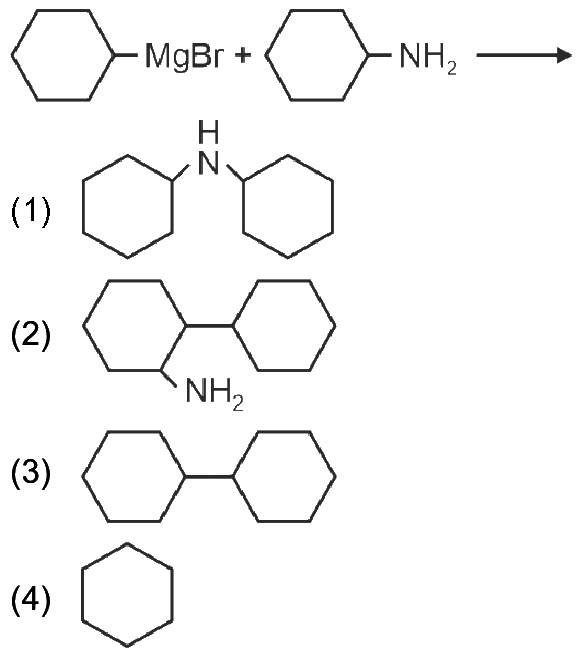
One of the products formed in the following reaction is: cyclohexyl–$\ce{MgBr}$ + cyclohexyl–$\ce{NH2}\rightarrow$
The following two reactions give the same foul-smelling product $Z$. Reaction 1: $\ce{C2H5Cl + }X \ce{-> }Z$ Reaction 2: $\ce{C2H5CONH2 ->[Br2,\ NaOH]}$ $Y$ $\ce{->[\text{CHCl3 / ethanolic KOH}][\Delta]}$ $Z$ $X$ and $Z$, respectively, are :
In the following reaction sequence, $X$ and $Z$ respectively are : $\ce{CH3CH2CH2OH + PCl3 -> CH3CH2CH2Cl + }X \ce{ + HCl}$ $\ce{CH3CH2CH2Cl ->[\text{alc. KOH}][\Delta]}$ $Y$ $Y \ce{->[HBr][\text{peroxide}]}$ $Z$
The major product $Z$ formed in the following sequence of reactions is $\ce{C2H6 ->[Cl2][\text{UV}]}$ $X$ $\ce{->[NH3]}$ $Y$ $\ce{->[\text{(i) NaNO2/HCl}][\text{(ii) H2O}]}$ $Z$
The number of chlorine atoms present in the organic products $X$ and $Y$ of the following reactions, respectively, are : $\ce{C6H6 + 6 Cl2 ->[\text{anhyd. AlCl3}][\text{dark, cold}]}$ $X$ $\ce{C6H6 + 3 Cl2 ->[\text{UV}][\text{500 K}]}$ $Y$
Want more Haloalkanes And Haloarenes questions?
MedicNEET has 43,000+ NEET-style questions across Physics, Chemistry & Biology with detailed NCERT-based explanations — including the long, tricky questions that actually come in the exam.
Download MedicNEET App — Free