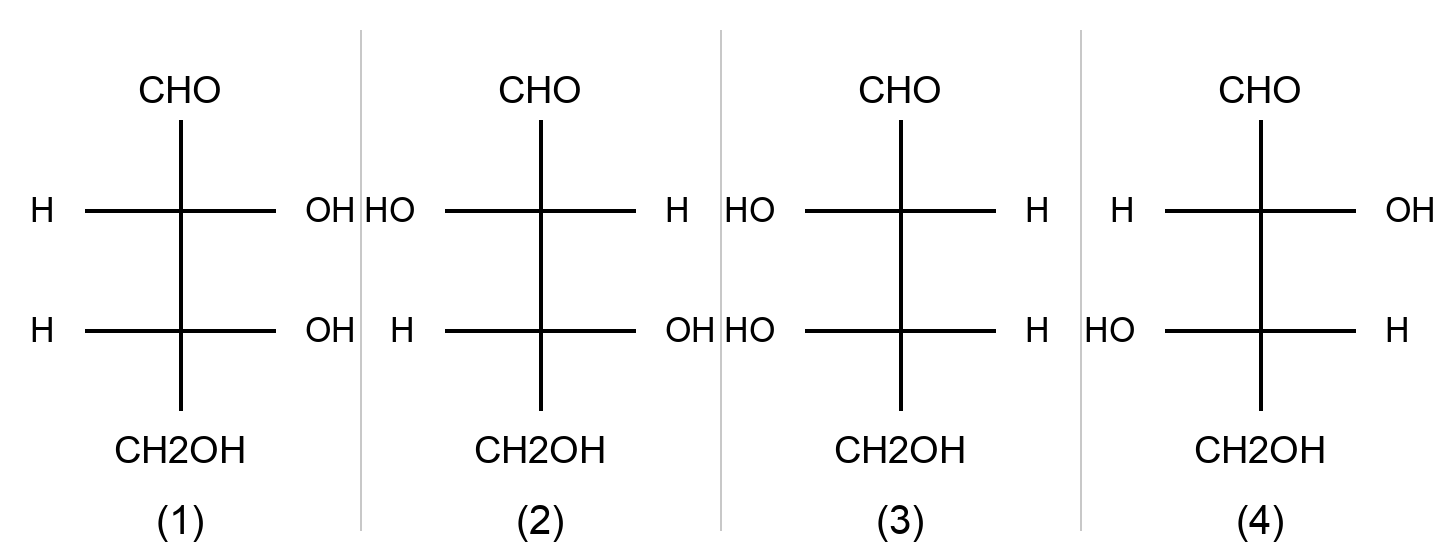
Which of the following compounds can form a zwitterion?
Q9
NEET 2018Polysaccharides
The difference between amylose and amylopectin is:
Q10
NEET 2019Enzymes
Enzymes that utilize ATP in phosphate transfer require an alkaline earth metal (M) as the cofactor. M is:
Q11
NEET 2019Amino acids
The non-essential amino acid among the following is:
Q12
NEET 2019 OdishaProtein structure
Which structure(s) of proteins remain(s) intact during the denaturation process?
Q13
NEET 2020Amino acids
Which of the following is a basic amino acid?
Q14
NEET 2020Carbohydrates
Sucrose on hydrolysis gives:
Q15
NEET 2021Vitamins
Deficiency of red blood cells (pernicious anaemia) is the deficiency disease of
Q16
NEET 2022Enzymes
The incorrect statement regarding enzymes is:
Q17
NEET 2023 Phase 1Nucleic acids
Given below are two statements:
Statement I: A unit formed by the attachment of a base to the 1' position of sugar is known as a nucleoside.
Statement II: When a nucleoside is linked to phosphorous acid at the 5'-position of the sugar moiety, we get a nucleotide.
In the light of the above statements, choose the correct answer from the options given below:
Q18
NEET 2023 Phase 2Vitamins
Cheilosis occurs due to deficiency of _________.
Q19
NEET 2024
Fehling's solution 'A' is
Q20
NEET 2024Glucose structure
The reagents with which glucose does NOT react to give the corresponding test/product are:
A. Tollen's reagent
B. Schiff's reagent
C. \ce{HCN}
D. \ce{NH2OH}
E. \ce{NaHSO3}
Choose the correct option from those given below:
Q21
NEET 2025Glucose structure
Sugar 'X':
A. is found in honey
B. is a keto sugar
C. exists in α and β anomeric forms
D. is laevorotatory
'X' is
Q22
NEET 2025Vitamins
Match List I with List II.
List I (Name of Vitamin)
A. Vitamin B12
B. Vitamin D
C. Vitamin B2
D. Vitamin B6
List II (Deficiency disease)
I. Cheilosis
II. Convulsions
III. Rickets
IV. Pernicious anaemia
Choose the correct answer from the options given below:
Q23
ReNEET 2026Vitamins
Match the vitamins in List-I with their sources in List-II. List-I: A. vitamin A, B. vitamin $\ce{B12}$, C. vitamin E, D. vitamin K. List-II: I. meat, II. sunflower oil, III. green leafy vegetables, IV. carrots.
Q24
NEET 2026 (1)Nucleic acids
The correct statement with regard to the secondary structure of DNA/RNA is
Q25
ReNEET 2026
The amino acid that gives a red-blood colour on treating its sodium fusion extract with sodium nitroprusside is:
Q26
ReNEET 2026Protein structure
The correct statement about peptides and proteins is:
Want more Biomolecules questions?
MedicNEET has 43,000+ NEET-style questions across Physics, Chemistry & Biology with detailed NCERT-based explanations — including the long, tricky questions that actually come in the exam.
Beyond the PYQs above — every Chemistry question format NEET now uses, starting with the newest ReNEET 2026-style reasoning MCQs. Tap an option for the answer and a worked solution. Free, no login.
The newest, most exam-current chemistry format — reasoning-based questions modelled on ReNEET 2026. Practise where NEET is heading before the exam does.
Q1. On complete hydrolysis, each of these gives a different number of monosaccharide units. Arrange glucose, maltose and starch in increasing order of the number of monosaccharide units produced.
Q2. Read these four statements about the open-chain structure of glucose and the tests that support it.
(i) Formation of a penta-acetate shows that glucose has five −OH groups.
(ii) Formation of an oxime (with NHX2OH) shows that glucose has a −CHO group.
(iii) Mild oxidation with bromine water gives gluconic acid, a six-carbon acid.
(iv) Heating with HI and red phosphorus gives n-hexane, showing a straight chain of six carbons.
How many of these statements are correct?
Q3. Match each hormone in List-I with its chemical class in List-II.
List-I
A. Insulin
B. Adrenaline
C. Testosterone
List-II
1. Steroid
2. Polypeptide
3. Amino-acid-derived
Q4. Read the statements about the zwitterion form of an amino acid given below.
1. The zwitterion is neutral overall.
2. In strong acid it changes into a cation.
3. In strong base it changes into an anion.
4. It can react with both acids and bases (amphoteric).
How many statements are correct?
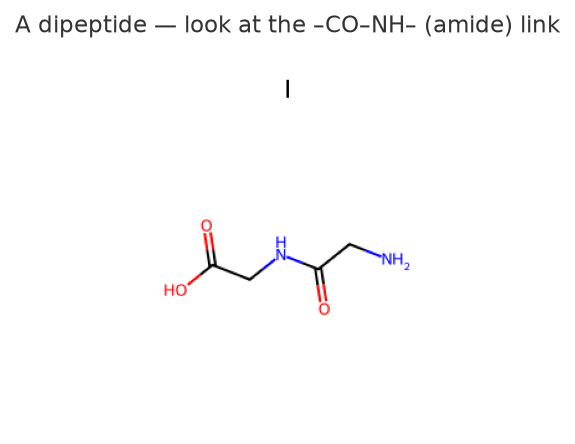
Q5. Read the assertion and reason about the peptide bond shown in the dipeptide (I).
A: The peptide bond is planar and has partial double-bond character.
R: Resonance spreads the C=O pi electrons over the C−N bond.
Q6. Read the assertion and reason about denaturation.
A: Boiling an egg destroys the protein's biological activity and cannot be reversed.
R: Denaturation breaks the hydrogen bonds and disulfide links of the secondary and tertiary structure, while the peptide-bonded primary sequence stays intact.
Q7. Read the statements about vitamin solubility given below.
1. Vitamins A, D, E and K are fat-soluble.
2. Vitamin C is fat-soluble.
3. The B group of vitamins is water-soluble.
4. Fat-soluble vitamins are stored in the liver.
How many statements are correct?
Q8. Match each component in List-I with the nucleic acid it belongs to in List-II.
List-I
A. Deoxyribose
B. Ribose
C. Thymine
D. Uracil
List-II
1. DNA
2. RNA
Q9. Assertion (A): Sucrose is a non-reducing sugar.
Reason (R): In sucrose the reducing groups of the two monosaccharides — the aldehydic group of glucose and the ketonic group of fructose — are involved in glycosidic bond formation.
Choose the correct option.
Q10. Match each vitamin in List-I with its source in List-II (as given in NCERT).
List-I: A. Vitamin A B. Vitamin C C. Vitamin D
List-II: 1. Citrus fruits, amla and green leafy vegetables 2. Exposure to sunlight, fish and egg yolk 3. Fish liver oil, carrots, butter and milk
You’ve practised 10 of 66 Biomolecules questions in this set.
🧩 Biomolecules — Biomolecules Questions — All Formats
Every format NEET uses — assertion-reason, statement, match-the-column and standard MCQs — each with an instant explanation.
Q1. On complete hydrolysis, each of these gives a different number of monosaccharide units. Arrange glucose, maltose and starch in increasing order of the number of monosaccharide units produced.
Q2. Match each protein structure level in List-I with the interaction that mainly holds it in List-II.
List-I
A. Primary
B. Secondary
C. Tertiary
D. Quaternary
List-II
1. Joining of separate polypeptide subunits
2. Peptide (covalent) bonds
3. Intra-chain hydrogen bonds
4. H-bonds, ionic, disulfide, hydrophobic and van der Waals forces
Q3. Consider these statements about starch:
(i) Starch is the main storage polysaccharide of plants.
(ii) Starch is a polymer of α-glucose.
(iii) Amylose is water-soluble while amylopectin is insoluble in water.
(iv) In amylopectin the branching occurs by a C1–C4 glycosidic linkage.
How many statements are correct?
Q4. Glucose adds one molecule of hydrogen cyanide (HCN) to form a cyanohydrin. This reaction provides evidence for the presence of which functional group in the open-chain structure of glucose?
Q5. A solution of a neutral amino acid is initially strongly acidic (pH well below its isoelectric point). As NaOH is added gradually until the pH rises past the isoelectric point and becomes basic, the predominant form of the amino acid changes in the order:
Q6. In the presence of the enzyme invertase, sucrose is converted into
Q7. Which hormone tends to increase the level of glucose in the blood?
Q8. In its cyclic (ring) form, fructose exists as a
Q9. In a strongly acidic solution (low pH), the predominant form of an amino acid is:
Q10. Hormones are best described as:
You’ve practised 10 of 285 Biomolecules questions in this set.
Biomolecules is a Class 12 NEET Chemistry chapter consistently tested from 2016 to ReNEET 2026. This page has all 26 authentic previous year questions from real NEET papers — with answers and detailed solutions, not model questions.
For full chapter-wise practice in timed test mode, download the MedicNEET app — 43,000+ questions across the full NEET syllabus. Back to the NEET Chemistry PYQ index.
All NEET Chemistry PYQ Chapters
Every NEET Chemistry previous-year question (2016–2026), chapter-wise — free, no login.