The reaction \ce{R-ONa + R'-X -> R-O-R' + NaX} can be classified as:
Which one is the most acidic compound?
The most suitable method of separation of a $1:1$ mixture of ortho- and para-nitrophenols is
The heating of phenyl-methyl ether (anisole) with \ce{HI} produces
Identify the major products P, Q and R in the following sequence of reactions: \ce{C6H6 + CH3CH2CH2Cl ->[\text{anhyd. } AlCl3] P} \ce{P ->[(i) O2][(ii) H3O+/\Delta] Q + R}
The compound A on treatment with \ce{Na} gives B, and with \ce{PCl5} gives C. B and C react together to give diethyl ether. A, B and C are, in order,
Two ways to go deeper on this chapter
Choose your next step
In the reaction \ce{C6H5OH + CHCl3 + NaOH -> salicylaldehyde} the electrophile involved is
Compound A, \ce{C8H10O}, reacts with \ce{NaOI} (produced by reacting Y with \ce{NaOH}) to yield a yellow precipitate with a characteristic smell. A and Y are respectively
The structure of intermediate A in the following reaction is: \ce{C6H5CH(CH3)2 + O2 -> A} \ce{A ->[H+/H2O] C6H5OH + CH3COCH3}
The reaction that does not give benzoic acid as the major product is:
When the vapours of a secondary alcohol are passed over heated copper at $573\,$K, the product formed is:
The major products C and D formed in the following reaction respectively are: \ce{H3C-CH2-CH2-O-C(CH3)3 + excess\ HI -> C + D}
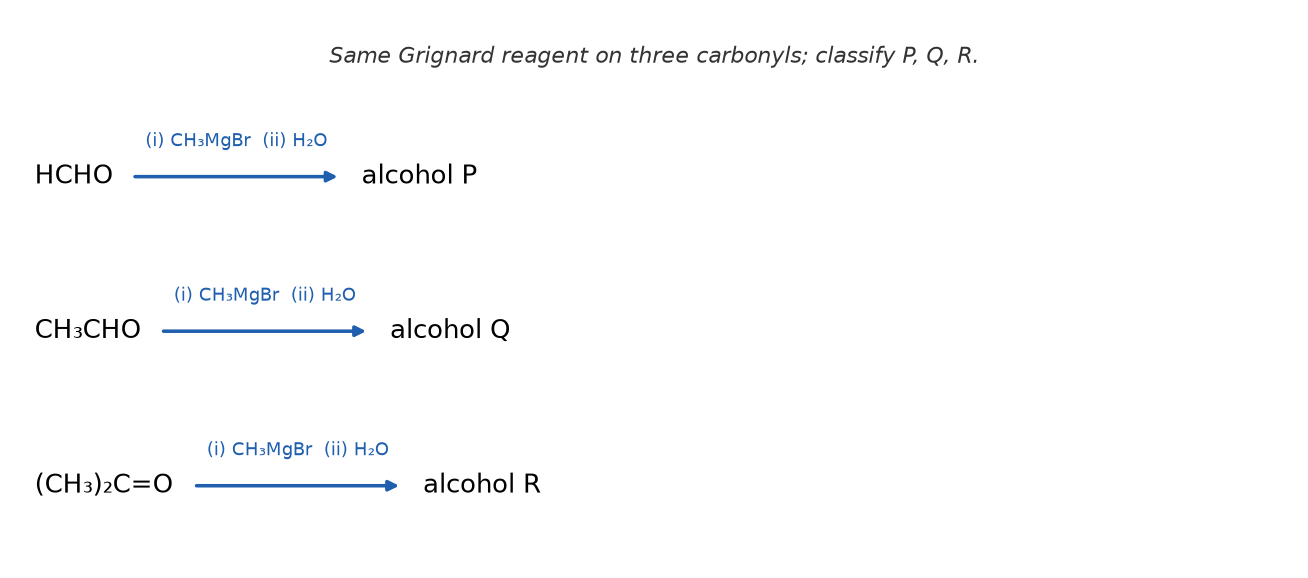
Reaction between acetone and methylmagnesium chloride followed by hydrolysis will give
Anisole on cleavage with \ce{HI} gives
The compound which shows metamerism is
What is the IUPAC name of the organic compound formed in the following chemical reaction? \ce{CH3COCH3 ->[\text{(i) } C2H5MgBr,\ \text{dry ether}][\text{(ii) } H2O,\ H+] Product}
Statement I: The acidic strength of monosubstituted nitrophenol is higher than phenol because of the electron withdrawing nitro group. Statement II: o-nitrophenol, m-nitrophenol and p-nitrophenol will have the same acidic strength as they have one nitro group attached to the phenolic ring. Choose the most appropriate answer from the options given below:
Given below are two statements: Statement I: In the Lucas test, primary, secondary and tertiary alcohols are distinguished on the basis of their reactivity with conc. \ce{HCl} + \ce{ZnCl2}, known as Lucas reagent. Statement II: Primary alcohols are most reactive and immediately produce turbidity at room temperature on reaction with Lucas reagent. In the light of the above statements, choose the most appropriate answer from the options given below:
Consider the following reaction and identify the major product (P): \ce{CH3-CH(CH3)-CH(OH)-CH3 ->[HBr] P} (3-methylbutan-2-ol)
Which amongst the following would be most readily dehydrated under acidic conditions?
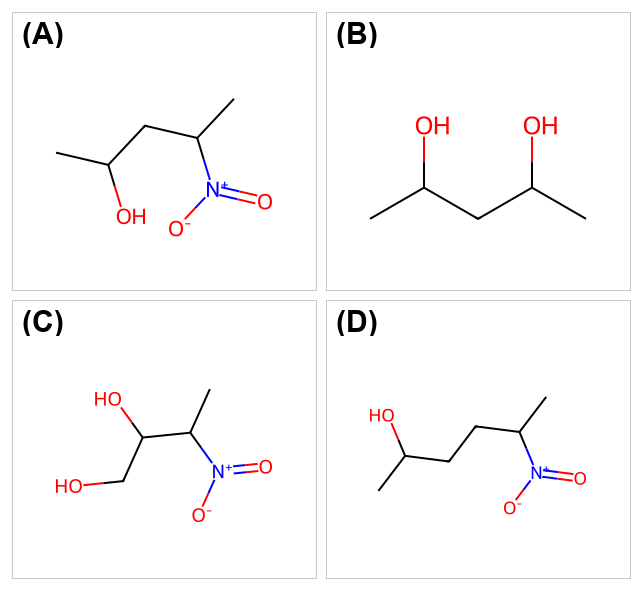
Consider the following reaction and identify the products A and B: \ce{C6H5-CH2-O-C6H5 ->[HI][\Delta] A + B} (benzyl phenyl ether)
The major product formed in the following conversion is: Substrate: 2-(2-oxopropyl)cyclopentan-1-one (a cyclopentanone ring bearing a \ce{-CH2-CO-CH3} side chain at C-2). Reagents: (i) \ce{NaBH4}; (ii) \ce{H2SO4}, $\Delta$.
Reagents which can be used to convert alcohols to carboxylic acids are: (A) \ce{CrO3 - H2SO4} (B) \ce{K2Cr2O7 + H2SO4} (C) \ce{KMnO4 + KOH/H3O+} (D) \ce{Cu, 573 K} (E) \ce{CrO3, (CH3CO)2O} Choose the most appropriate answer from the options given below.
Identify 'X' in the following reactions: \ce{R-COOH ->[\text{(i) X}][\text{(ii) } H2O/HCl] R-CH2OH} \ce{R-CH=CH2 ->[\text{(i) X}][\text{(ii) } H2O,\ NaOH,\ H2O2] R-CH2-CH2-OH}
Identify the correct reagents that would bring about the following transformation (an alkene converted, via the anti-Markovnikov primary alcohol, to an aldehyde):
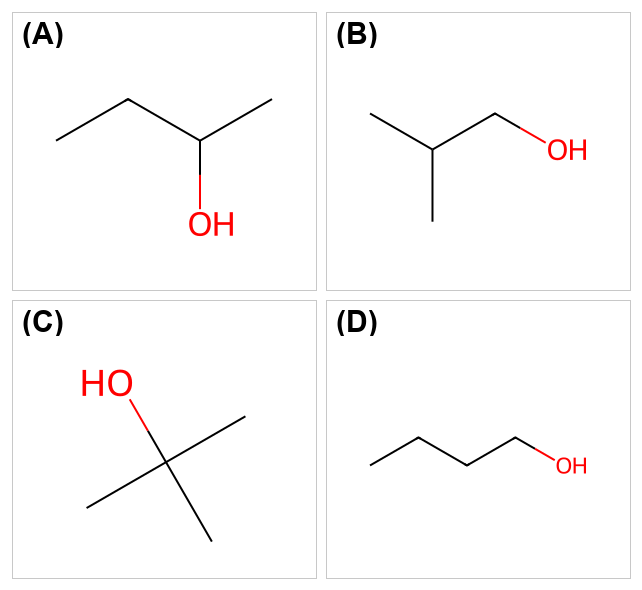
Which one of the following alcohols reacts instantaneously with Lucas reagent?
The products A and B obtained in the following reactions, respectively, are: \ce{3 ROH + PCl3 -> 3 RCl + A} \ce{ROH + PCl5 -> RCl + HCl + B}
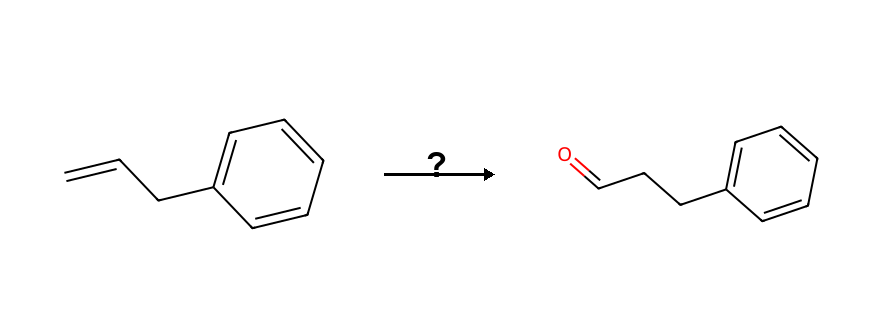
Identify the correct reagents that would bring about the following transformation: \ce{C6H5-CH2-CH=CH2 -> C6H5-CH2-CH2-CHO} (allylbenzene is converted to 3-phenylpropanal)
The total number of possible isomers (both structural as well as stereoisomers) of cyclic ethers of molecular formula \ce{C4H8O} is:
The pair of molecules that are metamers among the following is:
Match List-I (organic transformation) with List-II (reagents) and choose the correct option. List-I A. \ce{C6H6 -> C6H5OH} (benzene to phenol) B. \ce{CH3COOH -> CH3CH2OH} C. \ce{CH3CH2CH2OH -> CH3CH=CH2} D. \ce{C6H5CH(CH3)2 -> C6H5OH} (cumene to phenol) List-II (I) (i) Oleum; (ii) \ce{NaOH}, heat; (iii) \ce{H+} (II) (i) \ce{O2}; (ii) \ce{H2O}/\ce{H+} (III) (i) \ce{CH3OH}, \ce{H+}; (ii) \ce{H2}, catalyst (IV) (i) conc. \ce{H2SO4}, heat; (ii) \ce{H+}/\ce{H2O}
The functional group that can be identified through the phthalein dye test is:
In the following reaction, two products X and Y are formed: \ce{C6H5OH ->[\text{conc. } HNO3][\text{conc. } H2SO4] X + Y} where X and Y are $o$-nitrophenol and $p$-nitrophenol. The suitable method that can be used for the separation of products X and Y is:
Want more Alcohols, Phenols And Ethers questions?
MedicNEET has 43,000+ NEET-style questions across Physics, Chemistry & Biology with detailed NCERT-based explanations — including the long, tricky questions that actually come in the exam.
Download MedicNEET App — Free