The rate of a first-order reaction is $0.04\ \text{mol L}^{-1}\text{ s}^{-1}$ at $10$ s and $0.03\ \text{mol L}^{-1}\text{ s}^{-1}$ at $20$ s after initiation of the reaction. The half-life period of the reaction is:
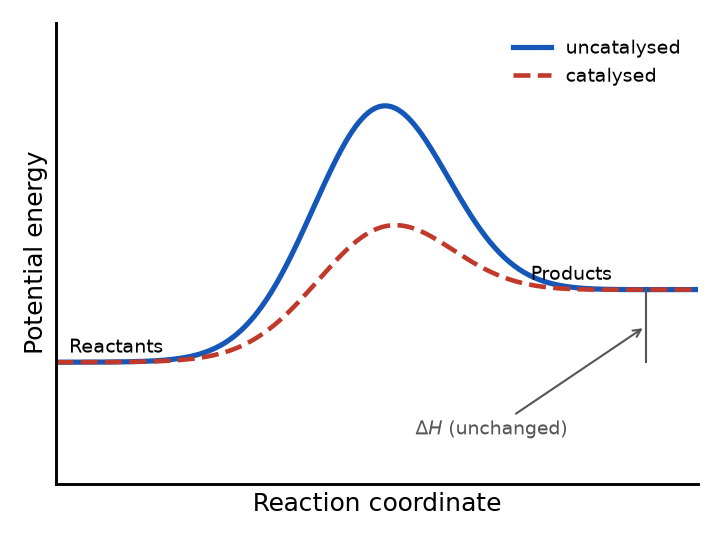
The addition of a catalyst during a chemical reaction alters which of the following quantities?
The decomposition of phosphine \ce{PH3} on tungsten at low pressure is a first-order reaction. It is because the
Which one of the following statements is \textbf{not} correct?
A first order reaction has a specific reaction rate of $10^{-2}\ \text{s}^{-1}$. How much time will it take for $20\ \text{g}$ of the reactant to reduce to $5\ \text{g}$?
Mechanism of a hypothetical reaction \ce{X2 + Y2 -> 2XY} is given below: (i) \ce{X2 <=> X + X} (fast) (ii) \ce{X + Y2 <=> XY + Y} (slow) (iii) \ce{X + Y -> XY} (fast) The overall order of the reaction will be
Two ways to go deeper on this chapter
Choose your next step
Which one of the following statements correctly describes the difference between a first-order and a second-order reaction?
When the initial concentration of the reactant is doubled, the half-life period of a zero order reaction
If the rate constant for a first order reaction is $k$, the time $t$ required for the completion of 99% of the reaction is given by:
For the chemical reaction \ce{N2(g) + 3H2(g) <=> 2NH3(g)} the correct option is:
A first order reaction has a rate constant of $2.303\times10^{-3}\ \text{s}^{-1}$. The time required for $40\ \text{g}$ of this reactant to reduce to $10\ \text{g}$ will be (Given $\log_{10} 2 = 0.3010$):
For a reaction, the activation energy $E_a = 0$ and the rate constant at $200$ K is $1.6\times 10^{6}\ \text{s}^{-1}$. The rate constant at $400$ K will be (Given $R = 8.314\ \text{J K}^{-1}\text{mol}^{-1}$):
The rate constant for a first order reaction is $4.606\times10^{-3}\ \text{s}^{-1}$. The time required to reduce $2.0\ \text{g}$ of the reactant to $0.2\ \text{g}$ is:
An increase in the concentration of the reactants of a reaction leads to change in:
The slope of the Arrhenius plot ($\ln k$ vs $1/T$) of a first-order reaction is $-5\times 10^{3}$ K. The value of $E_a$ of the reaction is (Given $R = 8.314\ \text{J K}^{-1}\text{mol}^{-1}$):
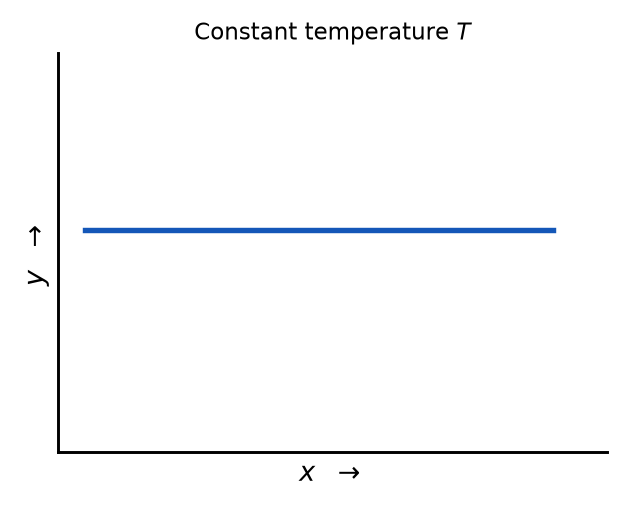
The given graph (drawn at constant temperature $T$) is a representation of the kinetics of a reaction. The plot of $y$ versus $x$ is a horizontal straight line parallel to the $x$-axis, i.e. $y$ is constant and independent of $x$. The $y$ and $x$ axes for zero order and first order reactions, respectively, are:
For a first order reaction \ce{A -> Products}, initial concentration of \ce{A} is $0.1\ \text{M}$, which becomes $0.001\ \text{M}$ after 5 minutes. Rate constant for the reaction in $\text{min}^{-1}$ is:
Given below are two statements: one is labelled as Assertion A and the other is labelled as Reason R. \textbf{Assertion A:} A reaction can have zero activation energy. \textbf{Reason R:} The minimum extra amount of energy absorbed by reactant molecules so that their energy becomes equal to the threshold value is called activation energy. In the light of the above statements, choose the correct answer from the options given below:
For a certain reaction, the rate $=k[A]^2[B]$. When the initial concentration of $A$ is tripled keeping the concentration of $B$ constant, the initial rate would
The correct option for the rate law that corresponds to an overall first order reaction is
For a reaction \ce{3A -> 2B}, the average rate of appearance of B is given by $\frac{\Delta[\ce{B}]}{\Delta t}$. The correct relation between the average rate of appearance of B and the average rate of disappearance of A is:
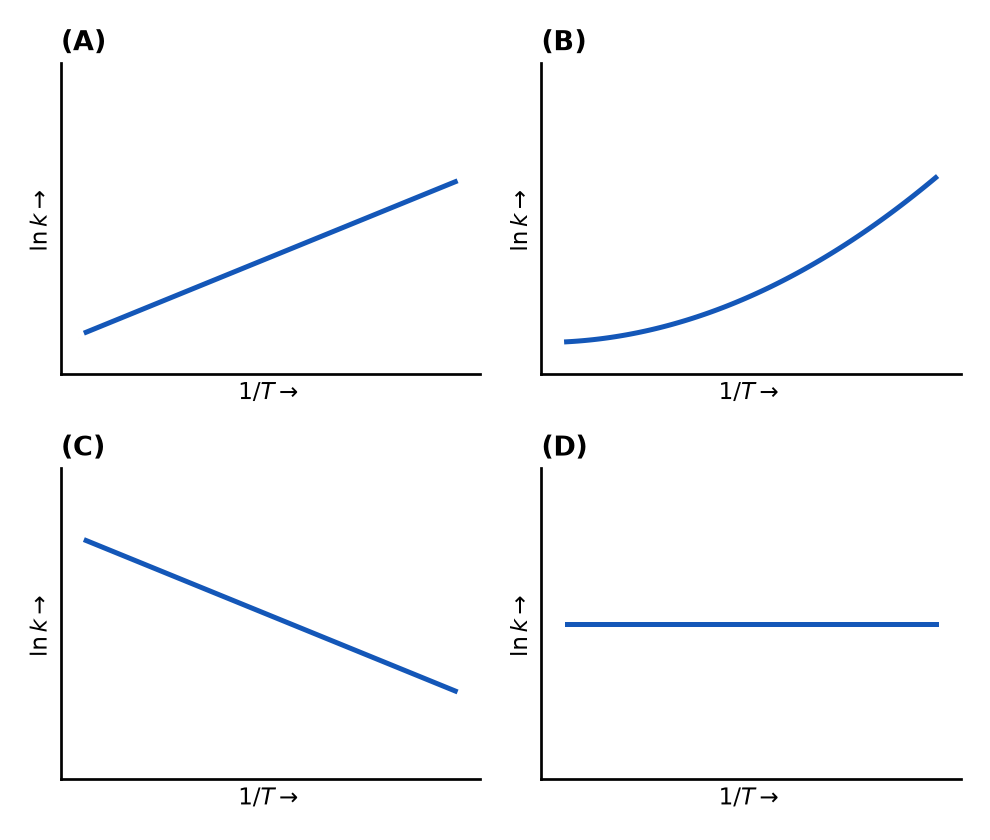
Which of the following plots of $\ln k$ versus $\frac{1}{T}$ is consistent with the Arrhenius equation?
Activation energy of any chemical reaction can be calculated if one knows the value of
If the rate constant of a reaction is $0.03\ \text{s}^{-1}$, how much time does it take for $7.2\ \text{mol L}^{-1}$ concentration of the reactant to get reduced to $0.9\ \text{mol L}^{-1}$? (Given: $\log 2 = 0.301$)
If the half-life $t_{1/2}$ for a first order reaction is $1$ minute, then the time required for $99.9\%$ completion of the reaction is closest to
$2A\xrightarrow{k}B$ is a zero-order reaction with $k=1.0\,\text{mol L}^{-1}\text{min}^{-1}$. If the initial concentration of $A$ is $2\,$M, the time taken to complete 75% of the reaction is:
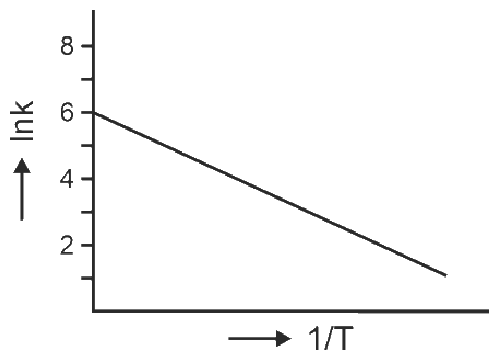
For an elementary chemical reaction, the Arrhenius plot ($\ln k$ vs $1/T$) is given. If the activation energy is $6.64\,\text{kJ mol}^{-1}$ and $R=8.3\,\text{J K}^{-1}\text{mol}^{-1}$, the temperature at which the rate constant becomes $e^{2}\,\text{min}^{-1}$ is:
Match List I with List II : List-I (Order of reaction) (A) Zero order (B) First order (C) Second order (D) Third order List-II (Unit of rate constant) (I) $\text{mol}^{-1}\,\text{L}\,\text{s}^{-1}$ (II) $\text{mol}^{-2}\,\text{L}^2\,\text{s}^{-1}$ (III) $\text{s}^{-1}$ (IV) $\text{mol}\,\text{L}^{-1}\,\text{s}^{-1}$ Choose the correct answer from the options given below :
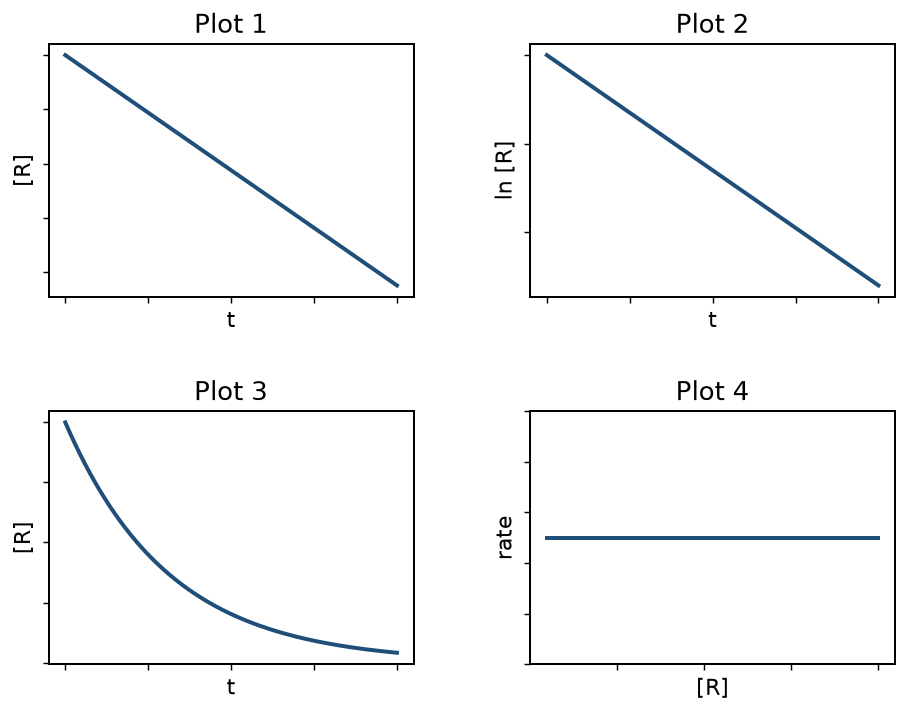
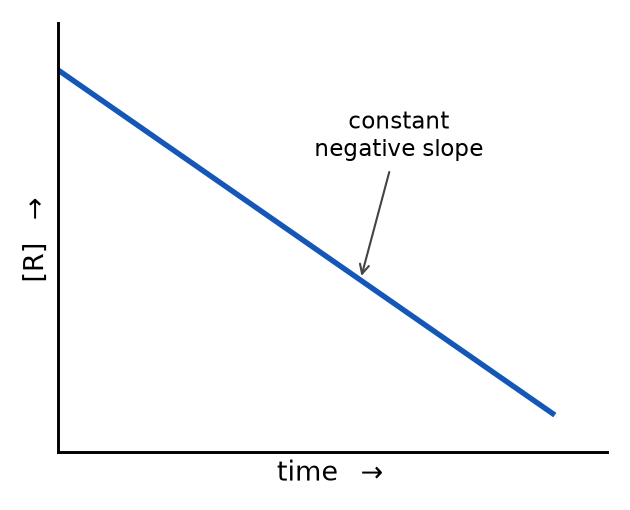
For a certain reaction \ce{R -> Product}, the plot of concentration $[R]$ versus time is a straight line with a constant negative slope, as shown in the graph. The order of the reaction is:
Given below is an expression for the rate constant of a first-order reaction occurring at a certain temperature $T$ (K): $\ln k = 14.34 - \frac{1.25\times10^{4}}{T}$ The energy of activation in $\text{kcal mol}^{-1}$ for the reaction is: (Given: $k$ in $\text{s}^{-1}$, $R=1.987\ \text{cal mol}^{-1}\,\text{K}^{-1}$)
Want more Chemical Kinetics questions?
MedicNEET has 43,000+ NEET-style questions across Physics, Chemistry & Biology with detailed NCERT-based explanations — including the long, tricky questions that actually come in the exam.
Download MedicNEET App — Free