NEET Chemistry Previous Year Questions (2016–2026) with Answers & Solutions
Class 11Chemistry54 Questions2016–2026
Year-wise Weightage (2016–2026)
Year
Questions Asked
Marks
2026
6
24
2025
2
8
2024
4
16
2023
6
24
2022
4
16
Show earlier years (2016–2021)
2021
6
24
2020
3
12
2019
9
36
2018
5
20
2017
6
24
2016
13
52
Q1
NEET 2016 Phase 1VSEPR shape
Consider the molecules \ce{CH4}, \ce{NH3} and \ce{H2O}. Which of the given statements is false?
Q2
NEET 2016 Phase 1Ionic character
Which one of the following orders is correct for the bond dissociation enthalpy of halogen molecules?
Q3
NEET 2016 Phase 1VSEPR shape
Predict the correct order among the following (repulsion between electron pairs as per VSEPR theory):
Q4
NEET 2016 Phase 1
Match the compounds in Column I with the hybridization and shape in Column II and mark the correct option.
Column I: (a) \ce{XeF6}, (b) \ce{XeO3}, (c) \ce{XeOF4}, (d) \ce{XeF4}
Column II: (i) Distorted octahedral, (ii) Square planar, (iii) Pyramidal, (iv) Square pyramidal
Q5
NEET 2016 Phase 1Hybridisation
The lone pair of electrons in the given carbanion, \ce{CH3-C#C^-}, is present in which of the following orbitals?
Q6
NEET 2016 Phase 2Ionic character
Which one of the following compounds shows the presence of intramolecular hydrogen bond?
Which of the following statements is not correct about diborane?
Q14
NEET 2017
Match the interhalogen compounds of Column I with the geometry in Column II and assign the correct code.
Column I: (a) \ce{XX'}, (b) \ce{XX'3}, (c) \ce{XX'5}, (d) \ce{XX'7}
Column II: (i) T-shape, (ii) Pentagonal bipyramidal, (iii) Linear, (iv) Square pyramidal, (v) Tetrahedral
Q15
NEET 2017Ionic character
The most suitable method of separation of a 1 : 1 mixture of ortho- and para-nitrophenols is
Q16
NEET 2017MO theory
Which one of the following pairs of species have the same bond order?
Q17
NEET 2018
Which one of the following elements is unable to form \ce{MF6^3-} ion?
Q18
NEET 2018VSEPR shape
In the structure of \ce{ClF3}, the number of lone pairs of electrons on the central atom Cl is:
Q19
NEET 2018Hybridisation
Which of the following molecules represents the order of hybridisation $sp^2$, $sp^2$, $sp$, $sp$ from left to right atoms?
Q20
NEET 2018Ionic character
Carboxylic acids have higher boiling points than aldehydes, ketones and even alcohols of comparable molecular mass. This is due to their:
Q21
NEET 2018MO theory
Consider the following species: \ce{CN^+}, \ce{CN^-}, \ce{NO} and \ce{CN}. Which of these will have the highest bond order?
Q22
NEET 2019Hybridisation
The number of sigma ($\sigma$) and pi ($\pi$) bonds in pent-2-en-4-yne is
Q23
NEET 2019MO theory
Which of the following diatomic molecular species has only $\pi$ bonds according to Molecular Orbital Theory?
Q24
NEET 2019
Match the Xenon compounds in Column-I with their structure in Column-II and assign the correct code:
Column-I: (a) \ce{XeF4}, (b) \ce{XeF6}, (c) \ce{XeOF4}, (d) \ce{XeO3}
Column-II: (i) pyramidal, (ii) square planar, (iii) distorted octahedral, (iv) square pyramidal
Q25
NEET 2019 Odisha · NEET 2022MO theory
Which amongst the following is an incorrect statement?
Q26
NEET 2019Hybridisation
Aluminium chloride in acidified aqueous solution forms a complex 'A', in which the hybridisation state of Al is 'B'. What are 'A' and 'B', respectively?
Q27
NEET 2019 OdishaMO theory
Which of the following is paramagnetic?
Q28
NEET 2019 OdishaDipole moment
Which of the following is the correct order of dipole moment?
Q29
NEET 2019 OdishaIonic character
The number of hydrogen bonded water molecule(s) associated with \ce{CuSO4.5H2O} is:
Q30
NEET 2020MO theory
Identify a molecule which does not exist.
Q31
NEET 2020Dipole moment
Which of the following set of molecules will have zero dipole moment?
Q32
NEET 2021Hybridisation
\ce{BF3} is planar and an electron-deficient compound. The hybridization and number of electrons around the central atom, respectively, are:
Q33
NEET 2021VSEPR shape
Match List-I with List-II.
List-I: (a) \ce{PCl5}, (b) \ce{SF6}, (c) \ce{BrF5}, (d) \ce{BF3}
List-II: (i) Square pyramidal, (ii) Trigonal planar, (iii) Octahedral, (iv) Trigonal bipyramidal
Q34
NEET 2021Ionic character
The correct sequence of bond enthalpy of the C-X bond is:
Q35
NEET 2021
Statement I: Acid strength increases in the order \ce{HF} < \ce{HCl} < \ce{HBr} < \ce{HI}.
Statement II: As the size of the elements \ce{F}, \ce{Cl}, \ce{Br}, \ce{I} increases down the group, the bond strength of \ce{HF}, \ce{HBr} and \ce{HI} decreases and so the acid strength increases.
In the light of the above statements, choose the correct answer from the options given below:
Q36
NEET 2021
Which of the following molecules is non-polar in nature?
Q37
NEET 2022 · NEET 2026 (1)VSEPR shape
Identify the incorrect statement related to \ce{PCl5} from the following:
Q38
NEET 2022VSEPR shape
Amongst the following, which one will have maximum 'lone pair–lone pair' electron repulsion?
Q39
NEET 2023 Phase 2Dipole moment
The correct order of dipole moments for molecules \ce{NH3}, \ce{H2S}, \ce{CH4} and \ce{HF}, is
Q40
NEET 2023 Phase 2VBT and MO
Which one of the following statements is incorrect related to Molecular Orbital Theory?
Q41
NEET 2023 Phase 1Resonance
Amongst the following, the total number of species NOT having eight electrons around the central atom in its outermost shell is:
\ce{NH3}, \ce{AlCl3}, \ce{BeCl2}, \ce{CCl4}, \ce{PCl5}
Q42
NEET 2023 Phase 1Hybridisation
The number of $\sigma$ bonds, $\pi$ bonds and lone pairs of electrons in pyridine (\ce{C5H5N}), respectively, are:
Q43
NEET 2023 Phase 1MO theory
The correct order of energies of the molecular orbitals of the \ce{N2} molecule is:
Q44
NEET 2024Resonance
Identify the correct answer.
Q45
NEET 2024Hybridisation
Match List-I with List-II.
List-I (Molecule): A. ethane; B. ethene; C. carbon molecule, \ce{C2}; D. ethyne
List-II (Number and types of bond/s between the two carbon atoms): I. one $\sigma$-bond and two $\pi$-bonds; II. two $\pi$-bonds; III. one $\sigma$-bond; IV. one $\sigma$-bond and one $\pi$-bond
Choose the correct answer from the options given below:
Q46
NEET 2024VSEPR shape
Match List-I with List-II.
List-I (Compound): A. \ce{NH3}; B. \ce{BrF5}; C. \ce{XeF4}; D. \ce{SF6}
List-II (Shape/geometry): I. Trigonal pyramidal; II. Square planar; III. Octahedral; IV. Square pyramidal
Choose the correct answer from the options given below:
Q47
NEET 2024Ionic character
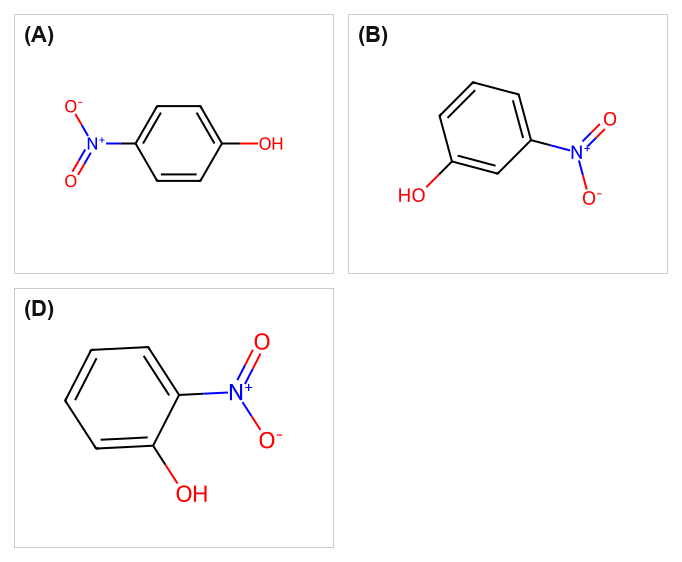
Intramolecular hydrogen bonding is present in which of the following compounds? (Structures (A), (B) and (D) are shown in the figure; (C) is \ce{HF}.)
Q48
NEET 2025
Match List-I with List-II.
List-I: A. \ce{XeO3}; B. \ce{XeF2}; C. \ce{XeOF4}; D. \ce{XeF6}
List-II: I. $sp^3d$; linear; II. $sp^3$; pyramidal; III. $sp^3d^3$; distorted octahedral; IV. $sp^3d^2$; square pyramidal
Choose the correct answer from the options given below:
Q49
NEET 2025Ionic character
Identify the correct orders against the property mentioned:
A. \ce{H2O} > \ce{NH3} > \ce{CHCl3} — dipole moment
B. \ce{XeF4} > \ce{XeO3} > \ce{XeF2} — number of lone pairs on central atom
C. \ce{O-H} > \ce{C-H} > \ce{N-O} — bond length
D. \ce{N2} > \ce{O2} > \ce{H2} — bond enthalpy
Choose the answer from the options given below:
Q50
ReNEET 2026
Match the species in List-I with their geometry in List-II. List-I: A. $\ce{PCl5}$, B. $\ce{BrF5}$, C. $\ce{BF4-}$, D. $\ce{[Ni(CN)4]^{2-}}$. List-II: I. Tetrahedral, II. Square planar, III. Trigonal bipyramidal, IV. Square pyramidal.
Q51
ReNEET 2026
The correct statement is:
Q52
NEET 2026 (1)VSEPR shape
Identify the correct statement about \ce{ClF3} from the following options:
Q53
NEET 2026 (1)Resonance
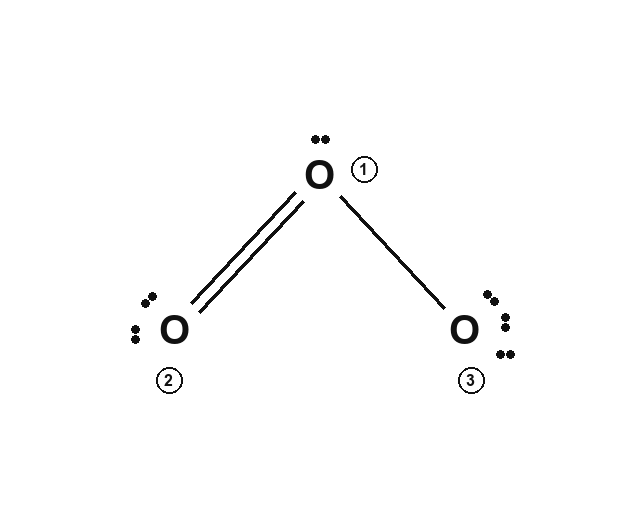
For the ozone (\ce{O3}) Lewis structure shown in the figure — a central O atom (1) doubly bonded to one terminal O atom (2) and singly bonded to the other terminal O atom (3) — the correct formal charges on the oxygen atoms numbered 2, 1 and 3 respectively are:
Q54
ReNEET 2026MO theory
The highest occupied molecular orbital for $\ce{Ne2}$ is:
Want more Chemical Bonding questions?
MedicNEET has 43,000+ NEET-style questions across Physics, Chemistry & Biology with detailed NCERT-based explanations — including the long, tricky questions that actually come in the exam.
Beyond the PYQs above — every Chemistry question format NEET now uses, starting with the newest ReNEET 2026-style reasoning MCQs. Tap an option for the answer and a worked solution. Free, no login.
✨ Chemical Bonding — ReNEET 2026-Style Reasoning Questions
The newest, most exam-current chemistry format — reasoning-based questions modelled on ReNEET 2026. Practise where NEET is heading before the exam does.
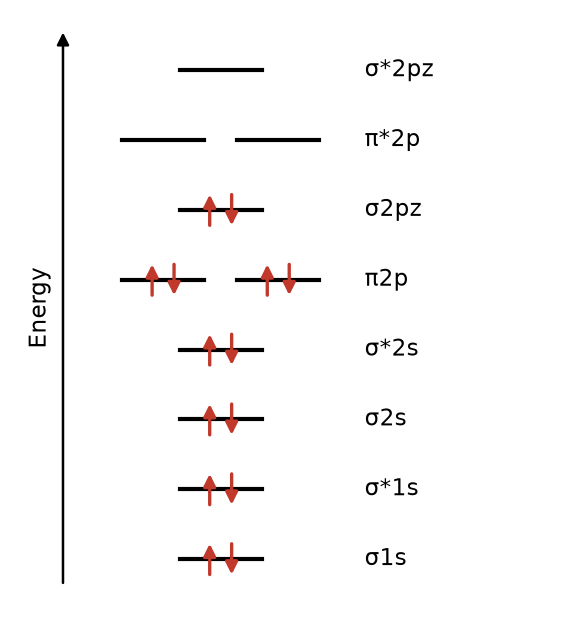
Q1. An MO energy-level diagram is filled for a neutral diatomic 'molecule X' made of second-row atoms. The bonding MOs σ1s, σ2s, σ2pz, π2px, π2py are each full, and the antibonding MOs σ∗1s and σ∗2s are each full, while all other antibonding MOs are empty. What is the bond order of molecule X?
Q2. Assertion (A): Of the second-row diatomics, the energy of the σ2pz molecular orbital is higher than that of the π2p molecular orbitals for NX2, but lower than the π2p orbitals for OX2. Reason (R): The molecular orbital energy ordering is the same for every homonuclear diatomic molecule of the second period.
Q3. Statement I: As the number of lone pairs on the central atom rises across CHX4, NHX3 and HX2O, the bond angle falls.
Statement II: Lone pair-bond pair repulsion is weaker than bond pair-bond pair repulsion.
Choose the correct option.
Q4. A chemist reasons: 'To find the hybridisation of a central atom I count its sigma bonds and lone pairs; I do not add its pi bonds.' Using this, what is the hybridisation of carbon in COX2?
Q5. The measured dipole moments are: NHX3=4.90×10⁻³⁰ C m and NFX3=0.80×10⁻³⁰ C m. Both molecules are pyramidal with a lone pair on nitrogen, and fluorine is more electronegative than hydrogen. Which statement best explains why NHX3 has the larger dipole moment?
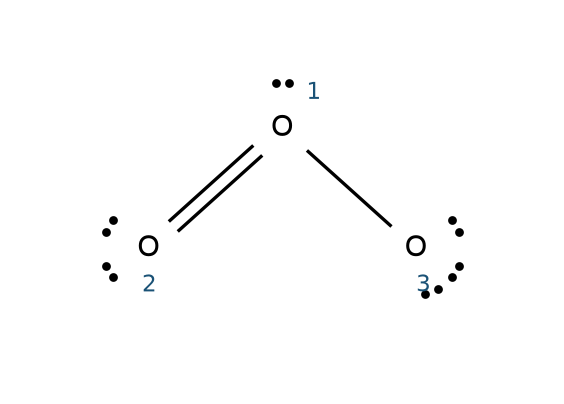
Q6. The Lewis structure of the ozone molecule OX3 is shown, with the three oxygen atoms labelled 1 (central), 2 and 3. Using formal charge =V−(lone-pair electrons)−21(bonding electrons), what are the formal charges on atoms 1, 2 and 3 respectively?
Q7. For the chlorides LiCl, NaCl and KCl, arrange them in order of decreasing covalent character.
Q8. Read the assertion and reason.
Assertion (A): In CaFX2, calcium has an electrovalence of +2 and each fluorine has an electrovalence of −1.
Reason (R): Calcium loses two electrons to reach the argon configuration while each fluorine gains one electron to reach the neon configuration.
Q9. For the molecule shown, NCERT marks the bond dipole with a crossed arrow ( ↣ with a cross on its tail). In the chemistry convention used by NCERT, where is the cross placed and where does the arrow head point?
Q10. In a Lewis structure, a single line (or one shared pair of dots) between two atoms stands for:
You’ve practised 10 of 98 Chemical Bonding questions in this set.
🧩 Chemical Bonding — Chemical Bonding Questions — All Formats
Every format NEET uses — assertion-reason, statement, match-the-column and standard MCQs — each with an instant explanation.
Q1. Formal charge is given by V−L−21S, where V is the number of valence electrons, L the number of non-bonding (lone-pair) electrons and S the number of bonding electrons. For the nitrogen atom in the ammonium ion NHX4X+ (four N-H single bonds, no lone pair), the formal charge is:
Q2. Which of the following arranges the species in the correct order of INCREASING bond order?
Q3. Four molecules are given: COX2, CClX4, BFX3 and CHClX3. The net dipole moment of a molecule is the vector sum of its bond dipoles. In which one is the net dipole moment NOT zero even though every bond in it is polar?
Q4. Consider these statements about hydrogen bonding from NCERT.
I. A hydrogen bond forms only when hydrogen is attached to one of the highly electronegative atoms fluorine, oxygen or nitrogen.
II. An intramolecular hydrogen bond forms between two molecules, while an intermolecular hydrogen bond forms within the same molecule.
III. The magnitude of hydrogen bonding is greatest in the solid state and least in the gaseous state.
Which statements are correct?
Q5. Pure p-orbital overlap predicts a bond angle of 90∘, but the real HX2O angle is 104.5∘ and CHX4 is 109.5∘. What does NCERT introduce to explain this difference?
Q6. For the formation of NaCl(s) the following enthalpy terms (in kJ mol−1) are given: sublimation of Na=+108.4; ionisation enthalpy of Na=+495.8; dissociation of 21ClX2 into atoms =+121.0; electron-gain enthalpy of Cl=−348.7; lattice enthalpy of NaCl=−788.0 (energy released on lattice formation). Using a Born-Haber cycle, the enthalpy of formation of NaCl(s) is:
Q7. In NCERT the percentage ionic character of a real bond is obtained as:
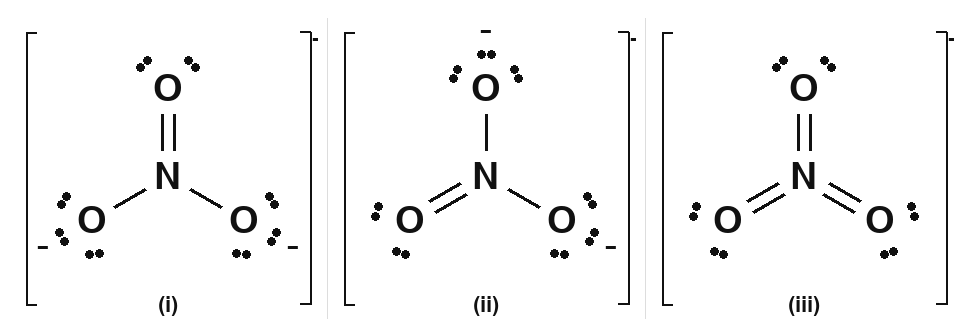
Q8. The figure shows three proposed canonical structures of the nitrate ion NOX3X−, labelled (i), (ii) and (iii). Which of them are acceptable resonance structures contributing to the resonance hybrid?
Q9. Which of the following statements about the trigonal bipyramidal geometry of PClX5 is INCORRECT?
Q10. When BFX3 reacts with a fluoride ion to form BFX4X−, the hybridisation of boron changes from:
You’ve practised 10 of 303 Chemical Bonding questions in this set.
Chemical Bonding is a Class 11 NEET Chemistry chapter consistently tested from 2016 to ReNEET 2026. This page has all 54 authentic previous year questions from real NEET papers — with answers and detailed solutions, not model questions.
For full chapter-wise practice in timed test mode, download the MedicNEET app — 43,000+ questions across the full NEET syllabus. Back to the NEET Chemistry PYQ index.
All NEET Chemistry PYQ Chapters
Every NEET Chemistry previous-year question (2016–2026), chapter-wise — free, no login.