
In the measurement of viscosity of liquids using the terminal velocity experiment, spherical balls of the same radius but different densities are used. The variation of the terminal velocity v with the ratio of the density of the spherical ball (σ) to the density of the liquid (ρ), σ/ρ, is best represented by:
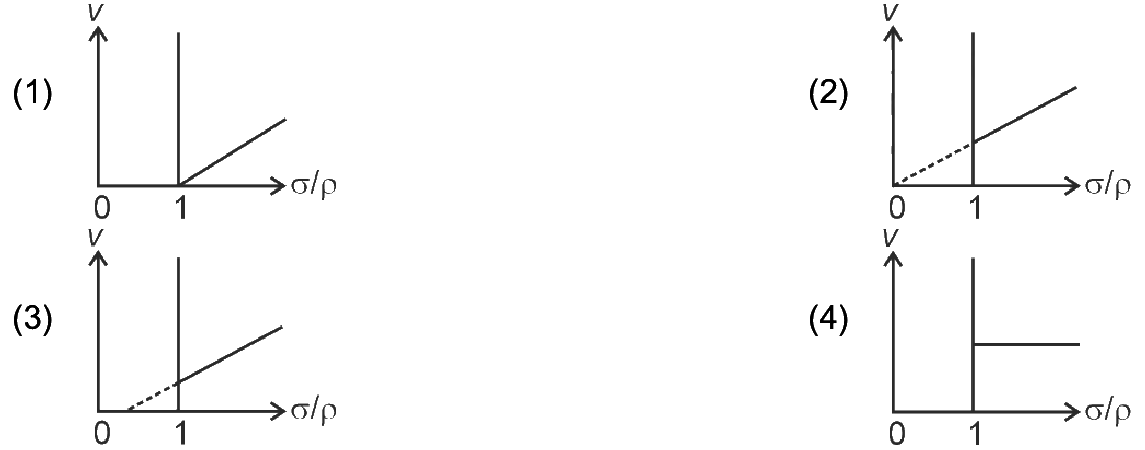
- A.straight line of positive slope, negative intercept (crosses axis at σ/ρ=1)✓
- B.straight line through origin
- C.straight line of positive slope, positive intercept
- D.horizontal line
Correct Answer
(A) straight line of positive slope, negative intercept (crosses axis at σ/ρ=1)
Solution & Explanation
Principle: a sphere falling at terminal velocity in a liquid has weight balanced by buoyancy plus viscous drag (Stokes). This gives v_T = (2r²·g)/(9η)·(σ − ρ), where σ is the ball's density and ρ the liquid's. Factor out ρ: v_T = (2r²·ρ·g)/(9η)·((σ/ρ) − 1). With r, ρ, η and g all fixed, write x = σ/ρ. Then v_T = m·x − m, where slope m = (2r²·ρ·g)/(9η) > 0. This is a straight line of positive slope (m) and a negative intercept (−m). It equals zero when σ/ρ = 1 (ball and liquid equal density → no sinking, v_T = 0), so the line crosses the horizontal axis at σ/ρ = 1. This is exactly option A. Why not B (through origin): the line passes through (1, 0), not (0, 0). Why not C/D: the intercept is negative and the line is not horizontal because v_T genuinely grows with σ/ρ.
✅ We had this exact concept in our bank before the exam — Concept match, 78% match.
That's the Predicted Batch — it trains you on the exact high-probability concepts NEET repeats every year. 98% of the 2026 paper (176/180) was in our bank before the exam.
Master these concepts + 50,000+ NEET PYQs in the app — free, built for NEET 2027.
Start the Predicted Batch — Free →