
ReNEET 2026 · Physics · Q3Electromagnetic InductionIn our bank: Concept match · 72%

Two identical inductors are connected in two different configurations P (series) and Q (parallel), where a time-varying current I(t) flows, as shown. The induced emf between points a and b for configuration P is E_P and for Q is E_Q. The ratio E_P/E_Q is: [Neglect mutual inductance.]
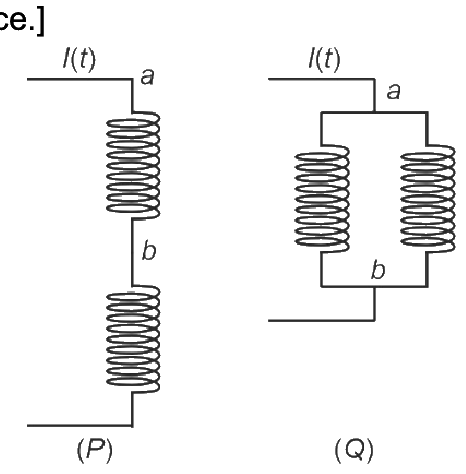
ReNEET 2026 Physics Question 3 figure
  1. A.(1)/(4)
  2. B.(1)/(2)
  3. C.1
  4. D.2

Correct Answer

(D) 2

Solution & Explanation

Key principle: for an inductor, the emf across it is L(dI/dt). The trick is reading exactly which coils the points a and b span in each diagram. Configuration P (series stack): the point b is the junction BETWEEN the two coils, so the path a→b crosses only ONE coil. Hence E_P=L(dI/dt). Configuration Q (parallel): the two coils are connected in parallel between a and b. With no mutual inductance, the parallel combination is L_Q=(L·L)/(L+L)=L/2, and the same total current I(t) flows in from a to b, so E_Q=L_Q(dI/dt)=(L/2)(dI/dt). Taking the ratio: E_P/E_Q=[L(dI/dt)]/[(L/2)(dI/dt)]=L/(L/2)=2. This matches option D (ratio = 2). Trap: if you wrongly took E_P across both series coils (2L), you would get E_P/E_Q=2L/(L/2)=4. The point b sitting at the mid-junction is what makes E_P span a single coil.

✅ We had this exact concept in our bank before the exam — Concept match, 72% match.

That's the Predicted Batch — it trains you on the exact high-probability concepts NEET repeats every year. 98% of the 2026 paper (176/180) was in our bank before the exam.

Master these concepts + 50,000+ NEET PYQs in the app — free, built for NEET 2027.

Start the Predicted Batch — Free →
📚From Electromagnetic Induction practice all 19 NEET Physics PYQs from this chapter

More ReNEET 2026 solutions

Phys Q5Consider a long solenoid of length l and radius r. If n is the number of turns per unit length and µ₀ the permeability of free space, the inductance of the solenoid is:Phys Q32A conducting loop of finite resistance lies in the x–y plane in a constant magnetic field along z. The area of the loop varies with time as A=A₀(1+ t). The figure that correctly indicates the qualitative behaviour of the power P dissipated in the loop as a function of time is:Phys Q1A particle of mass M moves along a horizontal x-axis from x=0 to x=L. The coefficient of kinetic friction varies as µ_k(x)=µ₀-α x, where µ₀,α are constants of appropriate dimensions, so that µ_k(L)=0. The total work done by the frictional force during the motion is nµ₀ MgL. The value of n is:Phys Q2The mean free path of molecules in an ideal gas A is half that of another ideal gas B. The diameter of the spherical molecules of gas A is twice the diameter of the molecules of B. If the number densities of gases A and B are n_A and n_B respectively, the correct option is:Phys Q4For sound waves, if the number of nodes for the 5^th harmonic of an open-ended pipe is n and that for the 9^th harmonic of the same pipe with one of its ends closed is m, the ratio (n)/(m) is:Phys Q6A particle moves along a straight line with position s(t)=α t²-β t+γ, where α=1 ms⁻², β=6 ms⁻¹, γ=5 m. The average speed of the particle (in ms⁻¹) from t=0 to t=6 s is:Phys Q7Consider the nuclear reaction ²³⁸U→²³⁴Th+⁴He. Taking the masses of ²³⁸U, ²³⁴Th and ⁴He as 238.050 u, 234.043 u and 4.003 u respectively, the Q-value of the reaction (in keV) is: [1 u =931.5 MeV c⁻²]Phys Q8A beam of light falls on a metal surface such that photo-electrons are generated. If the power of the light source starts to decrease linearly with time t, then the variation of the photocurrent I and the magnitude of the stopping potential |V| with time is best represented by:Phys Q9Three identical capacitors P, Q and S, each of capacitance C, are connected to a battery of voltage V as shown. If the energy stored in capacitor P is U_P and the total energy stored in the system is U_T, then the ratio (U_P)/(U_T) is: