
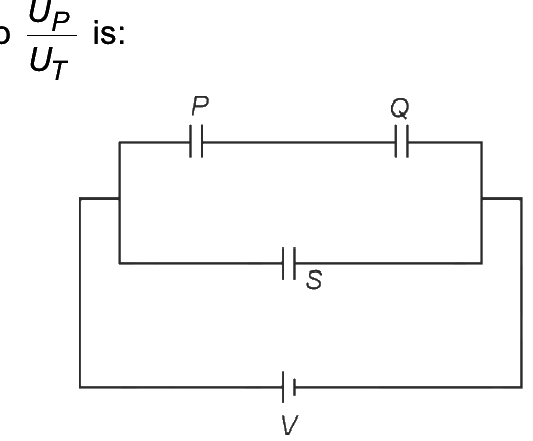
Three identical capacitors P, Q and S, each of capacitance C, are connected to a battery of voltage V as shown. If the energy stored in capacitor P is U_P and the total energy stored in the system is U_T, then the ratio (U_P)/(U_T) is:
- A.(2)/(3)
- B.(1)/(3)
- C.(1)/(2)
- D.(1)/(6)✓
Correct Answer
(D) (1)/(6)
Solution & Explanation
Setup (from the figure): P and Q are in series with each other, and that series branch is connected across the battery V; capacitor S is connected directly across the full battery voltage V. Each capacitor has capacitance C. Use energy U=(1/2)CV² per capacitor. Step 1 — Voltages on each capacitor. P and Q (equal, in series) share V equally → each has V/2. S is directly across the battery → it has the full V. Step 2 — Energy in P. U_P=(1/2)C(V/2)²=(1/2)C(V²/4)=CV²/8. Step 3 — Energies of Q and S. U_Q=(1/2)C(V/2)²=CV²/8 (same as P). U_S=(1/2)C V²=CV²/2=4CV²/8. Step 4 — Total energy. U_T=U_P+U_Q+U_S=CV²/8+CV²/8+4CV²/8=6CV²/8=3CV²/4. Step 5 — Ratio. U_P/U_T=(CV²/8)/(3CV²/4)=(1/8)·(4/3)=1/6. This matches option D (1/6). Trap: don't give every capacitor the full V. The series pair splits the voltage, so P stores only one-sixth of the total energy.
✅ We had this exact concept in our bank before the exam — Concept match, 73% match.
That's the Predicted Batch — it trains you on the exact high-probability concepts NEET repeats every year. 98% of the 2026 paper (176/180) was in our bank before the exam.
Master these concepts + 50,000+ NEET PYQs in the app — free, built for NEET 2027.
Start the Predicted Batch — Free →