
ReNEET 2026 · Physics · Q21Electrostatic Potential and CapacitanceIn our bank: Strong match · 84%

A unit positive point charge is taken slowly through an infinitesimally thin tube inside a charged dielectric sphere of radius R having uniform positive charge density ρ. The initial and final positions A and B are at distances 2R and 3R from the centre. In this process the magnitude of the total work done on the point charge is (ρ R²)/(nε₀). The value of n is: (ε₀ = permittivity of vacuum)
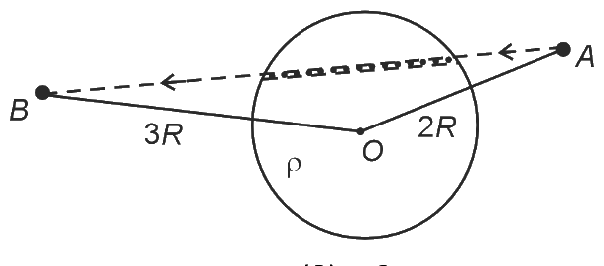
ReNEET 2026 Physics Question 21 figure
  1. A.2
  2. B.6
  3. C.9
  4. D.18

Correct Answer

(D) 18

Solution & Explanation

Both points A (2R) and B (3R) lie OUTSIDE the sphere, so the field there is that of a point charge Q at the centre. Total charge: Q = ρ·(4/3)π R³. Potential outside at distance r: V = kQ/r, with k = 1/(4πε₀). Work by external agent (slow move) = q(V_B − V_A), with q = +1: W = kQ[1/(3R) − 1/(2R)] = kQ·(2 − 3)/(6R) = −kQ/(6R). Magnitude: |W| = kQ/(6R) = (1/(4πε₀))·(1/(6R))·ρ·(4/3)π R³. Simplify the constants: (1/(4π))·(1/6)·(4/3)π = (4π)/(72π) = 1/18. So |W| = ρR²/(18ε₀). Comparing with ρR²/(nε₀) gives n = 18, option D. Trap: since both points are outside, the uniform-density interior field is never used — treat it as a point charge.

✅ We had this exact concept in our bank before the exam — Strong match, 84% match.

That's the Predicted Batch — it trains you on the exact high-probability concepts NEET repeats every year. 98% of the 2026 paper (176/180) was in our bank before the exam.

Master these concepts + 50,000+ NEET PYQs in the app — free, built for NEET 2027.

Start the Predicted Batch — Free →
📚From Electrostatic Potential and Capacitance practice all 36 NEET Physics PYQs from this chapter

More ReNEET 2026 solutions

Phys Q9Three identical capacitors P, Q and S, each of capacitance C, are connected to a battery of voltage V as shown. If the energy stored in capacitor P is U_P and the total energy stored in the system is U_T, then the ratio (U_P)/(U_T) is:Phys Q33A point charge Q is placed inside a cavity within a solid isolated conducting sphere. Consider points A (inside cavity), B and C (outside the sphere, equidistant from its centre) with field magnitudes E_A,E_B,E_C. The correct option is:Phys Q34A fixed uniformly charged insulating sphere of radius R has total charge +Q. A point charge -q (q Q, mass m) is released from rest at a distance 3R from the centre. When it reaches the surface of the sphere, its speed is: (ε₀ = permittivity of vacuum; neglect gravity)Phys Q1A particle of mass M moves along a horizontal x-axis from x=0 to x=L. The coefficient of kinetic friction varies as µ_k(x)=µ₀-α x, where µ₀,α are constants of appropriate dimensions, so that µ_k(L)=0. The total work done by the frictional force during the motion is nµ₀ MgL. The value of n is:Phys Q2The mean free path of molecules in an ideal gas A is half that of another ideal gas B. The diameter of the spherical molecules of gas A is twice the diameter of the molecules of B. If the number densities of gases A and B are n_A and n_B respectively, the correct option is:Phys Q3Two identical inductors are connected in two different configurations P (series) and Q (parallel), where a time-varying current I(t) flows, as shown. The induced emf between points a and b for configuration P is E_P and for Q is E_Q. The ratio E_P/E_Q is: [Neglect mutual inductance.]Phys Q4For sound waves, if the number of nodes for the 5^th harmonic of an open-ended pipe is n and that for the 9^th harmonic of the same pipe with one of its ends closed is m, the ratio (n)/(m) is:Phys Q5Consider a long solenoid of length l and radius r. If n is the number of turns per unit length and µ₀ the permeability of free space, the inductance of the solenoid is:Phys Q6A particle moves along a straight line with position s(t)=α t²-β t+γ, where α=1 ms⁻², β=6 ms⁻¹, γ=5 m. The average speed of the particle (in ms⁻¹) from t=0 to t=6 s is: