
ReNEET 2026 · Physics · Q23System of Particles and Rotational MotionIn our bank: Concept match · 74%

A frictionless circular wire of unit radius lies in a horizontal plane. Two point particles of unit mass start simultaneously from A (θ=(π)/(2)) with identical uniform angular speeds in opposite directions and meet again at B (θ=-(π)/(2)). Which figure best represents the magnitude of the total linear momentum P of the system as a function of θ?
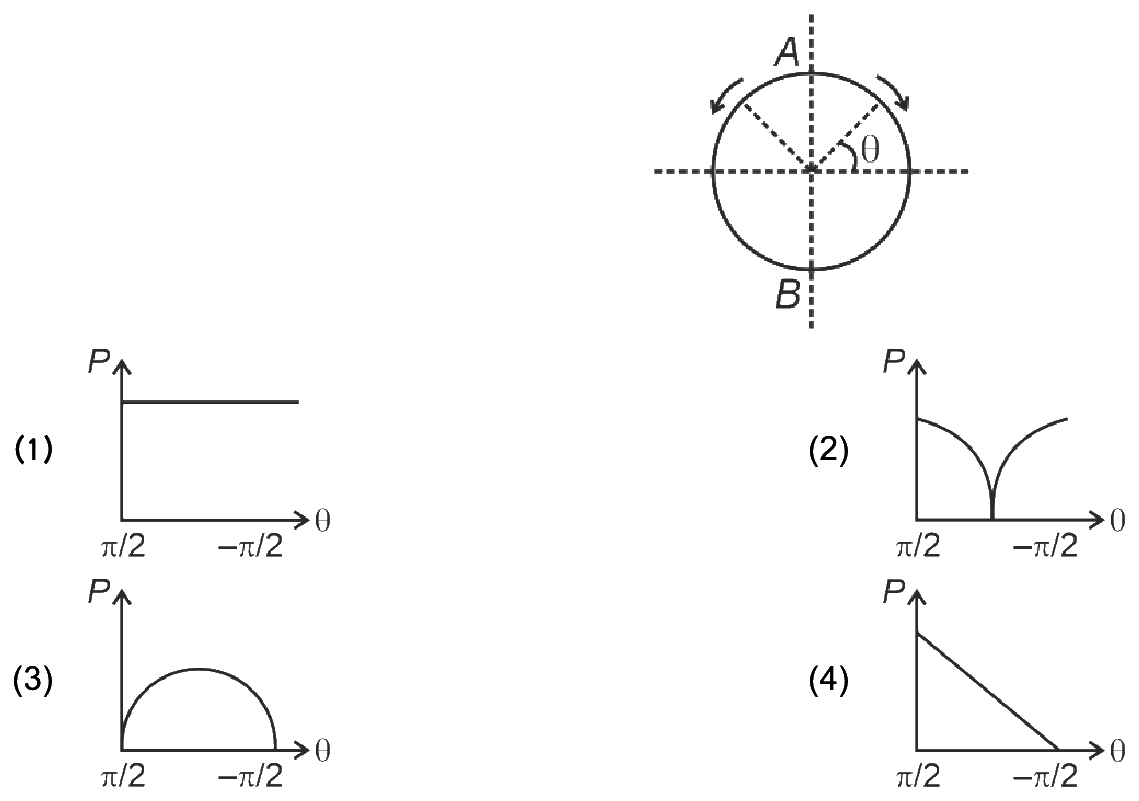
ReNEET 2026 Physics Question 23 figure
  1. A.horizontal line (constant P)
  2. B.two lobes meeting at zero at θ=-(π)/(2)
  3. C.a single dome: P rises from 0 at θ=(π)/(2), peaks, returns to 0 at θ=-(π)/(2)
  4. D.straight line decreasing

Correct Answer

(C) a single dome: P rises from 0 at θ=(π)/(2), peaks, returns to 0 at θ=-(π)/(2)

Solution & Explanation

Both particles have unit mass and equal angular speed ω on a unit-radius circle, so each has the same speed v = ωR. Start at A (θ = π/2) and run in opposite directions, meeting at B (θ = −π/2). At any common angular position the two are mirror images about the vertical AB line. Resolve velocities: the components perpendicular to AB are equal and opposite → they cancel. The components along AB add up. So the total momentum points along the diameter AB and its magnitude grows from the turning points toward the middle. At the start (A) and at the meeting point (B) the particles move oppositely along/around the same line so the along-AB components also vanish → P = 0 at both ends. Midway the components are fully aligned → P is maximum. Thus |P| versus θ is a single smooth dome: 0 at θ = π/2, a peak in between, back to 0 at θ = −π/2 — option C.

✅ We had this exact concept in our bank before the exam — Concept match, 74% match.

That's the Predicted Batch — it trains you on the exact high-probability concepts NEET repeats every year. 98% of the 2026 paper (176/180) was in our bank before the exam.

Master these concepts + 50,000+ NEET PYQs in the app — free, built for NEET 2027.

Start the Predicted Batch — Free →
📚From System of Particles and Rotational Motion practice all 34 NEET Physics PYQs from this chapter

More ReNEET 2026 solutions

Phys Q27A solid sphere A of radius R and mass M is attached at a point to a smaller solid sphere B of radius r<R and mass m<M, their line of centres horizontal. The moment of inertia of the system about a vertical axis through the centre of A is I_A, and about a vertical axis through the centre of B is I_B. The difference I_A-I_B is:Phys Q31A thin horizontal disc rotates about a vertical axis passing through its fixed centre O. Its angular momentum is L_A and L_B when computed about points A and B respectively, where OB=2× OA. The value of (L_A)/(L_B) is:Phys Q1A particle of mass M moves along a horizontal x-axis from x=0 to x=L. The coefficient of kinetic friction varies as µ_k(x)=µ₀-α x, where µ₀,α are constants of appropriate dimensions, so that µ_k(L)=0. The total work done by the frictional force during the motion is nµ₀ MgL. The value of n is:Phys Q2The mean free path of molecules in an ideal gas A is half that of another ideal gas B. The diameter of the spherical molecules of gas A is twice the diameter of the molecules of B. If the number densities of gases A and B are n_A and n_B respectively, the correct option is:Phys Q3Two identical inductors are connected in two different configurations P (series) and Q (parallel), where a time-varying current I(t) flows, as shown. The induced emf between points a and b for configuration P is E_P and for Q is E_Q. The ratio E_P/E_Q is: [Neglect mutual inductance.]Phys Q4For sound waves, if the number of nodes for the 5^th harmonic of an open-ended pipe is n and that for the 9^th harmonic of the same pipe with one of its ends closed is m, the ratio (n)/(m) is:Phys Q5Consider a long solenoid of length l and radius r. If n is the number of turns per unit length and µ₀ the permeability of free space, the inductance of the solenoid is:Phys Q6A particle moves along a straight line with position s(t)=α t²-β t+γ, where α=1 ms⁻², β=6 ms⁻¹, γ=5 m. The average speed of the particle (in ms⁻¹) from t=0 to t=6 s is:Phys Q7Consider the nuclear reaction ²³⁸U→²³⁴Th+⁴He. Taking the masses of ²³⁸U, ²³⁴Th and ⁴He as 238.050 u, 234.043 u and 4.003 u respectively, the Q-value of the reaction (in keV) is: [1 u =931.5 MeV c⁻²]