
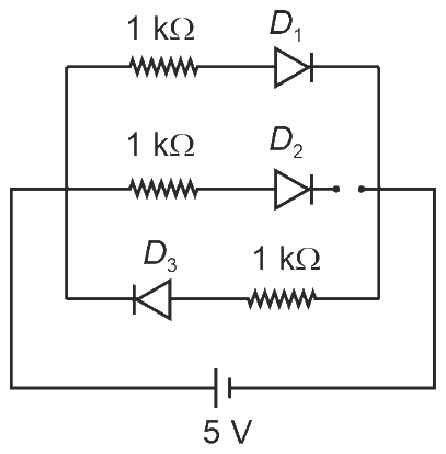
Three identical p-n junction diodes D₁, D₂ and D₃ are connected across a battery as shown (each in series with a 1 kΩ resistor). If the widths of the depletion regions of D₁, D₂, D₃ are W₁, W₂, W₃ respectively, then the correct option is:
- A.W₁>W₂>W₃
- B.W₃=W₁>W₂
- C.W₃>W₂>W₁✓
- D.W₂>W₁=W₃
Correct Answer
(C) W₃>W₂>W₁
Solution & Explanation
The depletion-region width depends on bias: forward bias narrows it (it shrinks below the unbiased value), no bias gives the equilibrium width, and reverse bias widens it. From the circuit, read each diode's bias relative to the battery polarity: D₁ is forward-biased → its depletion region is the narrowest → smallest W₁. D₂ is unbiased (no net potential across it) → equilibrium width → intermediate W₂. D₃ is reverse-biased → its depletion region is the widest → largest W₃. Ordering the widths: W₃ > W₂ > W₁, matching option C. Key idea: applied forward voltage opposes the built-in potential (less charge uncovered, thinner layer), while reverse voltage adds to it (more charge uncovered, thicker layer).
✅ We had this exact concept in our bank before the exam — Concept match, 80% match.
That's the Predicted Batch — it trains you on the exact high-probability concepts NEET repeats every year. 98% of the 2026 paper (176/180) was in our bank before the exam.
Master these concepts + 50,000+ NEET PYQs in the app — free, built for NEET 2027.
Start the Predicted Batch — Free →