
Outbreeding Devices in Flowering Plants — Four Mechanisms to Prevent Self-Pollination
📚 Practice ConceptMajority of flowering plants produce hermaphrodite flowers and pollen grains are likely to come in contact with the stigma of the same flower. Continued self-pollination result in inbreeding depression. Flowering plants have developed many devices to discourage self-pollination and to encourage cross-pollination. In some species, pollen release and stigma receptivity are not synchronised. Either the pollen is released before the stigma becomes receptive or stigma becomes receptive much before the release of pollen. In some other species, the anther and stigma are placed at different positions so that the pollen cannot come in contact with the stigma of the same flower. Both these devices prevent autogamy. The third device to prevent inbreeding is self-incompatibility. This is a genetic mechanism and prevents self-pollen (from the same flower or other flowers of the same plant) from fertilising the ovules by inhibiting pollen germination or pollen tube growth in the pistil. Another device to prevent self-pollination is the production of unisexual flowers. If both male and female flowers are present on the same plant such as castor and maize (monoecious), it prevents autogamy but not geitonogamy. In several species such as papaya, male and female flowers are present on different plants, that is each plant is either male or female (dioecy). This condition prevents both autogamy and geitonogamy.
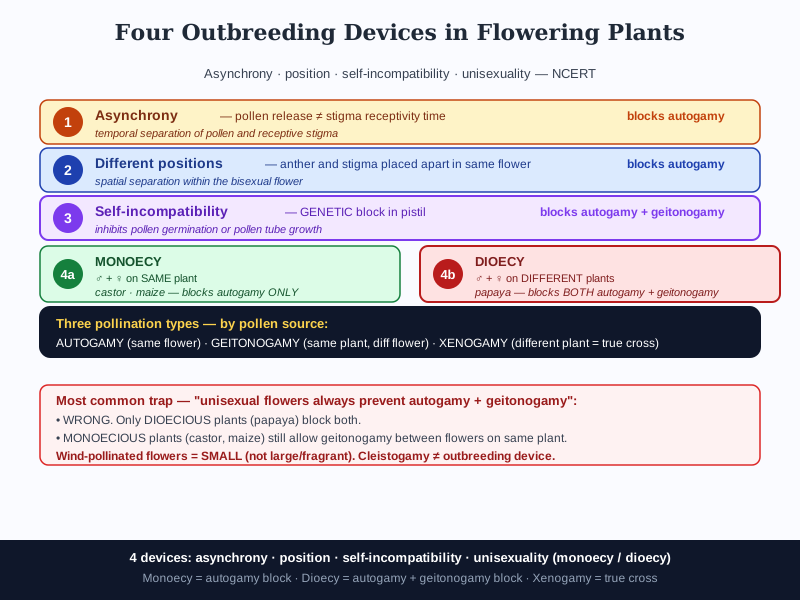
Production of unisexual flowers always prevents both autogamy and geitonogamy in flowering plants.
MONOECIOUS plants (castor, maize) prevent autogamy but NOT geitonogamy. Only DIOECIOUS plants (papaya) prevent BOTH autogamy and geitonogamy.
MONO = one plant has both sexes = blocks autogamy only. DIO = two plants = blocks autogamy AND geitonogamy. Self-incompat = genetic block.
- Asynchrony of pollen release and stigma receptivity → prevents autogamy.
- Different positions of anther and stigma → prevents autogamy.
- Self-incompatibility = GENETIC mechanism inhibiting pollen germination/pollen tube growth in pistil.
- Monoecious (castor, maize) blocks autogamy only; Dioecious (papaya) blocks both autogamy and geitonogamy.
Consider the following statements about outbreeding devices in flowering plants: S1: In Vallisneria, female flowers reach the surface of water to receive pollen. S2: Cleistogamous flowers promote assured seed set even in the absence of pollinators. S3: Production of unisexual flowers prevents both autogamy and geitonogamy. S4: Self-incompatibility prevents autogamy but not xenogamy. S5: Wind-pollinated flowers are usually large, fragrant, and produce copious nectar.
View bonus solution & explanation
Correct answer: A — S1, S2, S3 and S4
S1 CORRECT: Vallisneria female flowers reach water surface to receive male flowers/pollen (NCERT). S2 CORRECT: Cleistogamous flowers stay closed → forced autogamy → assured seed set without pollinators. S3 CORRECT (partial — applies to DIOECY): Dioecious plants like papaya block both; monoecious plants like castor/maize block only autogamy. S4 CORRECT: Self-incompatibility blocks self-pollen (autogamy + geitonogamy) at the genetic level but allows xenogamy (cross). S5 WRONG: Wind-pollinated flowers are SMALL, inconspicuous, NOT fragrant, and do NOT produce nectar (NCERT).
What is Outbreeding Devices in Flowering Plants?
What did NEET previous years ask on Outbreeding Devices in Flowering Plants?
What is the most common NEET trap on Outbreeding Devices in Flowering Plants?
How do you remember Outbreeding Devices in Flowering Plants for NEET?
What are the key components of Outbreeding Devices in Flowering Plants?
Through deep analysis of NEET and NTA, 176 of the 180 ReNEET 2026 (June 21) questions were already in the MedicNEET question bank before the exam.
176/180MedicNEET's Biology question bank is built from the same NCERT lines NTA picks repeatedly. Not random MCQs — questions crafted exactly like NTA crafts them.
You just learned this concept. The free app turns it into a daily goal built from your weak topics and brings it back just before you forget it — using active recall and spaced repetition — so it stays till exam day.