
NEET 2024 · ChemistryPrevious Year Question
Which one of the following alcohols reacts instantaneously with Lucas reagent?
Answer: (C) (C). \textbf{Answer:} (C) \textbf{Solution:} The Lucas reagent (conc.
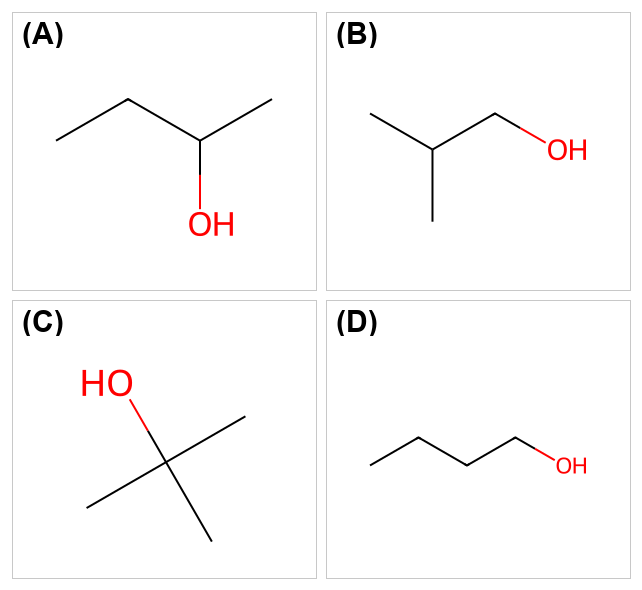
- A.(A)
- B.(B)
- C.(C)✓
- D.(D)
Correct Answer
(C) (C)
Solution & Explanation
\textbf{Answer:} (C) \textbf{Solution:} The Lucas reagent (conc. + ) reacts fastest with tertiary alcohols, because they ionise to a stable 3 carbocation and give immediate turbidity at room temperature. Option (C) is the tertiary alcohol, so it reacts instantaneously, whereas the primary and secondary alcohols in the other options react slowly or not at all at room temperature.
🎯
43,000+ questions in हिंदी & English · one-tap toggle
Open →📚Practice all NEET Chemistry PYQs chapter-wise →💡Don't get it? Learn the Alcohols, Phenols And Ethers concepts →Practice NEET 2024 Chemistry — free, with instant solutions
The app builds a daily goal from your weak topics and brings each question back just before you forget it — so what you solve today turns into marks on exam day.
More NEET PYQ solutions
ChemIdentify the suitable reagent for the following conversion: C6H5COOCH3 -> C6H5CHO (methyl benzoate to benzaldehyde)ChemThe correct order of decreasing acidity of the following aliphatic acids isChemThe major product of the following reaction is: 4-oxo-4-phenylbutanenitrile C6H5-CO-CH2-CH2-CN is treated with (i) CH3MgBr (excess) and then (ii) H3O+.ChemOut of the following complex compounds, which compound will have the minimum conductance in solution?ChemWhich of the following are paramagnetic? A. [NiCl4]^2- B. Ni(CO)4 C. [Ni(CN)4]^2- D. [Ni(H2O)6]^2+ E. Ni(PPh3)4ChemThe correct order of the wavelength of light absorbed by the following complexes is: A. [Co(NH3)6]^3+ B. [Co(CN)6]^3- C. [Cu(H2O)4]^2+ D. [Ti(H2O)6]^3+ChemThe correct order of decreasing basic strength of the given amines is: (N-ethylethanamine = (C2H5)2NH; ethanamine = C2H5NH2; N-methylaniline = C6H5NH(CH3); benzenamine/aniline = C6H5NH2)ChemPredict the major product P in the following sequence of reactions. The starting material is 1-methylcyclopent-1-ene: (i) HBr, benzoyl peroxide; (ii) KCN; (iii) Na(Hg)/C2H5OH P (major). The structures of the options (A)-(D) are shown in the image below: