
The compound that CANNOT be obtained from the aldol condensation reaction shown (2,2-dimethylcyclopentanone + PhCHO , Δ) is:
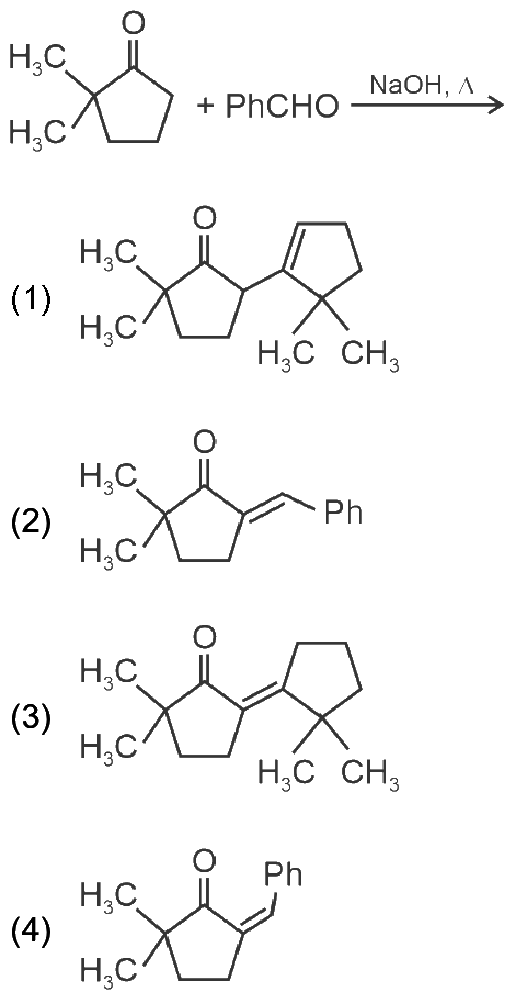
- A.a 2,2-dimethyl cyclopentanone bearing a second cyclopentenyl ring (self-condensation type product)✓
- B.the benzylidene (=CH–Ph) product on the α-carbon, one geometry
- C.a dimeric α,β-unsaturated cyclopentanone (self aldol)
- D.the benzylidene (=CH–Ph) product, other geometry
Correct Answer
(A) a 2,2-dimethyl cyclopentanone bearing a second cyclopentenyl ring (self-condensation type product)
Solution & Explanation
Concept: An aldol/cross-aldol condensation needs a carbonyl compound with an α-hydrogen (the nucleophile, via its enolate) that attacks a carbonyl carbon (the electrophile), followed by dehydration to an α,β-unsaturated carbonyl. Step 1 — Identify the α-positions of 2,2-dimethylcyclopentanone. The carbonyl is C1. Going one way the α-carbon is C2, but it is quaternary (bears the two methyl groups) and has NO α-hydrogen. Going the other way the α-carbon is C5, which does carry α-hydrogens. Step 2 — So the only enolisable site is C5. With PhCHO (benzaldehyde, which itself has no α-H) the cross product is the C5-benzylidene compound, =CH–Ph at C5, formable as both E and Z geometries — these are options (2) and (4). Step 3 — Self-aldol of the ketone (one molecule's C5 enolate attacking another's C1) gives the dimeric α,β-unsaturated cyclopentanone — option (3). Step 4 — The product in option (1) requires a fused/second-ring connectivity that the single available α-carbon and the gem-dimethyl blocking cannot deliver. Hence the compound that CANNOT be obtained is option (1) → answer A.
✅ We had this exact concept in our bank before the exam — Concept match, 76% match.
That's the Predicted Batch — it trains you on the exact high-probability concepts NEET repeats every year. 98% of the 2026 paper (176/180) was in our bank before the exam.
Master these concepts + 50,000+ NEET PYQs in the app — free, built for NEET 2027.
Start the Predicted Batch — Free →