
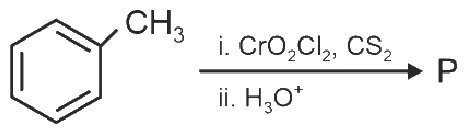
Consider the reaction: toluene (i) CrO₂Cl₂, CS₂(ii) H₃O+ P. Choose the correct option about P.
- A.On treating P with saturated NaHCO₃ solution, brisk effervescence is observed
- B.P can be prepared by treating benzene with anhydrous AlCl₃ and CH₃COCl
- C.On treatment with bromine water, P gives a white precipitate
- D.P is obtained by the hydrogenation of benzoyl chloride with Pd on BaSO₄✓
Correct Answer
(D) P is obtained by the hydrogenation of benzoyl chloride with Pd on BaSO₄
Solution & Explanation
Step 1 — Identify P. Toluene with CrO₂Cl₂ in CS₂, then aqueous workup (H₃O⁺), is the ÉTARD reaction. It oxidises the –CH₃ group exactly to the aldehyde stage, giving benzaldehyde, C₆H₅CHO. So P = benzaldehyde. Step 2 — Test each statement against benzaldehyde: (1) NaHCO₃ effervescence (CO₂) occurs only with carboxylic acids; benzaldehyde is an aldehyde, no effervescence → wrong. (2) Benzene + CH₃COCl/anhydrous AlCl₃ (Friedel–Crafts acylation) gives acetophenone C₆H₅COCH₃, NOT benzaldehyde → wrong. (3) Bromine water gives a white precipitate with activated aromatic rings like phenol/aniline (ring tribromination); benzaldehyde's ring is deactivated by –CHO and gives no such precipitate → wrong. (4) The Rosenmund reduction — catalytic hydrogenation of benzoyl chloride C₆H₅COCl over Pd poisoned on BaSO₄ — stops at the aldehyde, giving benzaldehyde. This is a genuine preparation of P → CORRECT. Answer D.
✅ We had this exact concept in our bank before the exam — Strong match, 86% match.
That's the Predicted Batch — it trains you on the exact high-probability concepts NEET repeats every year. 98% of the 2026 paper (176/180) was in our bank before the exam.
Master these concepts + 50,000+ NEET PYQs in the app — free, built for NEET 2027.
Start the Predicted Batch — Free →