
Consider two circuits A and B, each with two resistors. One resistor has a positive temperature coefficient +α and the other -α. In circuit A the two are in series; in circuit B they are in parallel, across the same battery. At the initial temperature each resistance is R₀. As temperature increases, the correct statement about the currents I_A and I_B is:
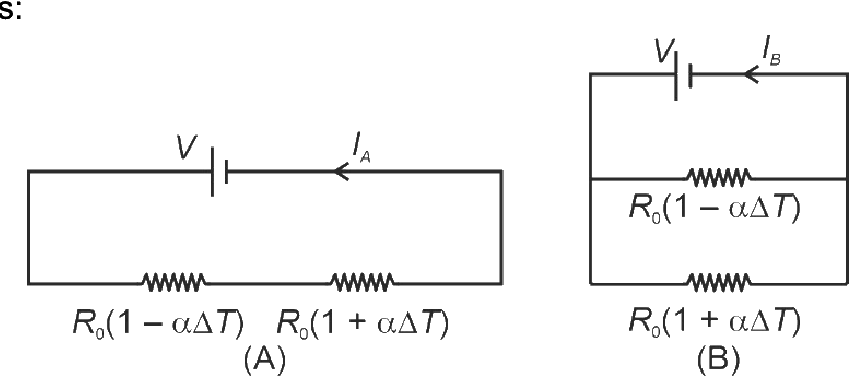
- A.I_A remains constant while I_B increases✓
- B.I_A decreases while I_B increases
- C.I_A increases while I_B decreases
- D.both I_A and I_B remain constant
Correct Answer
(A) I_A remains constant while I_B increases
Solution & Explanation
Let the two resistances at higher temperature be R₊ = R₀(1 + αΔT) and R₋ = R₀(1 − αΔT). Circuit A (series): R_eq = R₀(1 + αΔT) + R₀(1 − αΔT) = 2R₀. The +αΔT and −αΔT terms cancel exactly, so R_eq stays 2R₀ for all temperatures — the current I_A = V/2R₀ is constant. Circuit B (parallel): R_eq = (R₊·R₋)/(R₊ + R₋) = [R₀²(1 − α²ΔT²)]/(2R₀) = (R₀/2)(1 − α²ΔT²). As T rises, ΔT grows, so the factor (1 − α²ΔT²) decreases, lowering R_eq below R₀/2. Lower resistance means larger current, so I_B increases. Therefore I_A remains constant while I_B increases — answer (A). Key point: in series the linear ±αΔT terms cancel; in parallel a second-order (1 − α²ΔT²) term survives and shrinks the resistance.
✅ We had this exact concept in our bank before the exam — Concept match, 72% match.
That's the Predicted Batch — it trains you on the exact high-probability concepts NEET repeats every year. 98% of the 2026 paper (176/180) was in our bank before the exam.
Master these concepts + 50,000+ NEET PYQs in the app — free, built for NEET 2027.
Start the Predicted Batch — Free →