How many questions from Neural Control and Coordination in NEET?
2–3 questions from Neural Control & Coordination appear in NEET every year (8–12 marks, ~3% of NEET Biology). High-yield: neuron structure (dendrites/axon/myelin), resting potential (−70 mV), action potential, synapse types, reflex arc, brain parts (cerebrum/cerebellum/medulla), ear and eye structure. Practice all 265 questions free in bilingual Hindi & English in the MedicNEET app.
Year-wise NEET Questions — Neural Control and Coordination
| Year | Questions | Marks |
|---|---|---|
| NEET 2016 | 1 | 4 |
| NEET 2017 | 3 | 12 |
| NEET 2018 | 2 | 8 |
| NEET 2019 | 1 | 4 |
| NEET 2020 | 1 | 4 |
| NEET 2021 | 1 | 4 |
| NEET 2022 | 1 | 4 |
| NEET 2023 | 3 | 12 |
| NEET 2024 | 2 | 8 |
| NEET 2026 | 3 | 12 |
Practise Neural Control and Coordination MCQs — Free
Every Neural Control and Coordination question format NEET uses, starting with the newest ReNEET 2026-style reasoning MCQs. Tap an option for the answer + NCERT explanation.
✨ Neural Control and Coordination — ReNEET 2026-Style Reasoning Questions
The newest, most exam-current format — reasoning-based questions modelled on ReNEET 2026. This is where NEET is heading; practise the pattern before the exam does.
- Q1. Which reasoning best explains why invertebrates have simpler neural systems?
- Q2. How is the visceral nervous system different from somatic system?
- Q3. How does the autonomic nervous system maintain balance in the body?
- Q4. Why does the vertebrate neural system show more development?
- Q5. Why is the neuron called excitable?
- Q6. Why is repolarisation necessary in impulse conduction?
- Q7. How does a neuron maintain resting potential?
- Q8. Why are association areas of the cerebral cortex important?
- Q9. How does the midbrain facilitate sensory integration?
- Q10. Why does the cerebellum have a convoluted surface?
You’ve practised 10 of 30 Neural Control and Coordination questions in this set.
Practise all 30 + every chapter — free app →📑 Neural Control and Coordination — NEET 2025 & 2026 Long-Form MCQs
The long, multi-statement questions that dominated NEET 2025 & 2026 — each covers 5-6 concepts at once, so they double as fast full-chapter revision.
- Q1. Which of the following statements correctly describe the Visceral Nervous System (VNS) and its functional relationship within the human neural system? S1. The VNS is a distinct subdivision of the Central Nervous System (CNS) that processes internal sensory information. S2. It comprises a complex network of nerves, fibres, ganglia, and plexuses. S3. Impulses travel exclusively from the viscera to the Central Nervous System via the VNS. S4. The VNS is responsible for transmitting regulatory impulses from the CNS to the viscera. S5. The VNS functions under voluntary control, allowing conscious regulation of visceral activities. S6. Myelinated nerve fibres are rarely found in the VNS, which primarily consists of unmyelinated fibres. Choose the correct option:
- Q2. Which of the following statements about the human neural system are NOT correct? S1. The central neural system (CNS) is composed solely of the brain. S2. Afferent nerve fibres transmit regulatory impulses from the CNS to peripheral tissues. S3. The somatic neural system primarily controls the involuntary smooth muscles of the body. S4. The visceral nervous system is a component of the peripheral nervous system. S5. Unmyelinated nerve fibres are typically found only in the central neural system, unlike myelinated fibres. S6. The autonomic neural system is further classified into sympathetic and parasympathetic divisions. Choose the option with only the NOT correct statements:
- Q3. Which of the following statements accurately describe the characteristics and advantages of impulse conduction in a myelinated axon? S1: Impulse conduction in myelinated axons is faster due to the process of saltatory conduction. S2: The myelin sheath acts as an electrical insulator, preventing continuous depolarisation along the axon. S3: Myelinated nerve fibres are predominantly found in the autonomous and somatic neural systems. S4: Nodes of Ranvier are gaps in the myelin sheath where action potentials are regenerated. S5: Compared to unmyelinated fibres of similar diameter, myelinated fibres consume less metabolic energy for impulse transmission.
- Q4. Which of the following statements regarding the human cerebral hemispheres and cortex are correct? S1: The cerebrum forms the major part of the human brain, divided longitudinally into two cerebral hemispheres connected by the corpus callosum. S2: The cerebral cortex is called the grey matter due to a high concentration of myelinated nerve fibres. S3: Association areas within the cerebral cortex are crucial for complex functions such as intersensory associations, memory, and communication. S4: The inner part of the cerebral hemisphere consists of fibres of tracts covered with myelin sheath, referred to as white matter. S5: The cerebrum primarily wraps around the hypothalamus, which serves as a major coordinating centre for sensory and motor signaling.
You’ve practised 4 of 30 Neural Control and Coordination questions in this set.
Practise all 30 + every chapter — free app →🧩 Neural Control and Coordination — All-Format Questions — Match, Assertion-Reason, Statement & Image-Based
Every question format NEET uses — match-the-column, assertion-reason, statement-based, and image/diagram questions — not just plain MCQs. Each with an instant NCERT-referenced solution.
- Q1. Match the labelled parts of the synapse (Column I) with their correct identity (Column II): A. Label A B. Label B C. Label C D. Label D Column II 1. Synaptic cleft 2. Synaptic vesicles 3. Neurotransmitter 4. Ca²⁺ ions
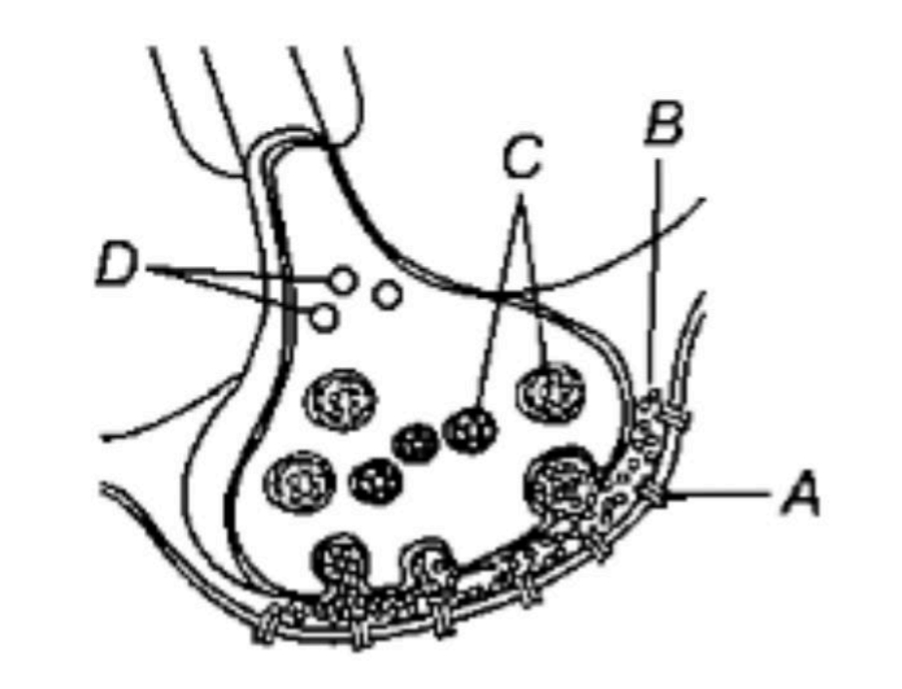
- Q2. 3. Identify ‘E’ in the figure:
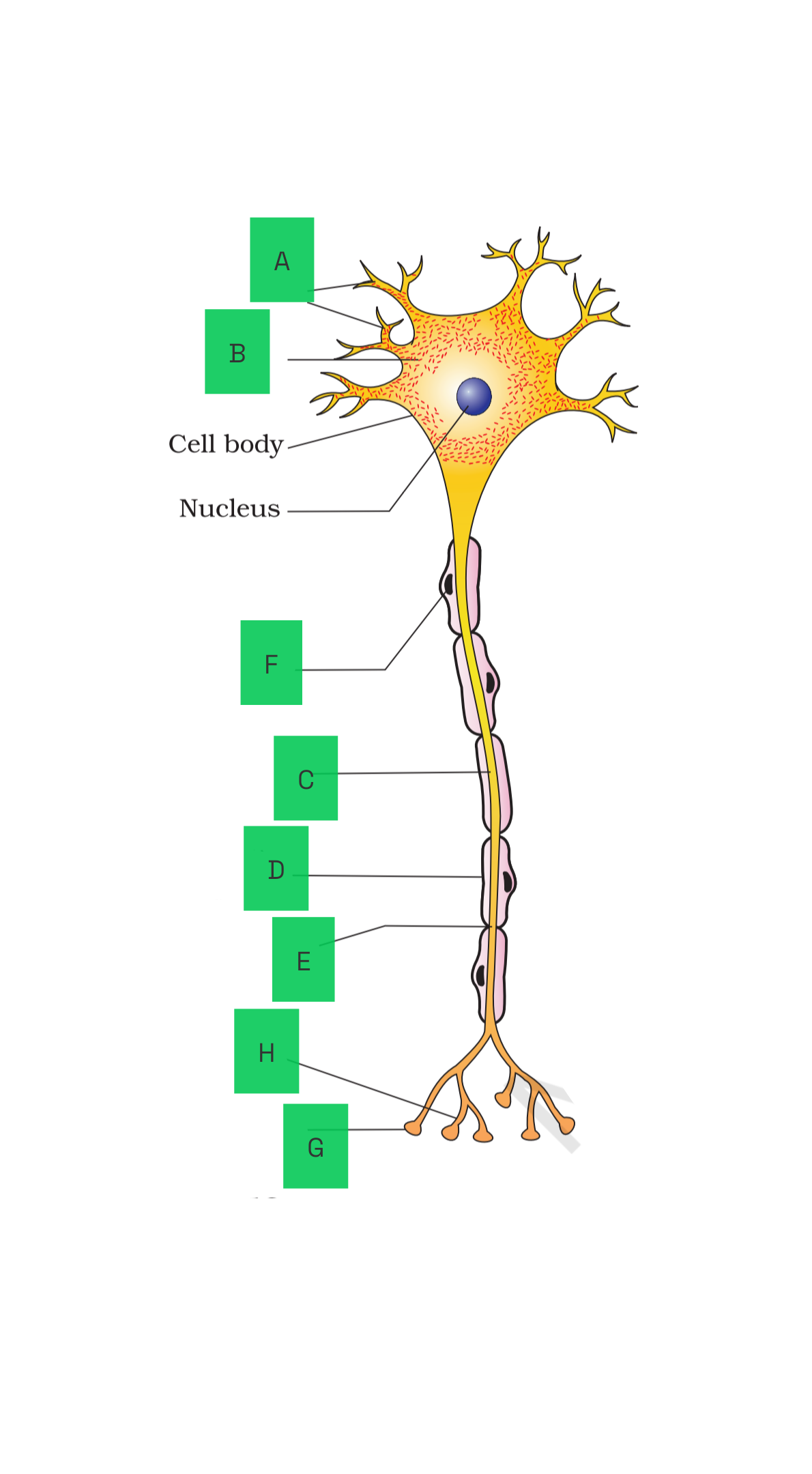
- Q3. Match the following (Column I) with the correct location or function (Column II): Column I A. Multipolar neuron B. Bipolar neuron C. Unipolar neuron D. Hypothalamus E. Medulla oblongata Column II 1. Found in the cerebral cortex 2. Found in the retina of the eye 3. Usually present during embryonic stage 4. Regulates body temperature, hunger and thirst 5. Controls respiration and cardiovascular reflexes
- Q4. Match the parts of the brain (Column I) with their respective components (Column II): Column I A. Forebrain B. Midbrain C. Hindbrain Column II 1. Cerebrum 2. Medulla oblongata 3. Corpora quadrigemina 4. Pons 5. Thalamus 6. Hypothalamus 7. Cerebellum 8. Cerebral aqueduct
- Q5. Assertion (A): Autonomic nervous system works voluntarily. Reason (R): It controls skeletal muscles.
- Q6. Assertion (A): The visceral nervous system includes ganglia and plexuses. Reason (R): It transmits impulses to and from viscera.
- Q7. Which of the following statements are correct? 1. The outermost meningeal layer covering the brain is the dura mater. 2. The limbic system is involved in regulating sexual behaviour and emotions. 3. The white matter of the brain is formed by myelinated fibres. 4. The thalamus acts as a major coordinating centre for sensory and motor signals. 5. The cerebral cortex appears white due to the presence of axonal tracts.
- Q8. Which of the following statements are correct? 1. The PNS includes afferent and efferent fibres. 2. Afferent fibres transmit impulses from CNS to tissues/organs. 3. Somatic neural system relays impulses from CNS to skeletal muscles. 4. Autonomic neural system transmits impulses to smooth and involuntary organs. 5. Sympathetic and parasympathetic systems are subdivisions of the autonomic neural system.
- Q9. Which of the following statements are correct? 1. The resting potential of a neuron is maintained by sodium–potassium pumps that transport 3 Na⁺ out and 2 K⁺ in. 2. Action potential is generated when the membrane becomes freely permeable to K⁺ ions first. 3. Electrical synapses allow direct current flow and are faster than chemical synapses. 4. Chemical synapses involve neurotransmitters released into the synaptic cleft. 5. Resting potential refers to the negative charge on the inner surface of the axonal membrane.
- Q10. Arrange the following events of generation and conduction of a nerve impulse in the correct sequence: 1. Sodium ions (Na⁺) enter the axon causing depolarisation. 2. Action potential is generated at the site of stimulus. 3. Current flows to adjacent regions, leading to depolarisation ahead. 4. Potassium ions (K⁺) diffuse out restoring resting potential. 5. Sodium–potassium pump maintains ionic gradients across resting membrane.
You’ve practised 10 of 173 Neural Control and Coordination questions in this set.
Practise all 173 + every chapter — free app →Sample NEET PYQs — Neural Control and Coordination
Which of the following statements is not correct?
- A. An action potential in an axon does not move backward because the segment behind is in a refractory phase
- B. Depolarisation of hair cells of cochlea results in the opening of the mechanically gated potassium-ion channels.
- C. Rods are very sensitive and contribute to daylight vision.
- D. In the knee-jerk reflex, stimulus is the stretching of muscle and response is its contraction.
Explanation: Answer: (c) — The statement that rods contribute to daylight (photopic) vision is not correct. Solution: Rods function in dim-light (scotopic) vision, while cones handle bright-light/colour vision, so attributing daylight vision to rods is wrong (eye photoreceptor detail is removed content, handled here in prose only). On the in-syllabus nerve-impulse side, after depolarisation K+ rapidly diffuses out and restores the resting potential, making the fibre once more responsive to further stimulation — a correct statement about the action potential and refractory recovery. NCERT Reference: Ch 18, p.233, lines 26-28 — "restores the resting potential of the membrane at the site of excitation"
Receptor sites for neurotransmitters are present on
- A. Membranes of synaptic vesicles
- B. Pre-synaptic membrane
- C. Tips of axons
- D. Post-synaptic membrane
Explanation: Answer: (d) Post-synaptic membrane. Solution: At a chemical synapse, the arriving impulse triggers release of neurotransmitters into the synaptic cleft. These released neurotransmitters bind to their specific receptors located on the post-synaptic membrane. This binding opens ion channels and generates a new (excitatory or inhibitory) potential in the post-synaptic neuron, so the receptor sites must be on the post-synaptic membrane. NCERT Reference: Ch 18, p.235, lines 03-05 — "released neurotransmitters bind to their specific receptors, present on the post-synaptic membrane"
Myelin sheath is produced by
- A. Schwann Cells and Oligodendrocytes
- B. Astrocytes and Schwann Cells
- C. Oligodendrocytes and Osteoclasts
- D. Osteoclasts and Astrocytes
Explanation: Answer: (a) Schwann Cells and Oligodendrocytes. Solution: In myelinated nerve fibres the axon is enveloped with Schwann cells, which form a myelin sheath around the axon. In the peripheral nervous system the myelin is made by Schwann cells, while in the CNS it is produced by oligodendrocytes (extension content) — hence both cell types make myelin. NCERT directly names Schwann cells as forming the myelin sheath. NCERT Reference: Ch 18, p.232, lines 18-19 — "The myelinated nerve fibres are enveloped with Schwann cells, which form a myelin sheath"
Which of the following structures or regions is incorrectly paired with its functions?
- A. Hypothalamus : production of releasing hormones and regulation of temperature, hunger and thirst.
- B. Limbic system : consists of fibre tracts that interconnect different regions of brain; controls movement.
- C. Medulla oblongata : controls respiration and cardiovascular reflexes.
- D. Corpus callosum : band of fibers connecting left and right cerebral hemispheres.
Explanation: Answer: (b) Limbic system: Forebrain, controls the movement. Solution: The limbic system does NOT control movement; together with the hypothalamus it regulates sexual behaviour, emotional reactions (excitement, pleasure, rage and fear) and motivation. So pairing the limbic system with 'controls movement' is the incorrect pair. The other listed structure-function pairings are correctly matched. NCERT Reference: Ch 18, p.236, lines 28-29 — "with the hypothalamus, it is involved in the regulation of sexual behaviour,"
Frequently Asked Questions — Neural Control and Coordination NEET
How many questions from Neural Control and Coordination come in NEET?+
How many Neural Control and Coordination questions does MedicNEET have?+
What is the NEET weightage of Neural Control and Coordination?+
Are Neural Control and Coordination questions available in Hindi?+
Are Neural Control and Coordination questions NCERT-based?+
What is the best app for Neural Control and Coordination NEET practice?+
How to score full marks in Neural Control and Coordination for NEET 2027?+
What are ReNEET 2026-style reasoning Neural Control and Coordination questions?+
Are these Neural Control and Coordination MCQs free to practise?+
Practise Neural Control and Coordination — Free
All 233+ Neural Control and Coordination questions · ReNEET 2026 reasoning + every format · Bilingual Hindi & English · NCERT-mapped explanations · No paywall
📲 Download MedicNEET App (Free)