Class 11 — Physics
A solid sphere of mass m and radius R rotates about its diameter. A solid cylinder of the same mass and radius rotates about its geometric axis with twice the sphere's angular speed. The ratio of their rotational kinetic energies (sphere : cylinder) is:
Two rotating bodies A and B (masses m and 2m, moments of inertia I_A and I_B with I_B > I_A) have equal rotational kinetic energy. If L_A and L_B are their angular momenta, then:
A uniform disc of radius 50 cm at rest is free to rotate about a perpendicular axis through its centre. Given a constant angular acceleration 2.0 rad/s², its net linear acceleration (m/s²) at a rim point at the end of 2.0 s is about:
A particle of mass 10 g moves on a circle of radius 6.4 cm with constant tangential acceleration. If its kinetic energy becomes 8×10⁻⁴ J by the end of the second revolution, the tangential acceleration is:
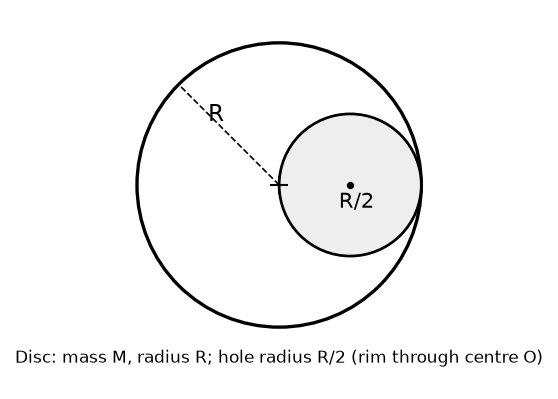
From a disc of mass M and radius R, a circular hole of radius R/2 whose rim passes through the centre is cut out. The moment of inertia of the remaining disc about an axis perpendicular to the plane and passing through the centre O is:
A light rod of length l carries two masses m1 and m2 at its ends. The moment of inertia of the system about an axis perpendicular to the rod through the centre of mass is:
Want more System Of Particles And Rotational Motion questions?
MedicNEET has 43,000+ NEET-style questions across Physics, Chemistry & Biology with detailed NCERT-based explanations — including the long, tricky questions that actually come in the exam.
Download MedicNEET App — FreeA bullet of mass 10 g moving horizontally with a velocity of 400 m/s strikes a wooden block of mass 2 kg suspended by a light inextensible string of length 5 m. As a result the centre of gravity of the block rises a vertical distance of 10 cm. The speed of the bullet after it emerges horizontally from the block is
A body of mass 1 kg begins to move under the action of a time-dependent force F=(2t î+3t² ĵ) N, where î and ĵ are unit vectors along the x and y axes. What power will be developed by the force at time t?
What is the minimum velocity with which a body of mass m must enter a vertical loop of radius R at the lowest point so that it can complete the loop?
Two identical balls A and B having velocities of 0.5 m/s and -0.3 m/s respectively collide elastically in one dimension. The velocities of B and A after the collision will respectively be
A particle of mass 10 g moves along a circle of radius 6.4 cm with a constant tangential acceleration. The magnitude of this acceleration, if the kinetic energy of the particle becomes equal to 8×10⁻⁴ J by the end of the second revolution after the beginning of the motion, is
A particle moves from a point (-2î+5ĵ) to (4ĵ+3k̂) when a force of (4î+3ĵ) N is applied. How much work is done by the force?
Want more Work, Energy And Power questions?
MedicNEET has 43,000+ NEET-style questions across Physics, Chemistry & Biology with detailed NCERT-based explanations — including the long, tricky questions that actually come in the exam.
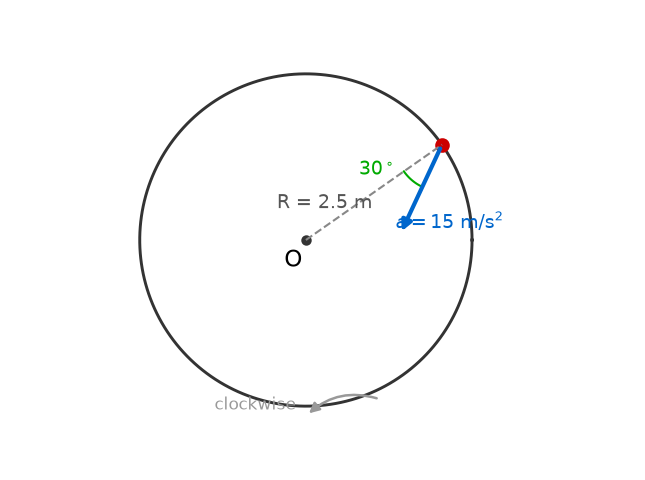
Download MedicNEET App — FreeIn the figure, $a=15\ \mathrm{m/s^2}$ represents the total acceleration of a particle moving in the clockwise direction in a circle of radius $R=2.5$ m at a given instant of time. The speed of the particle is:
If the magnitude of the sum of two vectors is equal to the magnitude of the difference of the two vectors, the angle between these vectors is:
A particle of mass 10 g moves along a circle of radius 6.4 cm with a constant tangential acceleration. The magnitude of this acceleration, if the kinetic energy of the particle becomes equal to $8\times10^{-4}$ J by the end of the second revolution after the beginning of the motion, is:
A particle moves from a point $(-2\hat i+5\hat j)$ to $(4\hat j+3\hat k)$ when a force of $(4\hat i+3\hat j)$ N is applied. How much work is done by the force?
A particle moves so that its position vector is given by $\vec r=\cos\omega t\,\hat x+\sin\omega t\,\hat y$, where $\omega$ is a constant. Which of the following is true?
Want more Motion In A Plane questions?
MedicNEET has 43,000+ NEET-style questions across Physics, Chemistry & Biology with detailed NCERT-based explanations — including the long, tricky questions that actually come in the exam.
Download MedicNEET App — FreeA car is negotiating a curved road of radius R. The road is banked at an angle θ and the coefficient of friction between the tyres and the road is μs. The maximum safe velocity on this road is:
What is the minimum velocity with which a body of mass m must enter a vertical loop of radius R so that it can complete the loop?
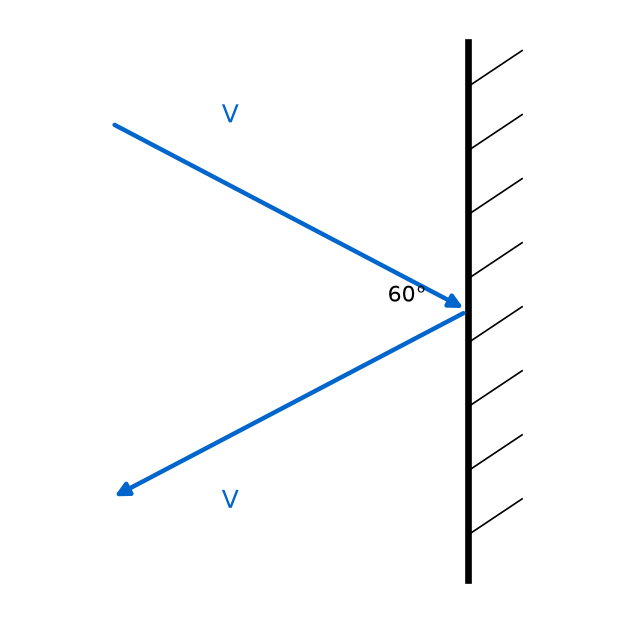
A rigid ball of mass m strikes a rigid wall at 60° and gets reflected without loss of speed, as shown in the figure. The value of the impulse imparted by the wall on the ball is:
Two identical balls A and B having velocities 0.5 m/s and −0.3 m/s respectively collide elastically in one dimension. The velocities of B and A after the collision, respectively, will be:
A bullet of mass 10 g moving horizontally at 400 m/s strikes a wooden block of mass 2 kg suspended by a light inextensible string of length 5 m. The centre of gravity of the block is found to rise a vertical distance of 10 cm. The speed of the bullet after it emerges horizontally from the block is:
Want more Laws Of Motion questions?
MedicNEET has 43,000+ NEET-style questions across Physics, Chemistry & Biology with detailed NCERT-based explanations — including the long, tricky questions that actually come in the exam.
Download MedicNEET App — FreeA black body is at a temperature of 5760 K. The energy of the radiation emitted by the body at wavelength 250 nm is U₁, at 500 nm is U₂ and at 1000 nm is U₃. Wien's constant b = 2.88 × 10⁶ nm·K. Which of the following is correct?
The coefficients of linear expansion of brass and steel rods are α₁ and α₂; their lengths are l₁ and l₂ respectively. If (l₂ − l₁) is to remain the same at all temperatures, the required condition is:
A piece of ice falls from a height h so that it melts completely. Only one-quarter of the heat produced is absorbed by the ice, and all the gravitational energy is converted into heat. The value of h is: (latent heat of ice = 3.4 × 10⁵ J kg⁻¹, g = 10 N kg⁻¹)
Two bodies have different thermal (heat) capacities. One of them is at 100 °C and the other at 0 °C. If the two are brought into contact in an isolated system (no heat loss to surroundings), the final common temperature will be:
A body cools from a temperature 3T to 2T in 10 minutes. The surroundings are at temperature T. Assuming Newton's law of cooling holds, the temperature of the body at the end of the next 10 minutes will be:
Want more Thermal Properties Of Matter questions?
MedicNEET has 43,000+ NEET-style questions across Physics, Chemistry & Biology with detailed NCERT-based explanations — including the long, tricky questions that actually come in the exam.
Download MedicNEET App — FreeThe second overtone of an open organ pipe has the same frequency as the first overtone of a closed pipe of length L. The length of the open pipe is:
An air column closed at one end and open at the other resonates with a tuning fork when the smallest length of the column is 50 cm. The next larger length of the column that resonates with the same tuning fork is:
A uniform rope of length L and mass m₁ hangs vertically from a rigid support, with a block of mass m₂ attached to its free (lower) end. A transverse pulse of wavelength λ₁ is produced at the lower end of the rope; when it reaches the top its wavelength is λ₂. The ratio λ₂/λ₁ is:
Three sound waves of equal amplitude have frequencies (n−1), n and (n+1) Hz. They superimpose to give beats. The number of beats produced per second is:
Want more Waves questions?
MedicNEET has 43,000+ NEET-style questions across Physics, Chemistry & Biology with detailed NCERT-based explanations — including the long, tricky questions that actually come in the exam.
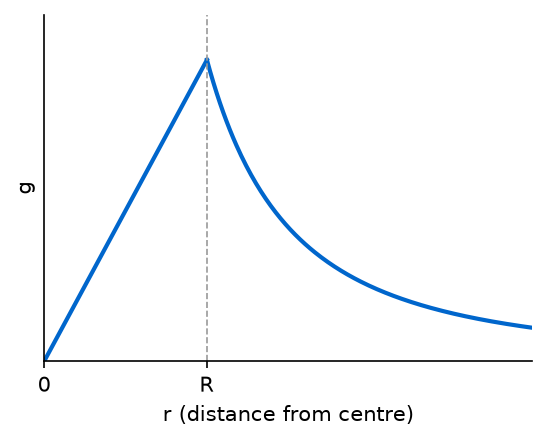
Download MedicNEET App — FreeStarting from the centre of the earth (radius R), the variation of g (acceleration due to gravity) with distance r is best shown by which graph?
A satellite of mass m orbits the earth (radius R) at height h. In terms of g₀ (surface gravity), the total energy of the satellite is:
The ratio of escape velocity at earth (vₑ) to the escape velocity at a planet (vₚ) whose radius and mean density are twice that of earth is:
At what height from the surface of earth the gravitational potential and the value of g are −5.4×10⁷ J kg⁻¹ and 6.0 m s⁻² respectively? (Radius of earth = 6400 km)
Want more Gravitation questions?
MedicNEET has 43,000+ NEET-style questions across Physics, Chemistry & Biology with detailed NCERT-based explanations — including the long, tricky questions that actually come in the exam.
Download MedicNEET App — FreeThe temperature inside a refrigerator is $t_2\,^\circ$C and the room temperature is $t_1\,^\circ$C. The amount of heat delivered to the room for each joule of electrical energy consumed ideally will be
A refrigerator works between $4\,^\circ$C and $30\,^\circ$C. It is required to remove 600 calories of heat every second in order to keep the temperature of the refrigerated space constant. The power required is: (Take $1$ cal $=4.2$ J)
A gas is compressed isothermally to half its initial volume. The same gas is compressed separately through an adiabatic process until its volume is again reduced to half. Then:
Want more Thermodynamics questions?
MedicNEET has 43,000+ NEET-style questions across Physics, Chemistry & Biology with detailed NCERT-based explanations — including the long, tricky questions that actually come in the exam.
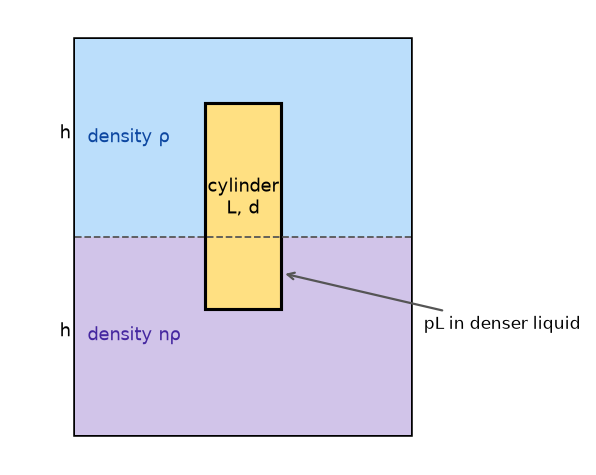
Download MedicNEET App — FreeTwo non-mixing liquids of densities ρ and nρ (n > 1) are put in a container. The height of each liquid is h. A solid cylinder of length L and density d is put in this container. The cylinder floats with its axis vertical and length pL (p < 1) in the denser liquid. The density d is equal to:
A rectangular film of liquid is extended from (4 cm × 2 cm) to (5 cm × 4 cm). If the work done is 3 × 10⁻⁴ J, the value of the surface tension of the liquid is:
Three liquids of densities ρ₁, ρ₂ and ρ₃ (with ρ₁ > ρ₂ > ρ₃), having the same value of surface tension T, rise to the same height in three identical capillaries. The angles of contact θ₁, θ₂ and θ₃ obey:
Want more Mechanical Properties Of Fluids questions?
MedicNEET has 43,000+ NEET-style questions across Physics, Chemistry & Biology with detailed NCERT-based explanations — including the long, tricky questions that actually come in the exam.
Download MedicNEET App — FreeIf the velocity of a particle is $v = At + Bt^2$, where A and B are constants, then the distance travelled by it between 1 s and 2 s is:
Two cars P and Q start from a point at the same time in a straight line and their positions are represented by $x_P = at + bt^2$ and $x_Q = ft - t^2$. At what time do the cars have the same velocity?
Want more Motion In A Straight Line questions?
MedicNEET has 43,000+ NEET-style questions across Physics, Chemistry & Biology with detailed NCERT-based explanations — including the long, tricky questions that actually come in the exam.
Download MedicNEET App — FreeThe molecules of a given mass of a gas have r.m.s. velocity of 200 ms⁻¹ at 27 °C and 1.0 × 10⁵ Nm⁻² pressure. When the temperature and pressure of the gas are respectively 127 °C and 0.05 × 10⁵ Nm⁻², the r.m.s. velocity of its molecules in ms⁻¹ is:
A given sample of an ideal gas occupies a volume V at a pressure P and absolute temperature T. The mass of each molecule of the gas is m. Which of the following gives the density of the gas?
Want more Kinetic Theory questions?
MedicNEET has 43,000+ NEET-style questions across Physics, Chemistry & Biology with detailed NCERT-based explanations — including the long, tricky questions that actually come in the exam.
Download MedicNEET App — FreePlanck's constant (h), speed of light in vacuum (c) and Newton's gravitational constant (G) are three fundamental constants. Which of the following combinations of these has the dimension of length?
Want more Units And Measurements questions?
MedicNEET has 43,000+ NEET-style questions across Physics, Chemistry & Biology with detailed NCERT-based explanations — including the long, tricky questions that actually come in the exam.
Download MedicNEET App — FreeA body of mass m is attached to the lower end of a spring whose upper end is fixed; the spring has negligible mass. When the mass m is slightly pulled down and released, it oscillates with a time period of 3 s. When the mass is increased by 1 kg, the time period becomes 5 s. The value of m (in kg) is
Want more Oscillations questions?
MedicNEET has 43,000+ NEET-style questions across Physics, Chemistry & Biology with detailed NCERT-based explanations — including the long, tricky questions that actually come in the exam.
Download MedicNEET App — FreeClass 12 — Physics
Match the corresponding entries of Column 1 with Column 2 (where m is the magnification produced by the mirror). Column 1: (A) m = −2 (B) m = −1/2 (C) m = +2 (D) m = +1/2 Column 2: (a) Convex mirror (b) Concave mirror (c) Real image (d) Virtual image
A person can see clearly objects only when they lie between 50 cm and 400 cm from his eyes. In order to increase the maximum distance of distinct vision to infinity, the type and power of the correcting lens the person has to use will be
The angle of incidence for a ray of light at a refracting surface of a prism is 45°. The angle of the prism is 60°. If the ray suffers minimum deviation through the prism, the angle of minimum deviation and refractive index of the material of the prism respectively are
Two identical glass (µ_g = 3/2) equiconvex lenses of focal length f each are kept in contact. The space between the two lenses is filled with water (µ_w = 4/3). The focal length of the combination is
An air bubble in a glass slab with refractive index 1.5 (near normal incidence) is 5 cm deep when viewed from one surface and 3 cm deep when viewed from the opposite face. The thickness (in cm) of the slab is
An astronomical telescope has objective and eyepiece of focal lengths 40 cm and 4 cm respectively. To view an object 200 cm away from the objective, the lenses must be separated by a distance
Want more Ray Optics And Optical Instruments questions?
MedicNEET has 43,000+ NEET-style questions across Physics, Chemistry & Biology with detailed NCERT-based explanations — including the long, tricky questions that actually come in the exam.
Download MedicNEET App — FreeThe potential differences across the resistance, capacitance and inductance are 80 V, 40 V and 100 V respectively in an L-C-R circuit. The power factor of this circuit is
A small signal voltage V(t) = V₀ sin ωt is applied across an ideal capacitor C:
An inductor 20 mH, a capacitor 50 μF and a resistor 40 Ω are connected in series across a source of emf V = 10 sin 340 t. The power loss in A.C. circuit is :
A 100 Ω resistance and a capacitor of 100 Ω reactance are connected in series across a 220 V source. When the capacitor is 50% charged, the peak value of the displacement current is
Which of the following combinations should be selected for better tuning of an L-C-R circuit used for communication?
An inductor 20 mH, a capacitor 100 μF and a resistor 50 Ω are connected in series across a source of emf, V = 10 sin 314 t. The power loss in the circuit is
Want more Alternating Current questions?
MedicNEET has 43,000+ NEET-style questions across Physics, Chemistry & Biology with detailed NCERT-based explanations — including the long, tricky questions that actually come in the exam.
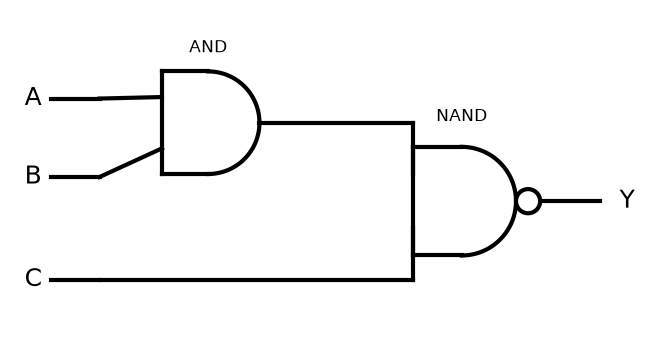
Download MedicNEET App — FreeWhat is the output Y in the following circuit, when all the three inputs A, B, C are first 0 and then 1?
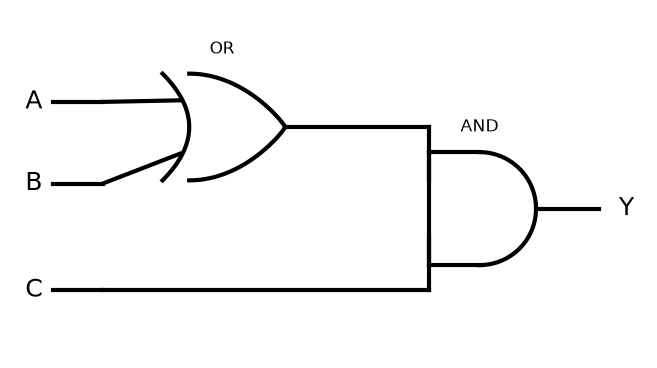
To get output 1 for the following circuit, the correct choice for the input is:
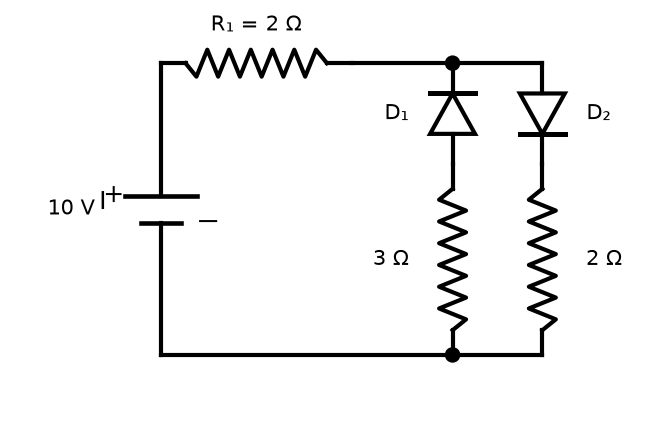
The given circuit has two ideal diodes connected as shown in the figure below. The current flowing through the resistance R₁ will be:
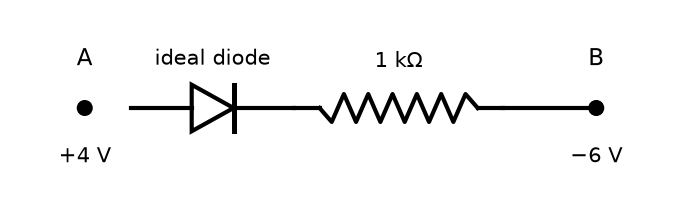
Consider the junction diode as ideal. The value of current flowing through AB is (refer to the given circuit):
Want more Semiconductor Electronics : Materials, Devices And Simple Circuits questions?
MedicNEET has 43,000+ NEET-style questions across Physics, Chemistry & Biology with detailed NCERT-based explanations — including the long, tricky questions that actually come in the exam.
Download MedicNEET App — FreeA linear aperture whose width is 0.02 cm is placed immediately in front of a lens of focal length 60 cm. The aperture is illuminated normally by a parallel beam of wavelength 5 × 10⁻⁵ cm. The distance of the first dark band of the diffraction pattern from the centre of the screen is
The intensity at the maximum in a Young's double slit experiment is I₀. Distance between two slits is d = 5λ, where λ is the wavelength of light used in the experiment. What will be the intensity in front of one of the slits on the screen placed at a distance D = 10d?
The interference pattern is obtained with two coherent light sources of intensity ratio n. In the interference pattern, the ratio (I_max − I_min)/(I_max + I_min) will be
In a diffraction pattern due to a single slit of width 'a', the first minimum is observed at an angle 30° when light of wavelength 5000 Å is incident on the slit. The first secondary maximum is observed at an angle of
Want more Wave Optics questions?
MedicNEET has 43,000+ NEET-style questions across Physics, Chemistry & Biology with detailed NCERT-based explanations — including the long, tricky questions that actually come in the exam.
Download MedicNEET App — FreeAn electron is moving in a circular path under the influence of a transverse magnetic field of 3.57 × 10⁻² T. If the value of e/m is 1.76 × 10¹¹ C/kg, the frequency of revolution of the electron is:
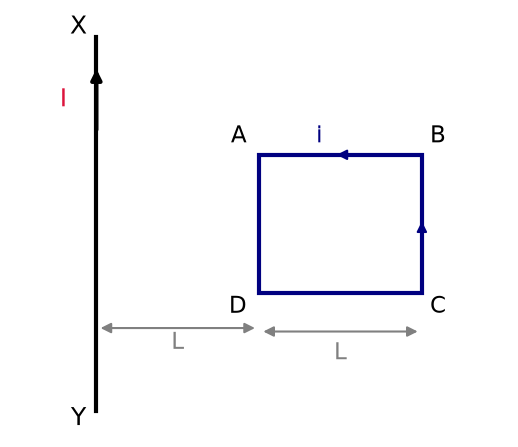
A square loop ABCD carrying a current i is placed near and coplanar with a long straight conductor XY carrying a current I. The net force on the loop will be:
A long wire carrying a steady current is bent into a circular loop of one turn. The magnetic field at the centre of the loop is B. It is then bent into a circular coil of n turns. The magnetic field at the centre of this coil of n turns will be:
A long straight wire of radius a carries a steady current I. The current is uniformly distributed over its cross-section. The ratio of the magnetic fields B and B′ at radial distances a/2 and 2a respectively, from the axis of the wire, is:
Want more Moving Charges And Magnetism questions?
MedicNEET has 43,000+ NEET-style questions across Physics, Chemistry & Biology with detailed NCERT-based explanations — including the long, tricky questions that actually come in the exam.
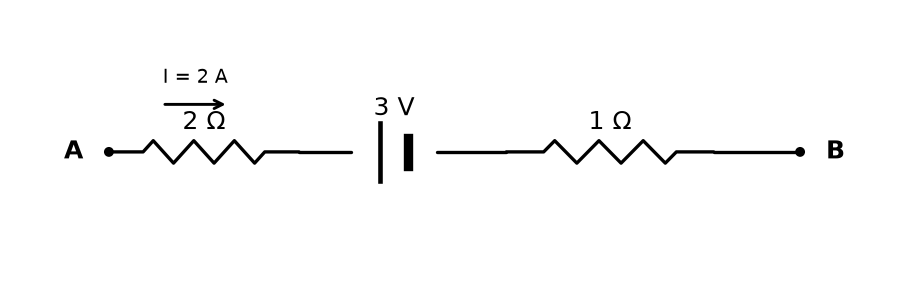
Download MedicNEET App — FreeThe potential difference (V_A - V_B) between points A and B in the figure (current 2 A from A to B through 2 $\Omega$, a 3 V cell, then 1 $\Omega$) is:
The charge through a resistance R varies with time as Q = at - bt$^{2}$ (a, b positive constants). The total heat produced in R is:
A filament bulb (500 W, 100 V) is to be used in a 230 V supply. A resistance R is connected in series so it works perfectly at 500 W. The value of R is:
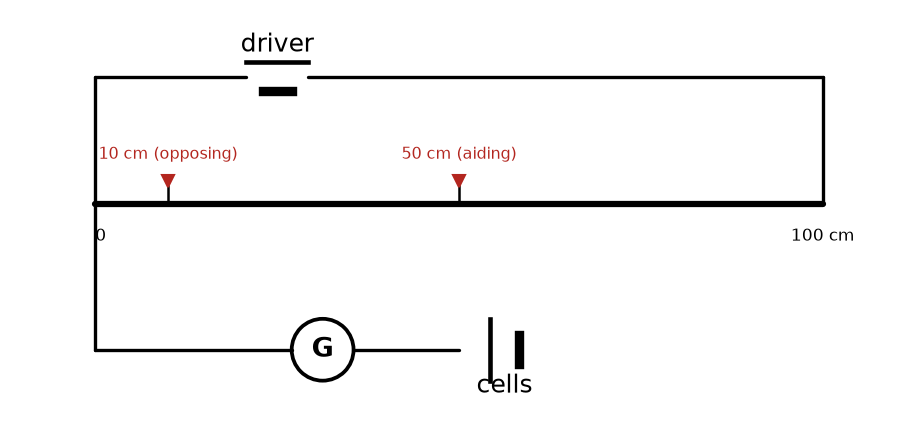
A potentiometer wire is 100 cm long with a constant PD across it. Two cells in series give balance at 50 cm (aiding) and 10 cm (opposing). The ratio of emfs is:
Want more Current Electricity questions?
MedicNEET has 43,000+ NEET-style questions across Physics, Chemistry & Biology with detailed NCERT-based explanations — including the long, tricky questions that actually come in the exam.
Download MedicNEET App — FreeElectrons of mass m with de Broglie wavelength λ fall on the target in an X-ray tube. The cutoff wavelength (λ₀) of the emitted X-ray is:
An electron of mass m and a photon have the same energy E. The ratio of the de Broglie wavelengths associated with them is (c being the velocity of light):
When a metallic surface is illuminated with radiation of wavelength λ, the stopping potential is V. If the same surface is illuminated with radiation of wavelength 2λ, the stopping potential is V/4. The threshold wavelength for the metallic surface is:
Photons with energy 5 eV are incident on a cathode C in a photoelectric cell. The maximum energy of emitted photoelectrons is 2 eV. When photons of energy 6 eV are incident on C, no photoelectrons will reach the anode A if the stopping potential of A relative to C is:
Want more Dual Nature Of Radiation And Matter questions?
MedicNEET has 43,000+ NEET-style questions across Physics, Chemistry & Biology with detailed NCERT-based explanations — including the long, tricky questions that actually come in the exam.
Download MedicNEET App — FreeWhen an α-particle of mass 'm' moving with velocity 'v' bombards a heavy nucleus of charge 'Ze', its distance of closest approach from the nucleus depends on m as:
Given the value of Rydberg constant is 10⁷ m⁻¹, the wave number of the last line of the Balmer series in hydrogen spectrum will be:
If an electron in a hydrogen atom jumps from the 3rd orbit to the 2nd orbit, it emits a photon of wavelength λ. When it jumps from the 4th orbit to the 3rd orbit, the corresponding wavelength of the photon will be:
Want more Atoms questions?
MedicNEET has 43,000+ NEET-style questions across Physics, Chemistry & Biology with detailed NCERT-based explanations — including the long, tricky questions that actually come in the exam.
Download MedicNEET App — FreeAn electric dipole is placed at an angle of 30° with an electric field of intensity 2 × 10⁵ N/C. It experiences a torque equal to 4 N·m. The charge on the dipole, if the dipole length is 2 cm, is
Two identical charged spheres suspended from a common point by two massless strings of length l are initially at a distance d (d << l) apart because of their mutual repulsion. The charges begin to leak from both the spheres at a constant rate. As a result, the spheres approach each other with a velocity v. Then v varies as a function of the distance x between the spheres as
An electric dipole is placed at an angle of 30° with an electric field of intensity 2 × 10⁵ N C⁻¹. It experiences a torque equal to 4 N m. Calculate the magnitude of charge on the dipole, if the dipole length is 2 cm.
Want more Electric Charges And Fields questions?
MedicNEET has 43,000+ NEET-style questions across Physics, Chemistry & Biology with detailed NCERT-based explanations — including the long, tricky questions that actually come in the exam.
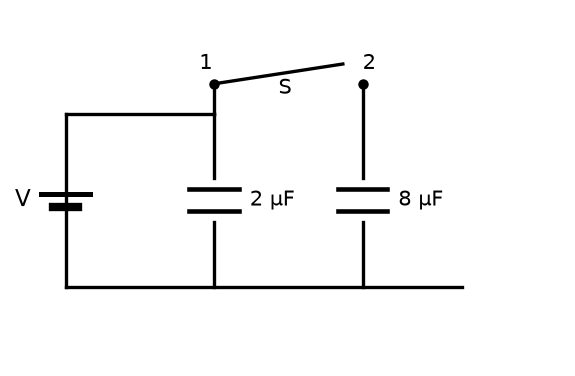
Download MedicNEET App — FreeA capacitor of 2 μF is charged as shown in the diagram. When the switch S is turned to position 2, the percentage of its stored energy dissipated is:
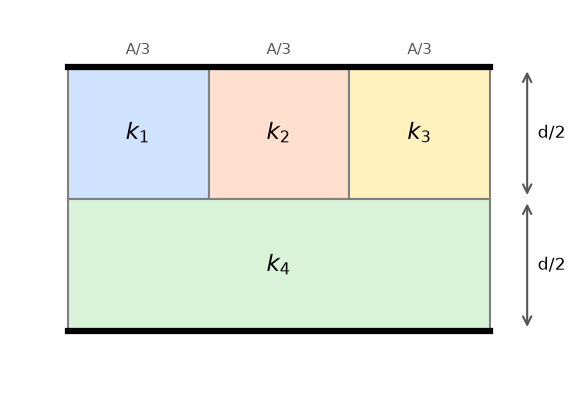
A parallel-plate capacitor of area A, plate separation d and capacitance C is filled with four dielectric materials having dielectric constants k1, k2, k3 and k4 as shown in the figure below. If a single dielectric material is to be used to have the same capacitance C in this capacitor, then its dielectric constant k is given by
Want more Electrostatic Potential And Capacitance questions?
MedicNEET has 43,000+ NEET-style questions across Physics, Chemistry & Biology with detailed NCERT-based explanations — including the long, tricky questions that actually come in the exam.
Download MedicNEET App — FreeThe magnetic susceptibility is negative for:
A bar magnet is hung by a thin cotton thread in a uniform horizontal magnetic field and is in equilibrium. The energy required to rotate it by 60° is W. The torque required to keep the magnet in this new (60°) position is:
Want more Magnetism And Matter questions?
MedicNEET has 43,000+ NEET-style questions across Physics, Chemistry & Biology with detailed NCERT-based explanations — including the long, tricky questions that actually come in the exam.
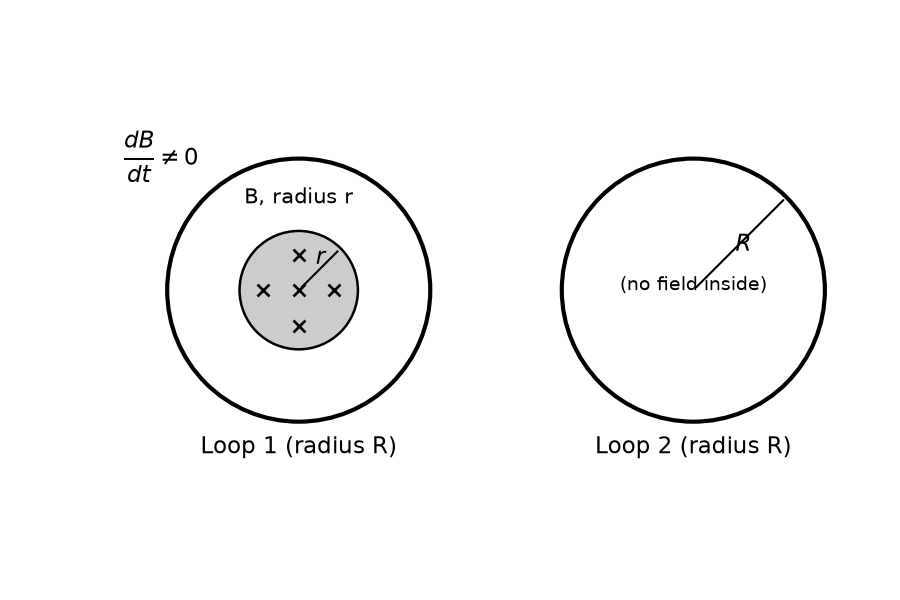
Download MedicNEET App — FreeA uniform magnetic field is restricted within a region of radius r. The magnetic field changes with time at a rate dB/dt. Loop 1 of radius R > r encloses the region r and loop 2 of radius R is outside the region of magnetic field as shown in the figure below. Then the e.m.f. generated is
A long solenoid has 1000 turns. When a current of 4 A flows through it, the magnetic flux linked with each turn of the solenoid is 4 × 10⁻³ Wb. The self-inductance of the solenoid is:
Want more Electromagnetic Induction questions?
MedicNEET has 43,000+ NEET-style questions across Physics, Chemistry & Biology with detailed NCERT-based explanations — including the long, tricky questions that actually come in the exam.
Download MedicNEET App — FreeOut of the following options which one can be used to produce a propagating electromagnetic wave?
Want more Electromagnetic Waves questions?
MedicNEET has 43,000+ NEET-style questions across Physics, Chemistry & Biology with detailed NCERT-based explanations — including the long, tricky questions that actually come in the exam.
Download MedicNEET App — Free